Japanese Princes In Marshall Islands
pp. 27-28 · Read in the full issue
How Mandated Territory Welcomed Members of Royal House
From a Special Correspondent.
JALUIT, Marshall Is., July 17.
IT was a red-letter day here in June, when the Japanese cruisers paid an official visit, on their way home from the South Seas. They had on board three princes, namely, Asaka no miya, Kuni no miya, and Fushimi no miya, one of them a commander, and the other two cadets.
Several weeks before their arrival preparations were begun to give the little township of Jebwar—the seat of government on the shores of this lagoon— an extra cleaning up and setting in order.
In addition to the usual regulations in force, owners of dogs were instructed to
securely fasten their canine friends so that none could roam around, and all ownerless dogs were to be destroyed. All rubbish was to be deposited in specified places and buried or burned, and coconut palms leaning over roads in the township were to be felled, or partly deprived of foliage so as to reduce danger to a mini mum. Notification was to be given to the authorities of any foolish, mad, and deaf and dumb persons in the township; and, two days before the arrival of the cruisers, no more canoes with natives were to approach the town.
From day to day police officials went to and fro supervising matters in an
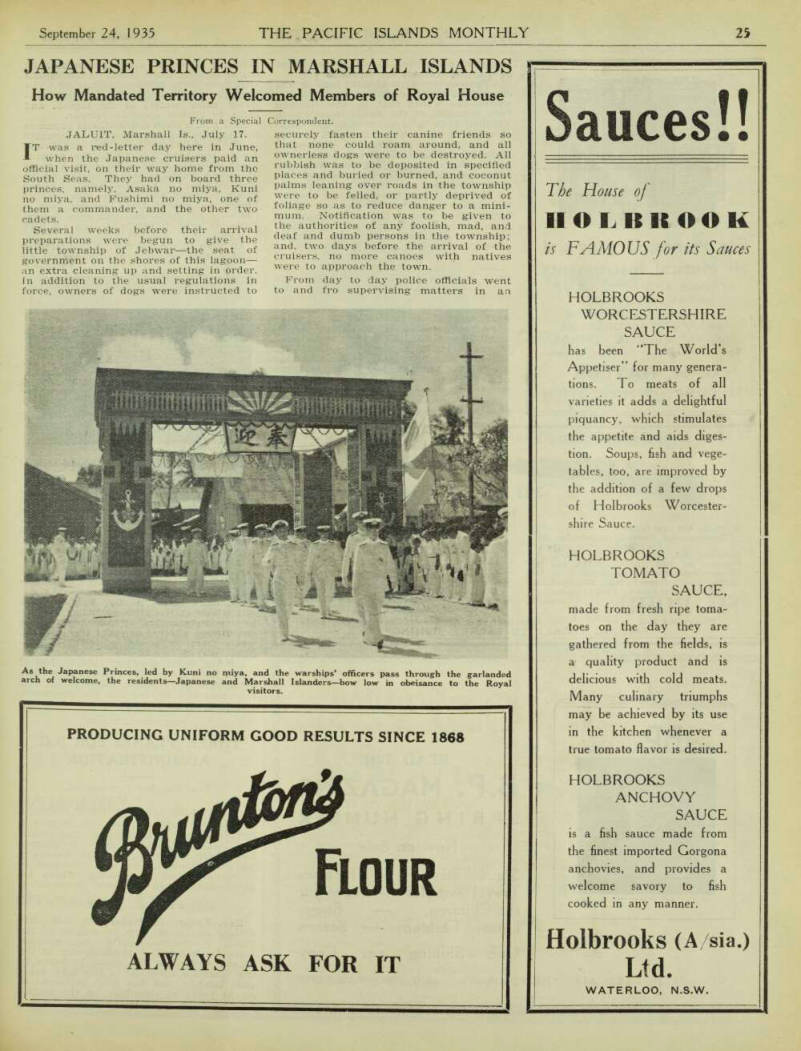
As the Japanese Princes, led by Kuni no miya, and the warships’ officers pass through the garlanded arch of welcome, the residents—Japanese and Marshall Islanders—bow low in obeisance to the Royal visitors.
energetic endeavour to attain perfection in the preparations for Royalty.
A four-square arch of light lumber was erected on the land end of the principal wharf —the wharf that in the German time belonged to the Jaluit Gesellschaft.
Another arch, a simpler one, was con structed at the head of the path leading to the village playground. There a house of native material was constructed for the Royal party, from which could be witnessed native games arranged for their diversion. A couple of days prior to the great day, the outer surfaces of the arches mentioned above were coated with bright green leaves arranged in scale fashion with appropriate symbolism, greetings, etc., while the inner surfaces were covered with green plaited coconut leaves.
Early in the morning of the ships’ ar rival, a great crowd of Japanese and Islanders assembled along the outer shores of Jebwar, right down to the end of the township facing the passage. All were arrayed in their very best; many were perfumed, also, and most carried small Rising Sun flags. In the distance, in the direction of the rising sun, the expected warships could be seen as they headed for the passage, visible emblems of Japan’s power and might at this, the outermost bounds of the Empire.
As the cruisers entered the passage, the crowds along the shore cried out
“Banzai! Banzai!” again and again. At the same time, brass bands on the vessels struck up some stirring martial air. The big grey cruisers slid into the compara tively calm waters of the lagoon, and came to anchor opposite Jebwar.
At 1 p.m. a siren sounded, and Japanese and natives began to line up at specified places along one side of the wharf, and beside the road leading to the govern ment offices. After some time a party of cadets landed, marched up the wharf, and dispersed. A little later, another group followed suit. Then some coolies swept the sanded track, leaving not a footprint of those who had gone before.
Someone said, “They will soon be here now.”
All were on the qui vive. A few minutes passed, then a speed launch dashed up
to the wharf with the Royal visitors, and other ships’ officers. The party marched up the wharf, with the Princes in the lead. As they passed along, all nearby onlookers bowed low, and did not raise their heads until the party had passed on.
Meantime, not a sound was heard, save a couple of curt words of command.
Subsequently, at the sport grounds, the Royal party witnessed native dancing old style, and a hybrid new.
At night, bright electric lights flashed out words of welcome. A paper lantern procession marched up and down along the lagoon shores, opposite the cruisers, while from on board powerful search lights played to and fro.
On the third morning, to the tune of “Auld Lang Syne,” the cruisers took their departure, amid much flag-waving and cheering, and headed for the Carolines, and then on to Nippon.
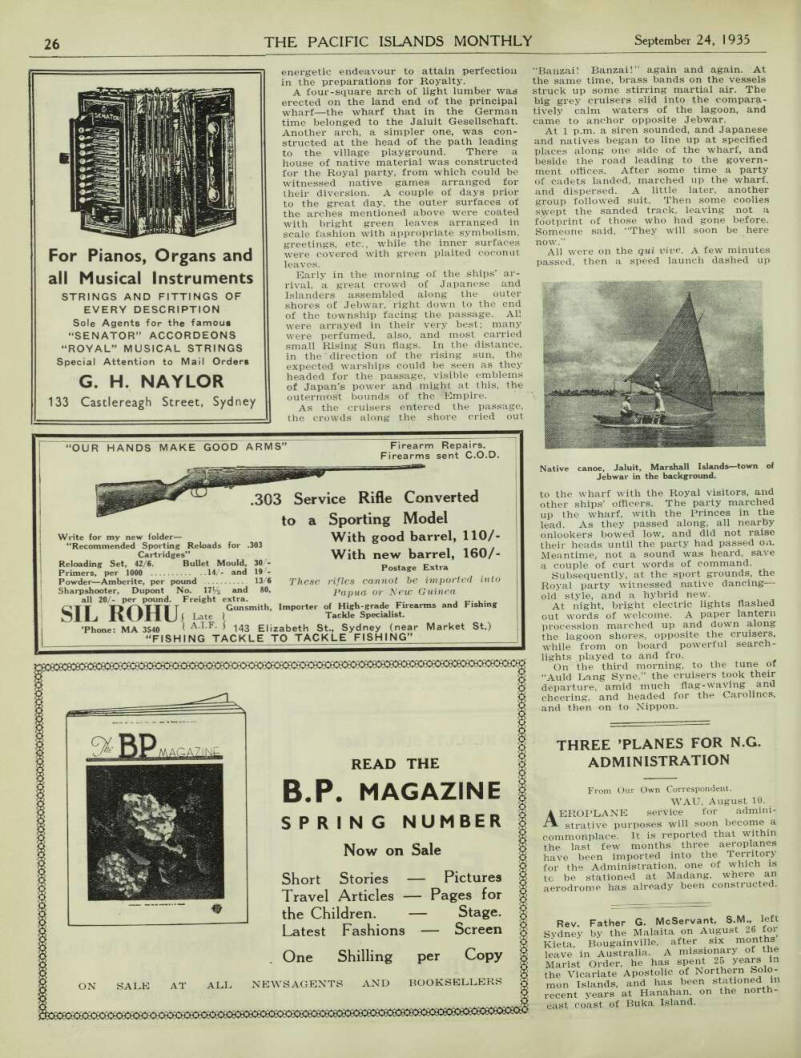
Native canoe, Jaluit, Marshall Islands-town of Jebwar in the background.