Vale Burleigh
pp. 60-61 · Read in the full issue
Gorman
Death of Well-known Pioneer of Salamaua, N.G.
AS the sun glittered on the silver coffin rails and the fragrant scent of white flowers and red pervaded the still heat of a February afternoon, Burleigh Gorman, footballer, miner, soldier, New Guinea prospector, storekeeper, and prince of good-fellows was laid to his last rest. For three weeks in a private hospital at Rand wick, N.S.W., he had waged a losing battle with Death and, finally, on February 27, at the age of 66, he succumbed to a serious illness, complicated by a recurrent attack of malaria.
BURLEIGH GORMAN, typical of those Australian pioneers who blazed the path on the New Guinea goldfields, and helped to bring to an eager world the vast dormant wealth of the Morobe gold fields, had an incredibly varied career.
Possibly not half a dozen men in the whole of the Mandated Territory knew his correct name—Alexander William — but as “Burleigh” Gorman he was known and beloved by all whom the rays of his warm personality descended on.
Born at Bloomfield station, near Yass, Southern New South Wales, on October 22, 1868, he went to Sydney at an early age, and there became well-known in sporting circles —especially Rugby Union football. After engaging in various commercial businesses in N.S.W., he
joined the rush to the Western Austra lian goldfields in the ’nineties, and for some years was mining at Kalgoorlie and Coolgardie fields.
After the outbreak of the Great War, he enlisted in the Miners’ Corps at Blackboy Hill Camp, W.A., being drafted to New Guinea. After service at Rabaul, he was discharged from the army as medically unfit, and returned to Sydney for home service at Liverpool Camp, N.S.W. On being demobilised he pur chased a store at Leeton in the N.S.W.
Irrigation Area, and remained in that charming district regaining his health for a year or so. But Burleigh Gorman had breathed the disturbing air of dark New Guinea, and his restless spirit bade him return to the land that called.
It was sometime in 1924 when he made his way to Rabaul and thence across to the mainland, plunging into the jungle to join the other pioneers seeking the elu sive yellow gleam. Finally, he drifted to Koranga Creek, where gold was being won by such early goldfields’ identities as the mysterious Sharkeye Park, Nettle ton the rover, the lean Queenslander Joe Sloan, and C. J. Levien. the tireless vis ionary to whose grit and energy New Guinea owes so much.
For weeks and months Burleigh Gor man struggled on, prospecting; winning sjmalli quantities of gold, only to see it swallowed up by the heavy expense entailed in getting supplies. Bad luck dogged his efforts, and, though most of the other pioneers reaped huge fortunes in those early days, Gorman could not “strike it rich." Time went on, and on one occasion on a trek to Salamaua to obtain supplies he met Captain Will Money, who had erected a palm-thatched
store-shed on the little strip of tropical beach at Salamaua. They chummed up, and Money, eager to get on to the field to join his pal, Dick Glasson, who was on good gold, asked Gorman to take over his little depot.
Within several months Gorman had bought the store, rebuilt it into a two storey bungalow, and erected a jetty on the beach. That was in 1925. Soon after wards arrived the advance-guard of the rush, clamouring to get to the field. By the old Marsina they came; veteran pros pectors—wrinkled and toothless, with a wise eye and taciturn manner, and young tyros fresh from the cities —the cuff and collar team, with loads of hope, vague ideas, not much money, and still more hope.
It was Burleigh Gorman who checked their stores and equipment, sorted their tools and belongings, collected their junk and battered suitcases that littered the narrow palm-fringed isthmus after the B.P. boat steamed away. It was Gor man who helped and encouraged them, provided them with a string of sweating native boys to carry the precious pro visions up the mountains and through the jungle track on a 14-days’ tortuous journey to Wau, the Mecca of those feverish, struggling, gold-hungered pros pectors.
Gorman became the miners’ general and shipping agent; looking after their stores, packing their carriers with fresh provisions, transacting their business, and taking care of their hard-won gold.
On one occasion there was £50,000 worth of the cherished metal in bags, battered tins and crazy parcels lying in his rickety store, awaiting shipment South.
The amiability and generosity of Bur leigh Gorman became by-words among the early men. To one well-known
prospector whose luck was temporarily out and who contemplated returning to Australia, he said, “I’ve not much of my own money here, but you can take any thing in the store.” The miner accep ted, and filled up his kit. How he journeyed back to the field and struck particularly rich dirt is now goldfields’ history.
Alone at the beach store, Gorman had some trying experiences with trouble-
some natives.
Once, when ill from mal aria, he was attacked by a “flash” Sepik native car rier. Wrest ing the stick from his ad versary, he sent his fist crashing to the native’s jaw, dropping him like a log. With his hand smash ed and his senses reel ing, he barely managed to order the gaping boys back to work and walk to his bungalow, where he collapsed.
Ordered South for treatment, he arrived in Sydney early in 1927, a very sick
man. The long months, when he had worked like a fury, had taken toll of his health; but he made a fortune. Mr. Gor man floated the Salamaua Trading Com pany, and, still retaining a share in the business, retired. The present lessee, Mr.
Allan Innes, was appointed manager.
When he had recovered sufficiently from his illness, Mr. Gorman linked up with the “Waratahs” —the Australian Rugby Union football team —and with them toured Great Britain and the Continent in 1927-28. On his return he made sev eral trips to New Guinea, but since 1930 he had resided in Sydney, and had lived at Coogee for the past three years.
Salamaua, once called the “Port of Hopes,” has grown enormously since Burleigh Gorman rebuilt his quaint bungalow-hotel in 1925. Messrs. Burns, Philp and Co., and Messrs. Carpenters Tiave big establishments, and there are numerous other buildings—commercial, banking, residential, and administrative.
Close at hand is a busy aerodrome, with great and small aeroplanes cutting criss cross tracks over a field that a few years ago was virgin jungle. Refrigera tion, wireless, electric light, and arm chairs housed in an up-to-date hotel have ousted Burleigh Gorman’s old ramshackle store-building of 1925, with its creaking stairs and packing-case seats. But the recollection of the stir ring times of those early days, and the genial Burleigh Gorman, is evergreen in the memories of the old hands.
Four burly Waratah footballers were pall-bearers to the grave. As the coffin was lowered and brown earth sprinkled on the tomb. Rev. Manning, of Parra matta, paid fitting tribute to Mr. Gor man’s personality, his prowess in sport, bis generosity, and the respect in which
his friends held him. Truly, he was a man among men.
Among those who attended the funeral were Mr. Earl Gorman (nephew), Mr. and Mrs. Frank Pryke, and Mr. R. L.
Dick, of New Guinea (now living at Coo gee, N.S.W.), Messrs. W. Galloway, J.
Clarkin, W. Hill and J. Noseda, as well as many of his comrade Waratah foot ballers.
Selwyn Hughes.
Mr. E. G. Theodore, who is actively con nected with the development of the Fiji goldmining industry, returned to Sydney by the Mariposa on February 25, after a visit to the Colony in connection with his interests at Tavua.
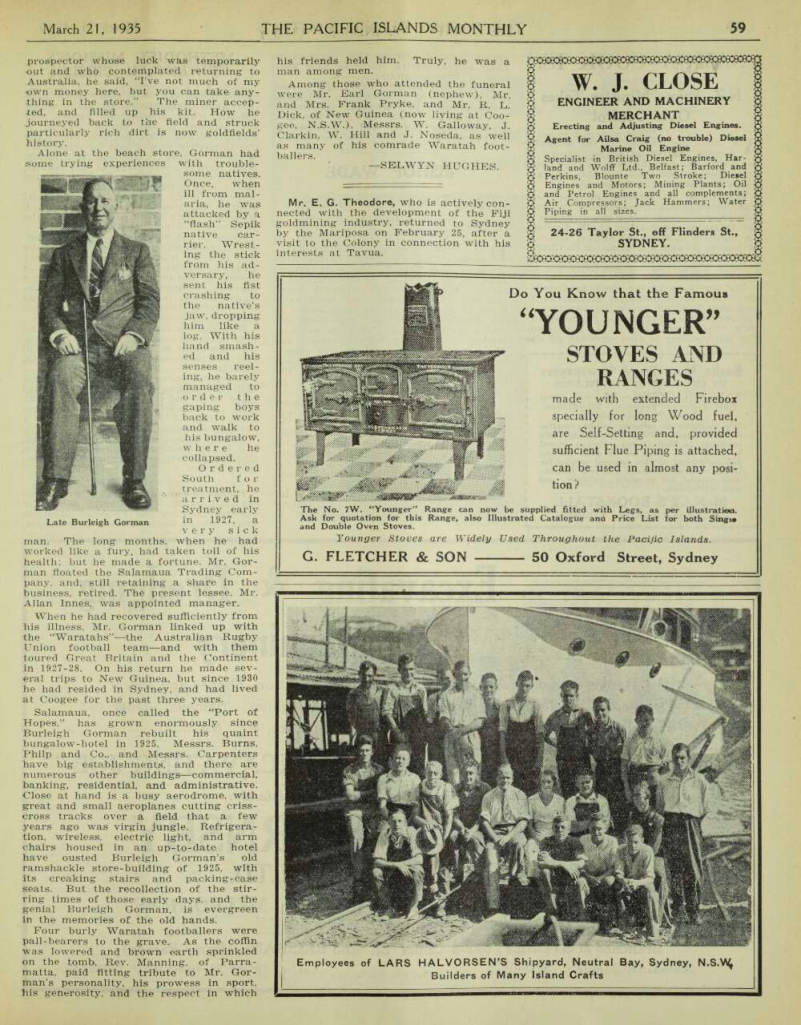
Late Burleigh Gorman