Solomons
p. 47 · Read in the full issue
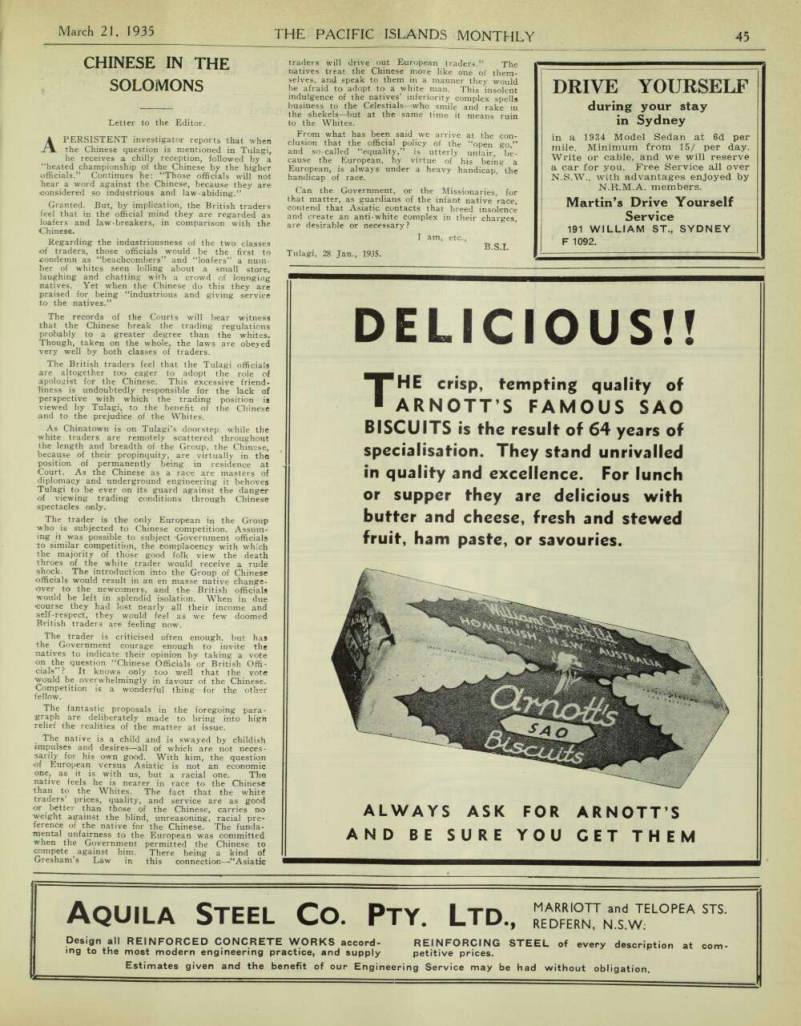
Chinese In The
Letter to the Editor.
A PERSISTENT investigator reports that when the Chinese question is mentioned in Tulagi, he receives a chilly reception, followed by a “heated championship of the Chinese by the higher officials.” Continues he: “Those officials will not hear a word against the Chinese, because they are considered so industrious and law-abiding.”
Granted. But, by implication, the British traders feel that in the official mind they are regarded as loafers and law-breakers, in comparison with the Chinese.
Regarding the industriousness of the two classes of traders, those officials would be the first to condemn as “beachcombers” and “loafers” a num ber of whites seen lolling about a small store, laughing and chatting with a crowd of lounging natives. Yet when the Chinese do this they are praised for being “industrious and giving service to the natives.”
The records of the Courts will bear witness that the Chinese break the trading regulations probably to a greater degree than the whites.
Though, taken on the whole, the laws are obeyed very well by both classes of traders.
The British traders feel that the Tulagi officials are altogether too eager to adopt the role of apologist for the Chinese. This excessive friend liness is undoubtedly responsible for the lack of perspective with which the trading position is viewed by Tulagi, to the benefit of the Chinese and to the prejudice of the Whites.
As Chinatown is on Tulagi’s doorstep, while the white traders are remotely scattered throughout the length and breadth of the Group, the Chinese, Because of their propinquity, are virtually in the position of permanently being in residence at Court. As the Chinese as a race are masters of diplomacy and underground engineering it behoves Tulagi to be ever on its guard against the danger of viewing trading conditions through Chinese spectacles only.
The trader is the only European in the Group who is subjected to Chinese competition. Assum ing it was possible to subject Government officials to similar competition, the complacency with which the majority of those good folk view the death throes of the white trader would receive a rude shock. The introduction into the Group of Chinese officials would result in an en masse native change over to the newcomers, and the British officials would be left in splendid isolation. When in due course they had lost nearly all their income and self-respect, they would feel as we few doomed British traders are feeling now.
The trader is criticised often enough, but has the Government courage enough to invite the natives to indicate their opinion by taking a vote on the question “Chinese Officials or British Offi cials”? It knows only too well that the vote would be overwhelmingly in favour of the Chinese.
Competition is a wonderful thing—for the other fellow.
The fantastic proposals in the foregoing para graph are deliberately made to bring into high relief the realities of the matter at issue.
The native is a child and is swayed by childish impulses and desires—all of which are not neces sarily for his own good. With him, the question of European versus Asiatic is not an economic one, as it is with us, but a racial one. The native feels he is nearer in race to the Chinese than to the Whites. The fact that the white traders’ prices, quality, and service are as good or better than those of the Chinese, carries no weight against the blind, unreasoning, racial pre ference of the native for the Chinese. The funda mental unfairness to the European was committed when the Government permitted the Chinese to compete against him. There being a kind of Gresham’s Law in this connection—“Asiatic
traders will drive out European traders.” The natives treat the Chinese more like one of them selves, and speak to them in a manner they would be afraid to adopt to a white man. This insolent indulgence of the natives’ inferiority complex spells business to the Celestials—who smile and rake in the shekels —but at the same time it means ruin to the Whites.
From what has been said we arrive at the con clusion that the official policy of the ‘‘open go,” and so-called “equality,” is utterly unfair, be cause the European, by virtue of his being a European, is always under a heavy handicap, the handicap of race.
Can the Government, or the Missionaries, for that matter, as guardians of the infant native race, contend that Asiatic contacts that breed insolence and create an anti-white complex in their charges, are desirable or necessary?
I am, etc.,
B.S.I.
Tulagi, 28 Jan., 1935.