N. Guinea Expeditions
p. 21 · Read in the full issue
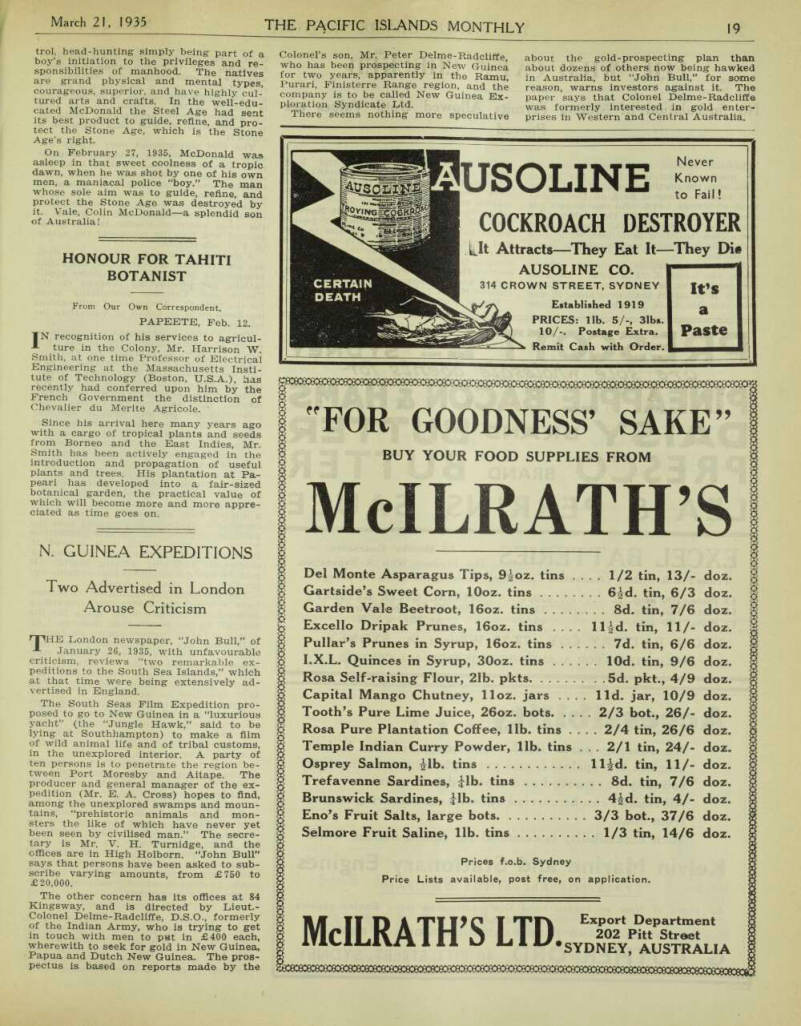
Two Advertised in London Arouse Criticism
THE London newspaper, “John Bull,” of January 26, 1935, with unfavourable criticism, reviews “two remarkable ex peditions to the South Sea Islands,” which at that time were being extensively ad vertised in England.
The South Seas Film Expedition pro posed to go to New Guinea in a “luxurious yacht” (the “Jungle Hawk,” said to be lying at Southhampton) to make a film of wild animal life and of tribal customs, in the unexplored interior. A party of ten persons is to penetrate the region be tween Port Moresby and Aitape. The producer and general manager of the ex pedition (Mr. E. A. Cross) hopes to find, among the unexplored swamps and moun tains, “prehistoric animals and mon sters the like of which have never yet been seen by civilised man.” The secre tary is Mr. V. H. Tumidge, and the offices are in High Holborn. “John Bull” says that persons have been asked to sub scribe varying amounts, from £750 to £20,000.
The other concern has its offices at 84 Kingsway, and is directed by Lieut.- Colonel Delme-Radcliffe, D.S.O., formerly of the Indian Army, who is trying to get in touch with men to put in £400 each, wherewith to seek for gold in New Guinea, Papua and Dutch New Guinea. The pros pectus is based on reports made by the
Colonel’s son, Mr. Peter Delme-Radcliffe, who has been prospecting in New Guinea for two years, apparently in the Ramu, Purari, Finisterre Range region, and the company is to be called New Guinea Exploration Syndicate Ltd, There seems nothing more speculative
about the gold-prospecting- plan than about dozens of others now being hawked in Australia, but “John Bull,” for some reason, warns investors against it. The paper says that Colonel Delme-Radcliffe was formerly interested in gold enter prises in Western and Central Australia.