Friend of the Stone Age
pp. 19-21 · Read in the full issue
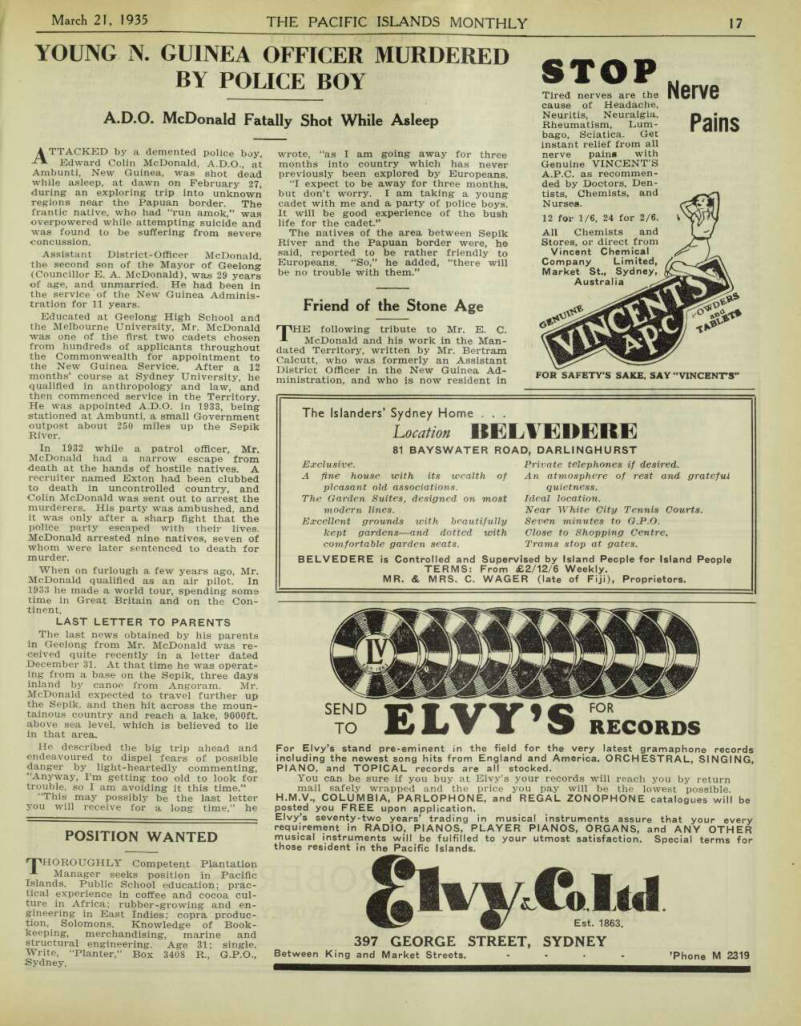
THE following tribute to Mr. E. C.
McDonald and his work in the Mandated Territory, written by Mr. Bertram Calcutt, who was formerly an Assistant District Officer in the New Guinea Administration, and who is now resident in
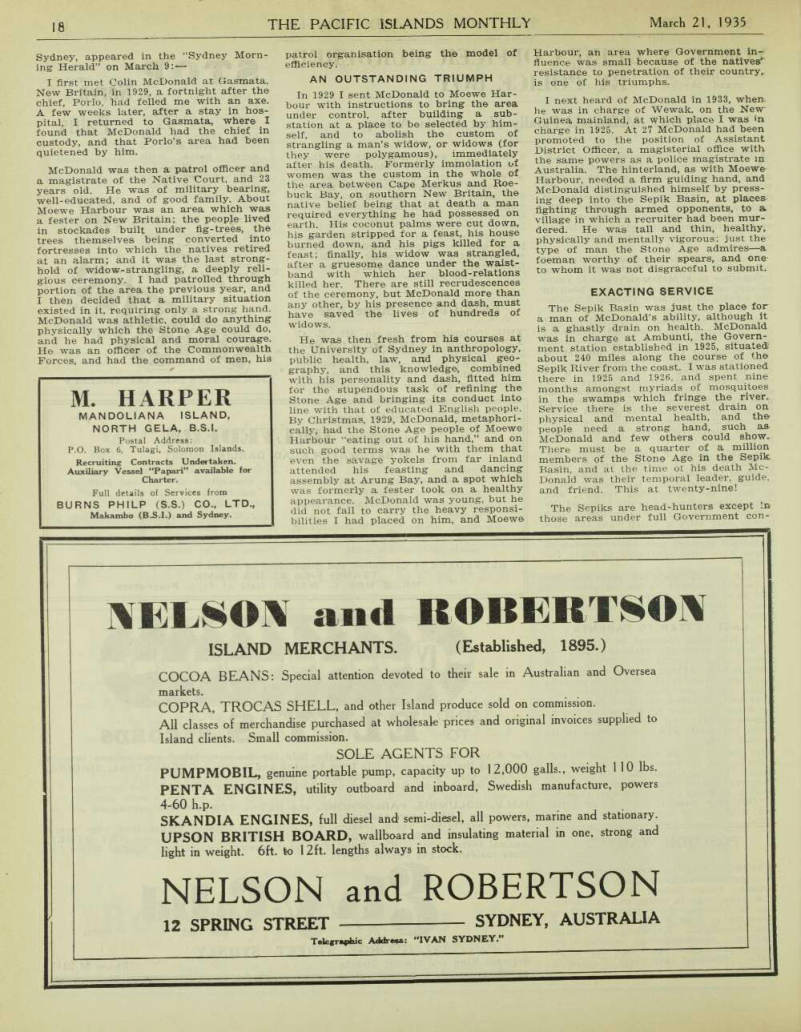
Sydney, appeared in the “Sydney Morning Herald” on March 9: I first met Colin McDonald at Gasmata, New Britain, in 1929, a fortnight after the chief, Porlo, had felled me with an axe.
A few weeks later, after a stay in hospital, I returned to Gasmata, where I found that McDonald had the chief in custody, and that Porlo’s area had been quietened by him.
McDonald was then a patrol officer and a magistrate of the Native Court, and 23 years old. He was of military bearing, well-educated, and of good family. About Moewe Harbour was an area which was a fester on New Britain; the people lived in stockades built under fig-trees, the trees themselves being converted into fortresses into which the natives retired at an alarm; and it was the last stronghold of widow-strangling, a deeply religious ceremony. I had patrolled through portion of the area the previous year, and I then decided that a military situation existed in it, requiring only a strong hand.
McDonald was athletic, could do anything physically which the Stone Age could do, and he had physical and moral courage.
He was an officer of the Commonwealth Forces, and had the command of men, his
patrol organisation being the model of efficiency.
An Outstanding Triumph
In 1929 I sent McDonald to Moewe Harbour with instructions to bring the area under control, after building a substation at a place to be selected by him self, and to abolish the custom of strangling a man’s widow, or widows (for they were polygamous), immediately after his death. Formerly immolation of women was the custom in the whole of the area between Cape Merkus and Roebuck Bay, on southern New Britain, the native belief being that at death a man required everything he had possessed on earth. His coconut palms were cut down, his garden stripped for a feast, his house burned down, and his pigs killed for a feast; finally, his widow was strangled, after a gruesome dance under the waistband with which her blood-relations killed her. There are still recrudescences of the ceremony, but McDonald more than any other, by his presence and dash, must have saved the lives of hundreds of widows.
He was then fresh from his courses at the University of Sydney in anthropology, public health, law, and physical geography, and this knowledge, combined with his personality and dash, fitted him for the stupendous task of refining the Stone Age and bringing its conduct into line with that of educated English people.
By Christmas, 1929, McDonald, metaphorically, had the Stone Age people of Moewe Harbour “eating out of his hand,” and on such good terms was he with them that even the savage yokels from far inland attended his feasting and dancing assembly at Arung Bay, and a spot which was formerly a fester took on a healthy appearance. McDonald was young, but he did not fail to carry the heavy responsibilities I had placed on him, and Moewe
Harbour, an area where Government in fluence was small because of the natives' resistance to penetration of their country is one of his triumphs.
I next heard of McDonald in 1933, when, he was in charge of Wewak, on the New Guinea mainland, at which place I was in charge in 1925. At 27 McDonald had been promoted to the position of Assistant District Officer, a magisterial office with the same powers as a police magistrate in Australia. The hinterland, as with Moewe Harbour, needed a firm guiding hand, and McDonald distinguished himself by pressing deep into the Sepik Basin, at places fighting through armed opponents, to a village in which a recruiter had been murdered. He was tall and thin, healthy, physically and mentally vigorous; just the type of man the Stone Age admires —a foeman worthy of their spears, and one to whom it was not disgraceful to submit.
Exacting Service
The Sepik Basin was just the place for a man of McDonald’s ability, although it is a ghastly drain on health. McDonald was in charge at Ambunti, the Government station established in 1925, situated about 240 miles along the course of the Sepik River from the coast. I was stationed there in 1925 and 1926, and spent nine months amongst myriads of mosquitoes in the swamps which fringe the river.
Service there is the severest drain on physical and mental health, and the people need a strong hand, such as McDonald and few others could show.
There must be a quarter of a million members of the Stone Age in the Sepik.
Basin, and at the time of his death Mc- Donald was their temporal leader, guide, and friend. This at twenty-nine!
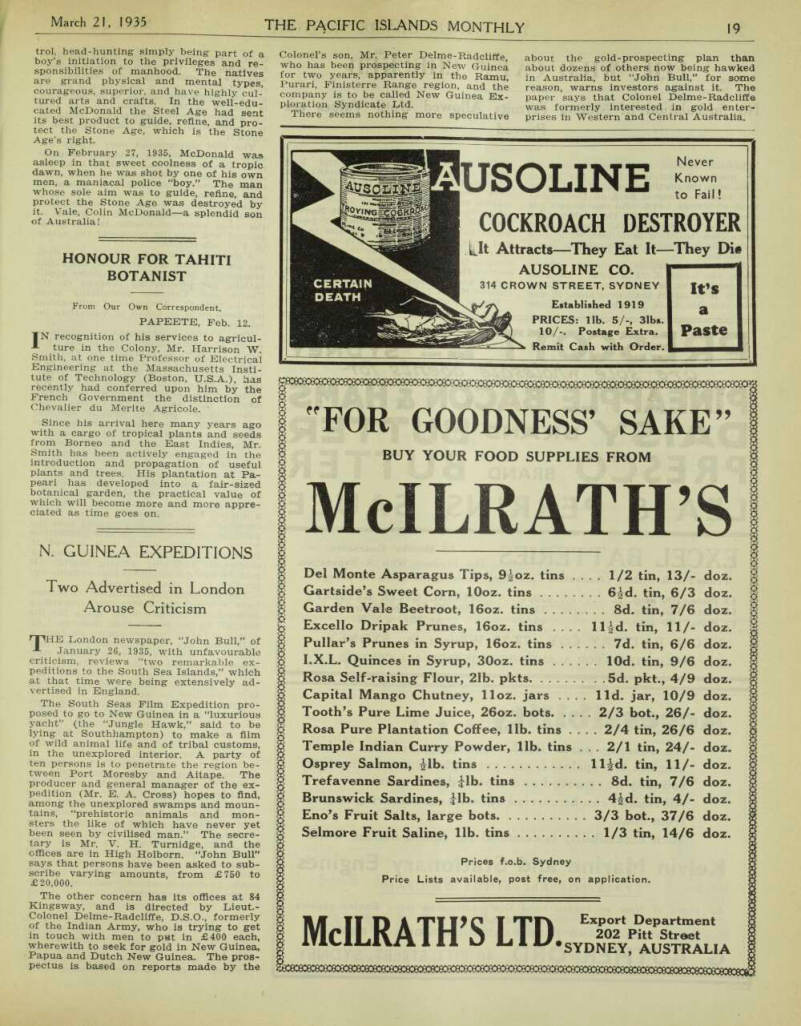
The Sepiks are head-hunters except in those areas under full Government con-
trol, head-hunting simply being part of a boy’s initiation to the privileges and re sponsibilities of manhood. The natives are grand physical and mental types, courageous, superior, and have highly cul tured arts and crafts. In the well-edu cated McDonald the Steel Age had sent its best product to guide, refine, and pro tect the Stone Age, which is the Stone Age’s right.
On February 27, 1935, McDonald was asleep in that sweet coolness of a tropic dawn, when he was shot by one of his own men, a maniacal police “boy.” The man whose sole aim was to guide, refine, and protect the Stone Age was destroyed by it. Vale, Colin McDonald—a splendid son of Australia!