Ceremonies
pp. 10-11 · Read in the full issue
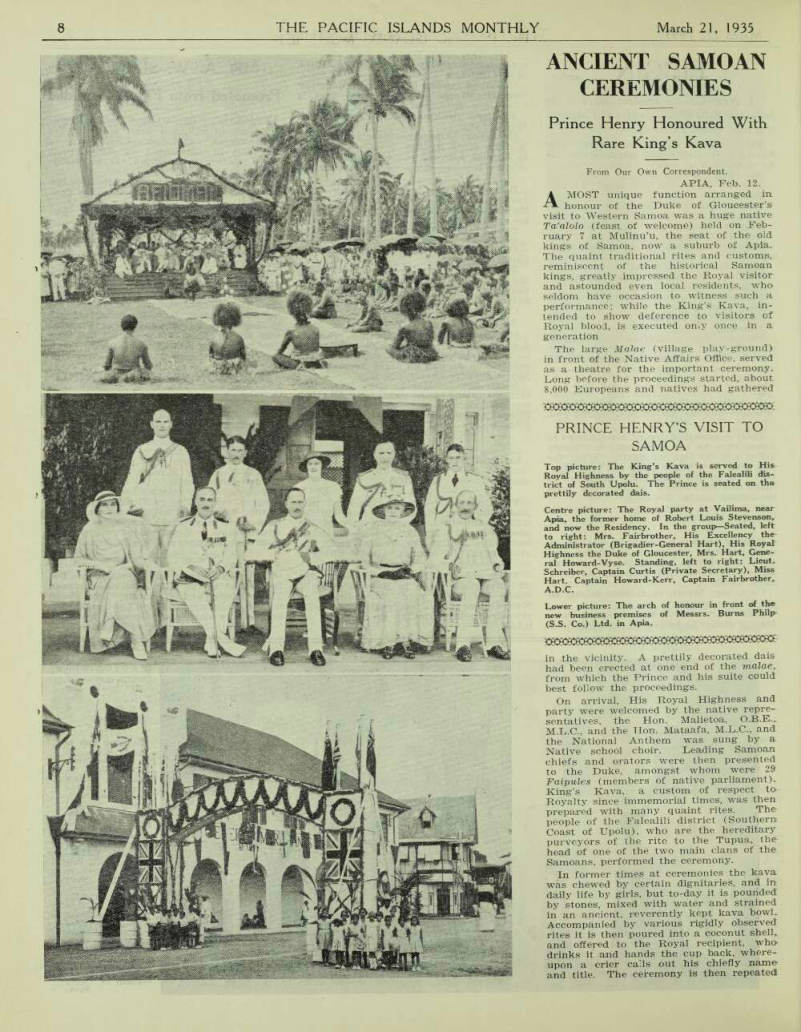
Ancient Samoan
Prince Henry Honoured With Rare King’s Kava
From Our Own Correspondent.
Apia, Feb. 12.
A MOST unique function arranged in honour of the Duke of Gloucester’s visit to Western Samoa was a huge native Ta’alolo (feast of welcome) held on Feb ruary 7 at Mulinu’u, the seat of the old kings of Samoa, now a suburb of Apia.
The quaint traditional rites and customs, reminiscent of the historical Samoan kings, greatly impressed the Royal visitor and astounded even local residents, who seldom have occasion to witness such a performance; while the King’s Kava, in tended to show deference to visitors of Royal blood, is executed only once in a generation The large Malae (village play-ground) in front of the Native Affairs Office, served as a theatre for the important ceremony.
Long before the proceedings started, about 8,000 Europeans and natives had gathered
in the vicinity. A prettily decorated dais had been erected at one end of the malae, from which the Prince and his suite could best follow the proceedings.
On arrival, His Royal Highness and party were welcomed by the native repre sentatives, the Hon. Malietoa, O.B.E., M.L.C., and the Hon. Mataafa, M.L.C., and the National Anthem was sung by a Native school choir. Leading Samoan chiefs and orators were then presented to the Duke, amongst whom were 29 Faipules (members of native parliament).
King’s Kava, a custom of respect to Royalty since immemorial times, was then prepared with many quaint rites. The people of the Falealili district (Southern Coast of Upolu), who are the hereditary purveyors of the rite to the Tupua, the head of one of the two main clans of the Samoans, performed the ceremony.
In former times at ceremonies the kava was chewed by certain dignitaries, and in daily life by girls, but to-day it is pounded by stones, mixed with water and strained in an ancient, reverently kept kava bowl.
Accompanied by various rigidly observed rites it is then poured into a coconut shell, and offered to the Royal recipient, who drinks it and hands the cup back, where upon a crier calls out his chiefly name and title. The ceremony is then repeated
for each recipient lower in rank than the first. The serving of the kava is accom panied by clapping of hands by all those present.
After the kava ceremony the Su’d Taute took place, the offering of food to Royalty.
To the accompaniment of beating drums a large line of Samoans, headed by a taupou (village virgin) approached the Duke, carrying an opened drinking coconut and cooked food, wrapped in leaves, amongst which was large cooked pig.
The Ta’alolos then followed by the tra ditional old districts of Savaii and Upolu.
The men of these districts in a dense crowd approached the dais, slowly march ing forward, singing songs of welcome, preceded by chiefs and a number of taupous in full ceremonial dancing dress with tuigas (high headdresses), dancing to the tune of the Samoan songs sung by the men. In front of the dais they paraded, district after district, offering a pretty and colourful typically Samoan spectacle.
After the ta’alolos a Samoan song in honour of the Royal visitor was sung by the male choir of Laulii village, followed by a dance performed by 200 girls from the Government native schools, dressed in Samoan style and singing songs specially composed in honour of the occasion. This dance and the subsequent performances of an axe dance by 200 natives of the Aana district, and a spear dance by 250 Manono Islanders were heartily applauded by the Prince and the large crowd.
At the finish of the programme a presen tation of gifts by representative Sameans from all the districts of Western Samoa took place. The gifts consisted ot fine mats, kava bowls, walking sticks, tapa cloth, native carvings, fans, etc.