Strange Rock Carving In Tahiti
pp. 38-39 · Read in the full issue
By J. D. Mccomish.
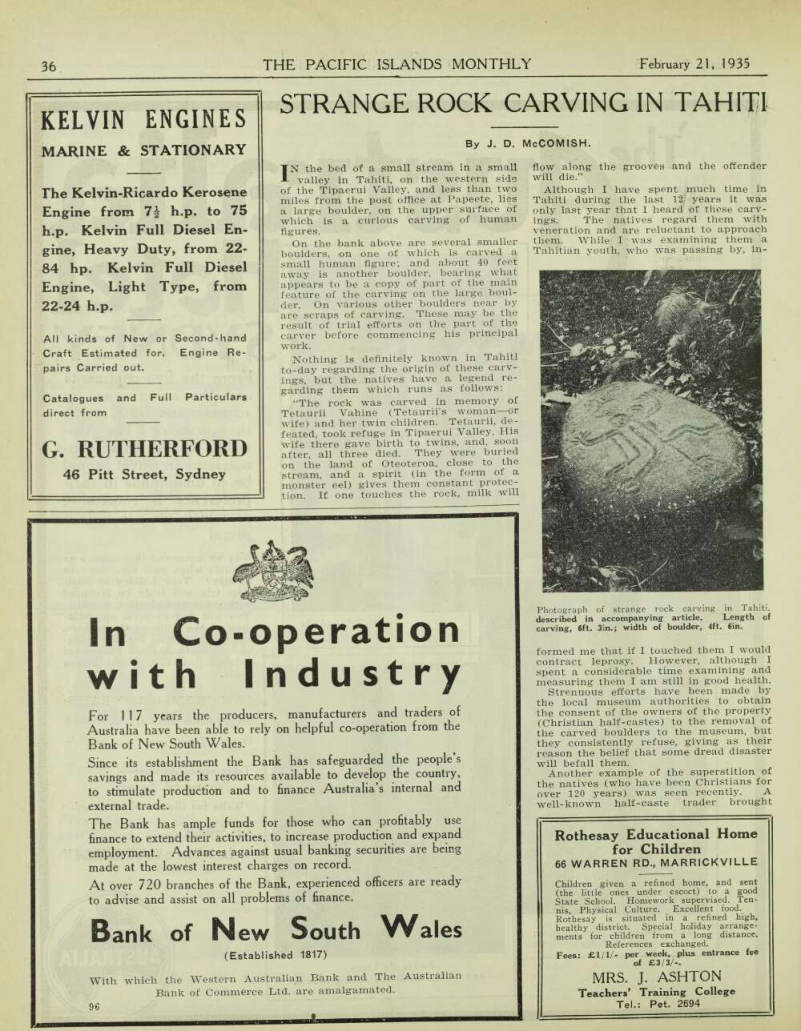
IN the bed of a small stream in a small valley in Tahiti, on the western side of the Tipaerui Valley, and less than two miles from the post office at Papeete, lies a large boulder, on the upper surface of which is a curious carving of human figures.
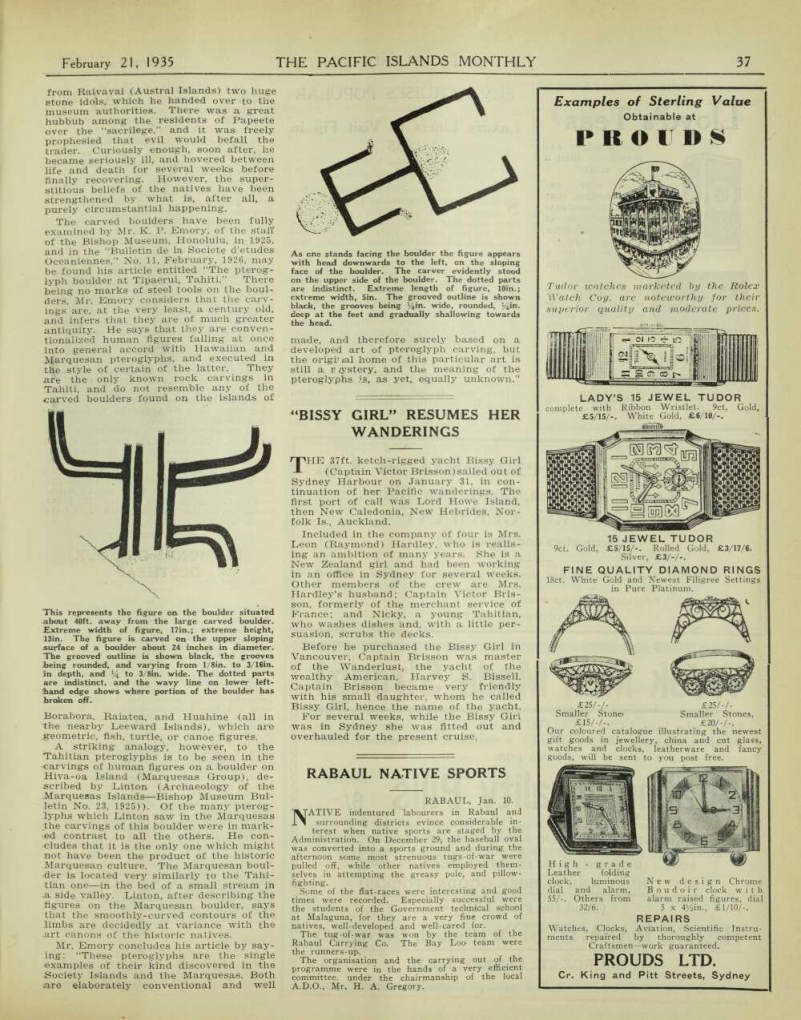
On the bank above are several smaller boulders, on one of which is carved a small human figure; and about 40 feet away is another boulder, bearing what appears to be a copy of part of the main feature of the carving on the large boul der. On various other boulders near by are scraps of carving. These may be the result of trial efforts on the part of the carver before commencing his principal work.
Nothing is definitely known in Tahiti to-day regarding the origin of these carv ings, but the natives have a legend re garding them which runs as follows: “The rock was carved in memory of Tetaurii Vahine (Tetaurii’s woman—or wife) and her twin children. Tetaurii, de feated, took refuge in Tipaerui Valley. His wife there gave birth to twins, and, soon after, all three died. They were buried on the land of Oteoteroa, close to the stream, and a spirit (in the form of a monster eel) gives them constant protec tion. If one touches the rock, milk will
flow along the grooves and the offender will die.”
Although I have spent much time in Tahiti during the last 12; years it was only last year that I heard of these carv ings. The natives regard them with veneration and are reluctant to approach them. While I was examining them a Tahitian youth, who was passing by, in-
formed me that if I touched them I would contract leprosy. However, although I spent a considerable time examining and measuring them I am still in good health.
Strenuous efforts have been made by the local museum authorities to obtain the consent of the owners of the property (Christian half-castes) to the removal of the carved boulders to the museum, but they consistently refuse, giving as their reason the belief that some dread disaster will befall them.
Another example of the superstition of the natives (who have been Christians for over 120 years) was seen recently. A well-known half-caste trader brought
Photograph of strange rock carving in Tahiti, described in accompanying article. Length of carving, 6ft. 3in.; width of boulder, 4ft. 6in.
from Raivavai (Austral Islands) two huge stone idols, which he handed over to the museum authorities. There was a great hubbub among the residents of Papeete over the “sacrilege,” and it was freely prophesied that evil would befall the trader. Curiously enough, soon after, he became seriously ill, and hovered between life and death for several weeks before finally recovering. However, the super stitious beliefs of the natives have been strengthened by what is, after all, a purely circumstantial happening.
The carved boulders have been fully examined by Mr. K. P. Emory, of the staff of the Bishop Museum, Honolulu, in 1925, and in the “Bulletin de la Societe d’etudes Oceaniennes,” No. 11, February, 1926, may be found his article entitled “The pterog lyph boulder at Tipaerui, Tahiti.” There being no marks of steel tools on the boul ders, Mr. Emory considers that the carv ings are, at the very least, a century old, and infers that they are of much greater antiquity. He says that they are conven tionalized human figures falling at once into general accord with Hawaiian and Marquesan pteroglyphs, and executed in the style of certain of the latter. They are the only known rock carvings in Tahiti, and do not resemble any of the carved boulders found on the islands of
Borabora, Raiatea, and Huahine (all in the nearby Leeward Islands), which are geometric, fish, turtle, or canoe figures.
A striking analogy, however, to the Tahitian pteroglyphs is to be seen in the carvings of human figures on a boulder on Hiva-oa Island (Marquesas Group), de scribed by Linton (Archaeology of the Marquesas Islands—Bishop Museum Bulletin No. 23, 1925)). Of the many pterog lyphs which Linton saw in the Marquesas the carvings of this boulder were in mark ed contrast to all the others. He con cludes that it is the only one which might not have been the product of the historic Marquesan culture. The Marquesan boul der is located very similarly to the Tahi tian one—in the bed of a small stream in a side valley. Linton, after describing the figures on the Marquesan boulder, says that the smoothly-curved contours of the limbs are decidedly at variance with the art canons of the historic natives.
Mr, Emory concludes his article by say ing; “These pteroglyphs are the single examples of their kind discovered in the Society Islands and the Marquesas. Both are elaborately conventional and well
made, and therefore surely based on a developed art of pteroglyph carving, but the original home of this particular art is still a it mystery, and the meaning of the pteroglyphs is, as yet, equally unknown.”
This represents the figure on the boulder situated about 40ft. away from the large carved boulder.
Extreme width of figure, 17in.; extreme height, 13in. The figure is carved on the upper sloping surface of a boulder about 24 inches in diameter.
The grooved outline is shown black, the grooves being rounded, and varying from 1/8in. to 3/16in. in depth, and ¼ to 3/8in. wide. The dotted parts are indistinct, and the wavy line on lower left hand edge shows where portion of the boulder has broken off.
As one stands facing the boulder the figure appears with head downwards to the left, on the sloping face of the boulder. The carver evidently stood on the upper side of the boulder. The dotted parts are indistinct. Extreme length of figure, 10in.; extreme width, Sin. The grooved outline is shown black, the grooves being %in. wide, rounded, ¼in. deep at the feet and gradually shallowing towards the head.