Fiji’S New Goldfields
pp. 17-19 · Read in the full issue
How E. G. Theodore’s Enterprise and Tenacity Are Winning Due Reward
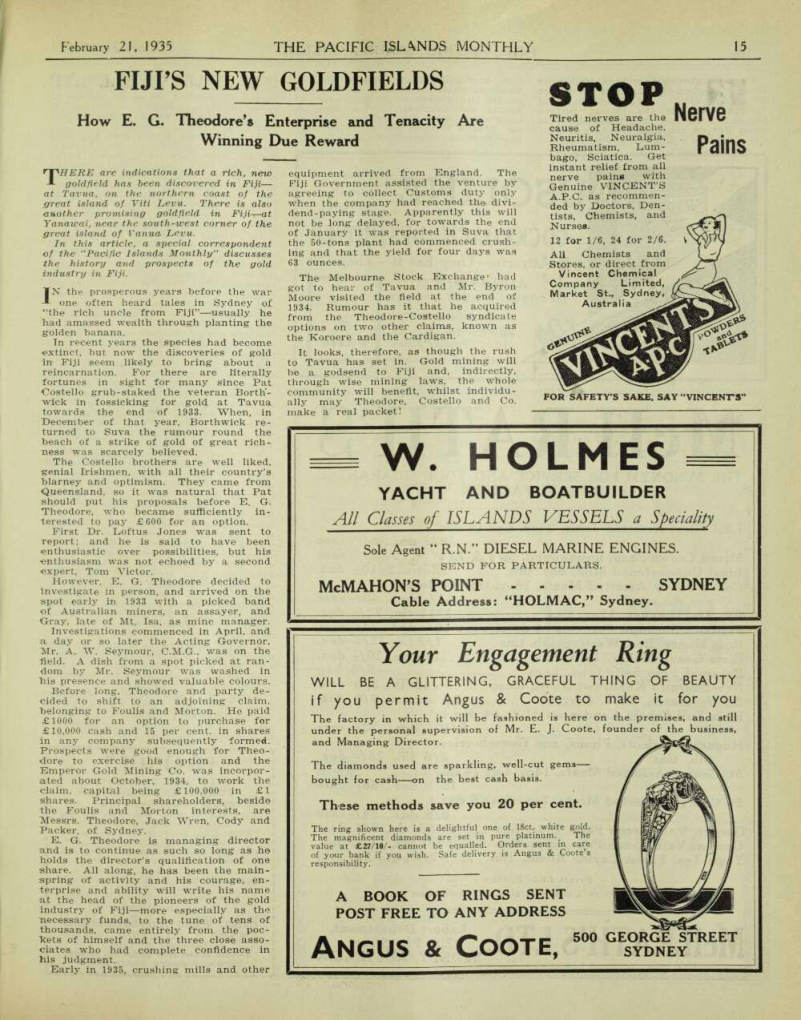
THERE are indications that a rich, new goldfield has been discovered in Fiji— at Tavua, on the northern coast of the great island of Viti Levu. There is also another promising goldfield in Fiji—at Yanawai, near the south-west corner of the great island of Vanua Levu.
In this article, a special correspondent of the Pacific Islands Monthly” discusses the history and prospects of the gold industry in Fiji.
IN the prosperous years before the war one often heard tales in Sydney of “the rich uncle from Fiji’’—usually he had amassed wealth through planting the golden banana.
In recent years the species had become extinct, but now the discoveries of gold in Fiji seem likely to bring about a reincarnation. For there are literally fortunes in sight for many since Pat Costello grub-staked the veteran Borthwick in fossicking for gold at Tavua towards the end of 1933. When, in December of that year, Borthwick re turned to Suva the rumour round the beach of a strike of gold of great rich ness was scarcely believed.
The Costello brothers are well liked, genial Irishmen, with all their country’s blarney and optimism. They came from Queensland, so it was natural that Pat should put his proposals before E. G.
Theodore, who became sufficiently in terested to pay £600 for an option.
First Dr. Loftus Jones was sent to report; and he is said to have been enthusiastic over possibilities, but his enthusiasm was not echoed by a second expert, Tom Victor.
However, E. G. Theodore decided to investigate in person, and arrived on the spot early in 1933 with a picked band of Australian miners, an assayer, and Gray, late of Mt. Isa, as mine manager.
Investigations commenced in April, and a day or so later the Acting Governor, Mr. A. W. Seymour, C.M.G., was on the held. A dish from a spot picked at ran dom by Mr. Seymour was washed in his presence and showed valuable colours.
Before long, Theodore and party de cided to shift to an adjoining claim, belonging to Foulis and Morton. He paid £1000 for an option to purchase for £10,000 cash and 15 per cent, in shares in any company subsequently formed.
Prospects were good enough for Theo dore to exercise his option and the Emperor Gold Mining Co. was incorpor ated about October, 1934, to work the claim, capital being £100,000 in £1 shares. Principal shareholders, beside the Foulis and Morton interests, are Messrs. Theodore, Jack Wren, Cody and Packer, of Sydney.
E. G. Theodore is managing director and is to continue as such so long as he holds the director’s qualification of one share. All along, he has been the main spring of activity and his courage, en terprise and ability will write his name at the head of the pioneers of the gold industry of Fiji—more especially as the necessary funds, to the tune of tens of thousands, came entirely from the poc hets of himself and the three close asso ciates who had complete confidence in his judgment.
Early in 1935, crushing mills and other
equipment arrived from England. The Fiji Government assisted the venture by agreeing to collect Customs duty only when the company had reached th© divi dend-paying stage. Apparently this will not be long delayed, for towards the end of January it was reported in Suva that the 50-tons plant had commenced crush ing and that the yield for four days was 63 ounces.
The Melbourne Stock Exchange had got to hear of Tavua and Mr. Byron Moore visited the field at the end of 1934. Rumour has it that he acquired from the Theodore-Costello syndicate options on two other claims, known as the Koroere and the Cardigan.
It looks, therefore, as though the rush to Tavua has set in. Gold mining will be a godsend to Fiji and, indirectly, through wise mining laws, the whole community will benefit, whilst individu ally may Theodore, Costello and Co. make a real packet!
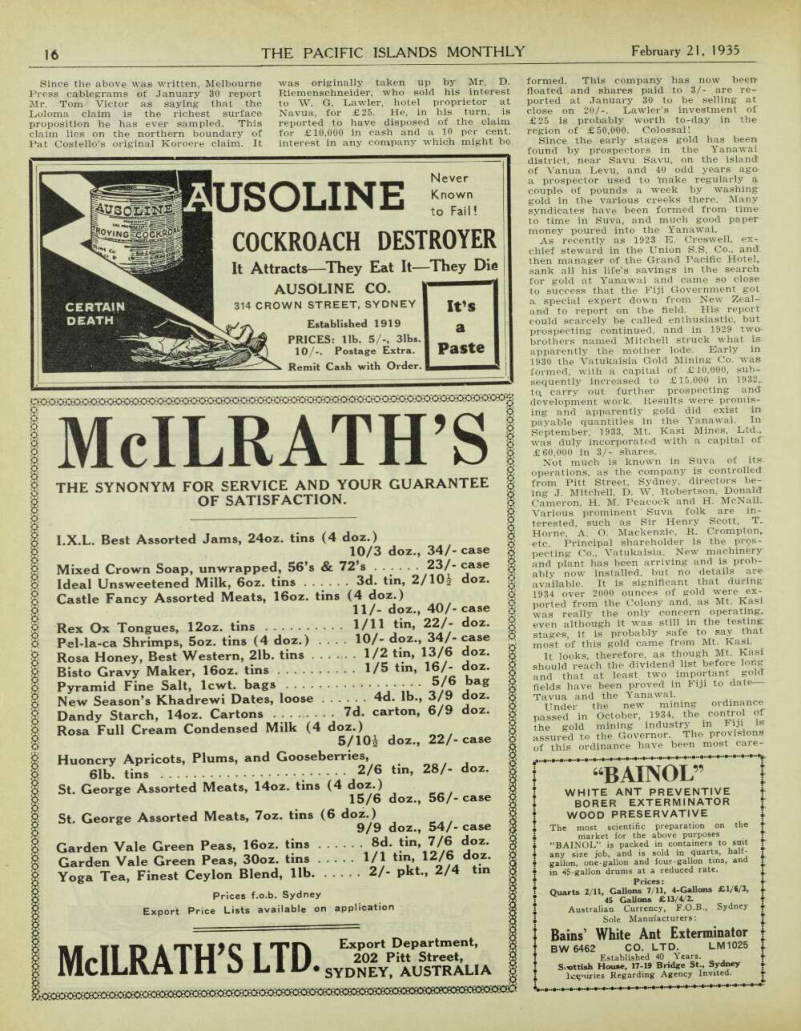
Since the above was written, Melbourne Press cablegrams of January 30 report Mr. Tom Victor as saying that the Loloma claim is the richest surface proposition he has ever sampled. This claim lies on the northern boundary of Pat Costello’s original Koroere claim. It
was originally taken up by Mr. D.
Riemenschneider, who sold his interest to W. G. Lawler, hotel proprietor at Navua, for £25. He, in his turn, is reported to have disposed of the claim for £10,000 in cash and a 10 per cent. interest in any company which might be
formed. This company has now been floated and shares paid to 3/- are re ported at January 30 to be selling at close on 20/-. Lawler’s investment of £25 is probably worth to-day in the region of £50,000. Colossal!
Since the early stages gold has been found by prospectors in the Yanawai district, near Savu Savu, on the island of Vanua Levu, and 40 odd years ago a prospector used to "make regularly a couple of pounds a week by washing gold in the various creeks there. Many syndicates have been formed from time to time in Suva, and much good paper money poured into the Yanawai.
As recently as 1923 E. Creswell, ex chief steward in the Union S.S. Co., and. then manager of the Grand Pacific Hotel, sank all his life’s savings in the search for gold at Yanawai and came so close to success that the Fiji Government got a special expert down from New Zeal and to report on the field. His report could scarcely be called enthusiastic, but prospecting continued, and in 1929 two brothers named Mitchell struck what is apparently the mother lode. Early in 1930 the Vatukaisia Gold Mining Co. was formed, with a capital of £10,000, subsequently increased to £15,000 in 1932,. to. carry out further prospecting and development work. Results were promis ing and apparently gold did exist in payable quantities in the Yanawai. In September, 1933, Mt. Kasi Mines, Ltd., was duly incorporated with a capital of £60,000 in 3/- shares.
Not much is known in Suva of its operations, as the company is controlled from Pitt Street, Sydney, directors be ing J. Mitchell, D. W. Robertson, Donald Cameron, H. M. Peacock and H. McNalL Various prominent Suva folk are in terested, such as Sir Henry Scott, T..
Horne, A. O. Mackenzie, R. Crompton, etc. Principal shareholder is the pros pecting Co., Vatukaisia. New machinery and plant has been arriving and is prob ably now installed, but no details are available. It is significant that during 1934 over 2000 ounces of gold were ex ported from the Colony and, as Mt. Kasi was really the only concern operating, even although it was still in the testing stages, it is probably safe to say that most of this gold came from Mt. Kasi.
It looks, therefore, as though Mt. Kasi should reach the dividend list before long and that at least two important gold fields have been proved in Fiji to date Tavua and the Yanawai.
Under the new mining ordinance passed in October, 1934, the control of the gold mining industry in Fiji is assured to the Governor. The provisions of this ordinance have been most care
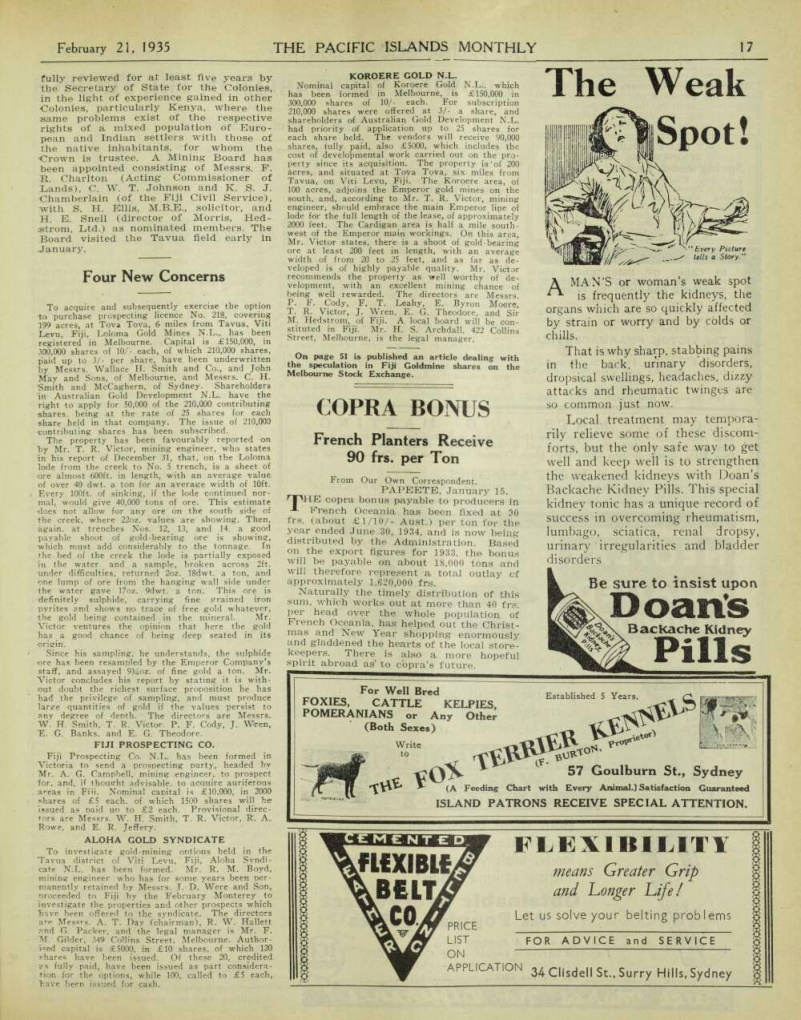
fully reviewed for at least five years by the Secretary of State for the Colonies, in the light of experience gained in other Colonies, particularly Kenya, where the same problems exist of the respective rights of a mixed population of Euro pean and Indian settlers with those of the native inhabitants, for whom the Crown is trustee. A Mining Board has been appointed consisting of Messrs. F.
R. Charlton (Acting Commissioner of Lands), C. W. T. Johnson and K. S. J.
Chamberlain (of the Fiji Civil Service), with S. H. Ellis, M.B.E., solicitor, and H. E. Snell (director of Morris, Hed strom, Ltd.) as nominated members. The Board visited the Tavua field early in January.