Inscription
p. 12 · Read in the full issue
Another Ancient Inscription
By Arthur J. Vogan, F.R.G.S., &C.
I AM only too glad to be able to render tribute to the editor of the bright little “P.I.M.,” whose far-flung columns, alone of all Australasian newspapers, have been so readily open to reporting upon archaeological and ethnological dis coveries through the wide and cryptically susurrous Pacific —still little known, from a scientific point of view.
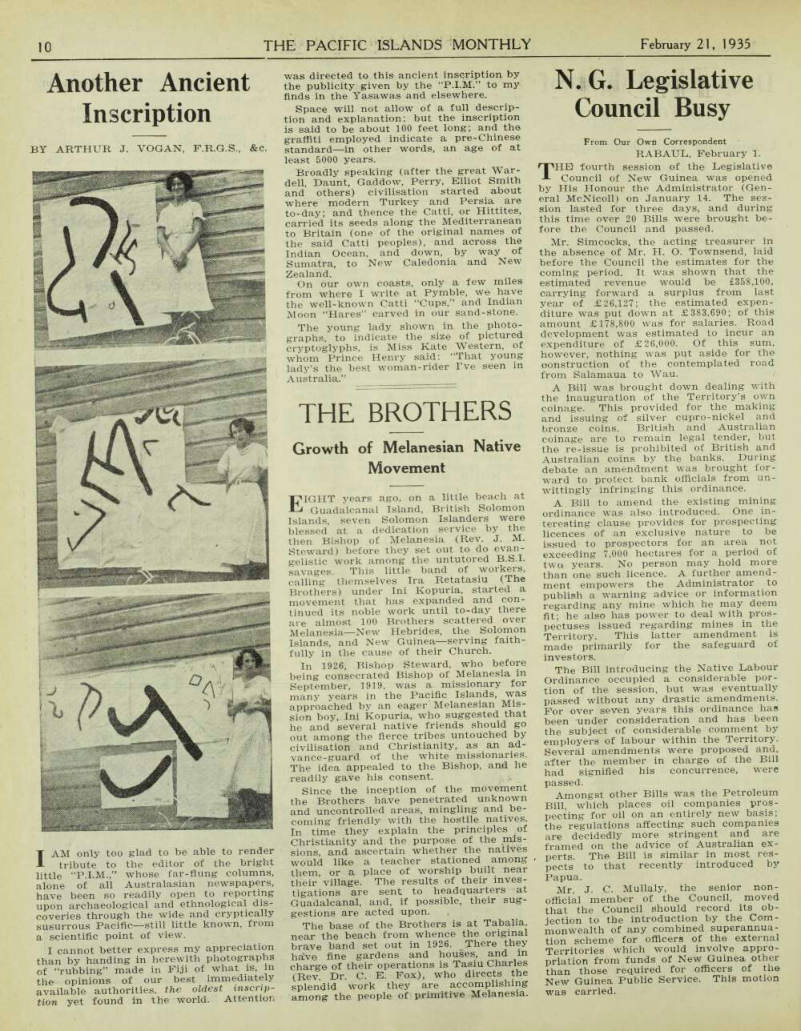
I cannot better express my appreciation than by handing in herewith photographs of “rubbing” made in Fiji of what is, in the opinions of our best immediately available authorities, the oldest inscrip tion yet found in the world. Attention
was directed to this ancient inscription by the publicity given by the “P.I.M.” to my finds in the Yasawas and elsewhere.
Space will not allow of a full descrip tion and explanation; but the inscription is said to be about 100 feet long; and the graffiti employed indicate a pre-Chinese standard —in other words, an age of at least 5000 years.
Broadly speaking (after the great War dell, Daunt, Gaddow, Perry, Elliot Smith and others) civilisation started about where modern Turkey and Persia are to-day; and thence the Catti, or Hittites, carried its seeds along the Mediterranean to Britain (one of the original names of the said Catti peoples), and across the Indian Ocean, and down, by way of Sumatra, to New Caledonia and New Zealand.
On our own coasts, only a few miles from where I write at Pymble, we have the well-known Catti “Cups,” and Indian Moon “Hares” carved in our sand-stone.
The young lady shown in the photo graphs, to indicate the size of pictured cryptoglyphs, is Miss Kate Western, of whom Prince Henry said; “That young lady’s the best woman-rider I’ve seen in Australia.”