Petition
pp. 83-84 · Read in the full issue
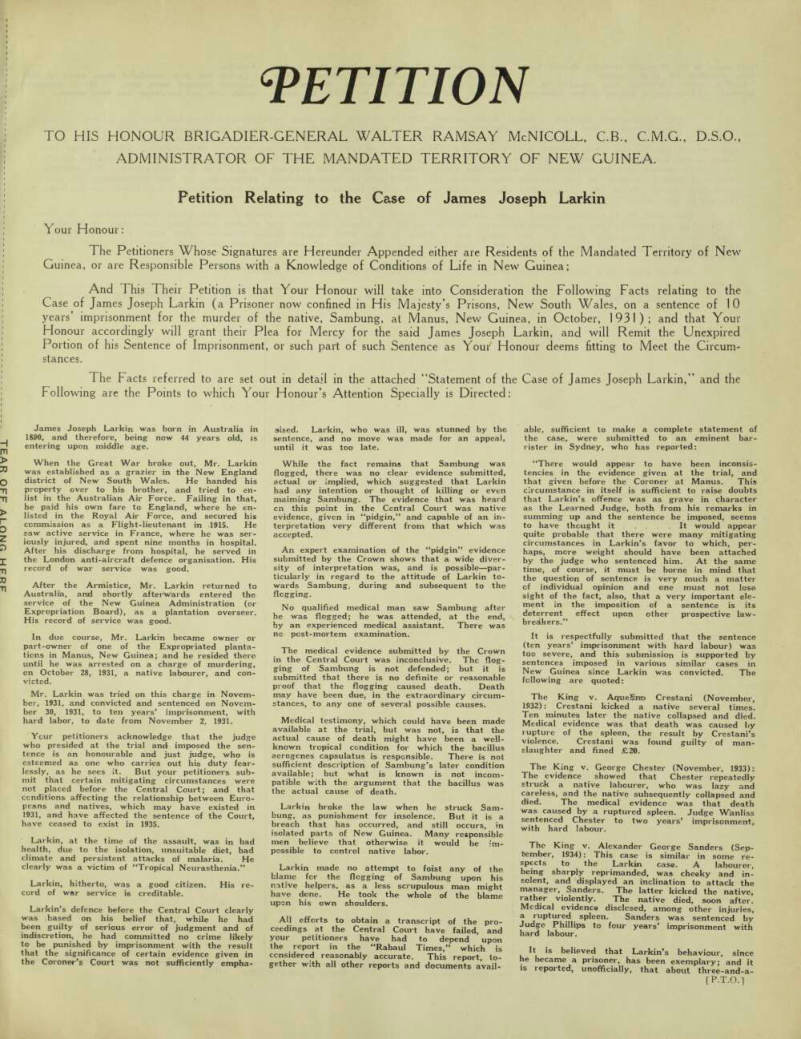
TO HIS HONOUR BRIGADIER-GENERAL WALTER RAMSAY McNICOLL, C.B., C.M.G., D.S.O., ADMINISTRATOR OF THE MANDATED TERRITORY OF NEW GUINEA.
Petition Relating to the Case of James Joseph Larkin Your Honour: The Petitioners Whose Signatures are Hereunder Appended either are Residents of the Mandated Territory of New Guinea, or are Responsible Persons with a Knowledge of Conditions of Life in New Guinea; And This Their Petition is that Your Honour will take into Consideration the Following Facts relating to the Case of James Joseph Larkin (a Prisoner now confined in His Majesty’s Prisons, New South Wales, on a sentence of 10 years’ imprisonment for the murder of the native, Sambung, at Manus, New Guinea, in October, 1931); and that Your Honour accordingly will grant their Plea for Mercy for the said James Joseph Larkin, and will Remit the Unexpired Portion of his Sentence of Imprisonment, or such part of such Sentence as Your Honour deems fitting to Meet the Circumstances.
The Facts referred to are set out in detail in the attached “Statement of the Case of James Joseph Larkin,’’ and the Following are the Points to which Your Honour’s Attention Specially is Directed:
James Joseph Larkin was born in Australia in 1890, and therefore, being now 44 years old, is entering upon middle age.
When the Great War broke out, Mr. Larkin was established as a grazier in the New England district of New South Wales. He handed his property over to his brother, and tried to en list in the Australian Air Force. Failing in that, he paid his own fare to England, where he en listed in the Royal Air Force, and secured his commission as a Flight-lieutenant in 1915. He saw active service in France, where he was ser iously injured, and spent nine months in hospital.
After his discharge from hospital, he served in the London anti-aircraft defence organisation. His record of war service was good.
After the Armistice, Mr. Larkin returned to Australia, and shortly afterwards entered the service of the New Guinea Administration (or Expropriation Board), as a plantation overseer.
His record of service was good.
In due course, Mr. Larkin became owner or part-owner of one of the Expropriated planta tions in Manus, New Guinea; and he resided there until he was arrested on a charge of murdering, on October 28, 1931, a native labourer, and con victed.
Mr. Larkin was tried on this charge in Novem ber, 1931, and convicted and sentenced on Novem ber 30, 1931, to ten years’ imprisonment, with hard labor, to date from November 2, 1931.
Your petitioners acknowledge that the judge who presided at the trial and imposed the sen tence is an honourable and just judge, who is esteemed as one who carries out his duty fear lessly, as he sees it. But your petitioners sub mit that certain mitigating circumstances were not placed before the Central Court; and that conditions affecting the relationship between Euro peans and natives, which may have existed in 1931, and have affected the sentence of the Court, have ceased to exist in 1935.
Larkin, at the time of the assault, was in bad health, due to the isolation, unsuitable diet, bad climate and persistent attacks of malaria. He clearly was a victim of “Tropical Neurasthenia.”
Larkin, hitherto, was a good citizen. His re cord of war service is creditable.
Larkin’s defence before the Central Court clearly was based on his belief that, while he had been guilty of serious error of judgment and of indiscretion, he had committed no crime likely to be punished by imprisonment with the result that the significance of certain evidence given in the Coroner’s Court was not sufficiently empha
sised. Larkin, who was ill, was stunned by the sentence, and no move was made for an appeal, until it was too late.
While the fact remains that Sambung was flogged, there was no clear evidence submitted, actual or implied, which suggested that Larkin had any intention or thought of killing or even maiming Sambung. The evidence that was heard on this point in the Central Court was native evidence, given in “pidgin,” and capable of an in terpretation very different from that which was accepted.
An expert examination of the “pidgin” evidence submitted by the Crown shows that a wide diver sity of interpretation was, and is possible—par ticularly in regard to the attitude of Larkin to wards Sambung, during and subsequent to the flogging.
No qualified medical man saw Sambung after he was flogged; he was attended, at the end, by an experienced medical assistant. There was no post-mortem examination.
The medical evidence submitted by the Crown in the Central Court was inconclusive. The flog ging of Sambung is not defended; but it is submitted that there is no definite or reasonable proof that the flogging caused death. Death may have been due, in the extraordinary circum stances, to any one of several possible causes.
Medical testimony, which could have been made available at the trial, but was not, is that the actual cause of death might have been a well known tropical condition for which the bacillus aerogenes capsulatus is responsible. There is not sufficient description of Sambung’s later condition available; but what is known is not incom patible with the argument that the bacillus was the actual cause of death.
Larkin broke the law when he struck Sam bung, as punishment for insolence. But it is a breach that has occurred, and still occurs, in isolated parts of New Guinea. Many responsible men believe that otherwise it would be im possible to control native labor.
Larkin made no attempt to foist any of the blame for the flogging of Sambung upon his native helpers, as a less scrupulous man might have done. He took the whole of the blame upon his own shoulders.
All efforts to obtain a transcript of the pro ceedings at the Central Court have failed, and your petitioners have had to depend upon the report in the “Rabaul Times,” which is considered reasonably accurate. This report, to gether with all other reports and documents avail-
able, sufficient to make a complete statement of the case, were submitted to an eminent bar rister in Sydney, who has reported: “There would appear to have been inconsis tencies in the evidence given at the trial, and that given before the Coroner at Manus. This circumstance in itself is sufficient to raise doubts that Larkin’s offence was as grave in character as the Learned Judge, both from his remarks in summing up and the sentence he imposed, seems to have thought it . . . . . It would appear quite probable that there were many mitigating circumstances in Larkin’s favor to which, per haps, more weight should have been attached by the judge who sentenced him. At the same time, of course, it must be borne in mind that the question of sentence is very much a matter cf individual opinion and one must not lose sight of the fact, also, that a very important ele ment in the imposition of a sentence is its deterrent effect upon other prospective law breakers.”
It is respectfully submitted that the sentence (ten years’ imprisonment with hard labour) was too severe, and this submission is supported by sentences imposed in various similar cases in New Guinea since Larkin was convicted. The following are quoted: The King v. Aquelino Crestani (November, 1932): Crestani kicked a native several times.
Ten minutes later the native collapsed and died.
Medical evidence was that death was caused by rupture of the spleen, the result by Crestani’s violence. Crestani was found guilty of man slaughter and fined £20.
The King v. George Chester (November, 1933): The evidence showed that Chester repeatedly struck a native labourer, who was lazy and careless, and the native subsequently collapsed and died. The medical evidence was that death was caused by a ruptured spleen. Judge Wanliss sentenced Chester to two years’ imprisonment, with hard labour.
The King v. Alexander George Sanders (Sep tember, 1934): This case is similar in some re spects to the Larkin case. A labourer, being sharply reprimanded, was cheeky and in solent, and displayed an inclination to attack the manager, Sanders. The latter kicked the native, rather violently. The native died, soon after.
Medical evidence disclosed, among other injuries, a ruptured spleen. Sanders was sentenced by Judge Phillips to four years’ imprisonment with hard labour.
It is believed that Larkin’s behaviour, since he became a prisoner, has been exemplary; and it is reported, unofficially, that about three-and-a-
P.T.O.
half years of his 10 years’ sentence already have been remitted for good conduct.
Larkin, when convicted, was engaged to be married. His fiancee, a woman of fine character,
has informed the Sydney committtee that Larkin will not, in any circumstances, return to New Guinea; but that, on his release, they will be married, and probably go to reside in South
America.
Larkin has now completed three years of the sentence imposed upon him. He is entering middle age and his career has been ruined.
Your petitioners humbly submit that James Larkin already has been severely punished for a crime which clearly was not premeditated and in connection with which his previous good record might be allowed to weigh. We submit that even if the remainder of Larkin’s sentence were remitted, he still would have to face the remainder of his life as a man whose career has been broken, and under the stigma of a conviction of serious crime. We submit thirdly, that the laws of the Territory relating to the treatment of natives have been amply vindicated, and that the effect of extending mercy to Larkin would not be detrimental, so far as future observance of and respect for the law are concerned. We submit, fourthly, that clemency in the Larkin case would not establish an embarrassing precedent as the circumstances surrounding the death of the native, and the conviction of Larkin (or murder are very unusual, and not likely to be duplicated in any other case.
The plea of the undersigned, your petitioners, therefore is, that Your Honour will give consideration to the circumstances surrounding the conviction and imprisonment of James Larkin, and to the fact that this man of hitherto good character has now served three years as a felon in the New South Wales Prisons; and that, if Your Honour thinks it fitting, you will exercise your power and remit the remainder of the sentence imposed upon the said James Joseph Larkin.
And in pursuance of this, their petition the following hereunto set their signatures: