Joseph Larkin
p. 77 · Read in the full issue
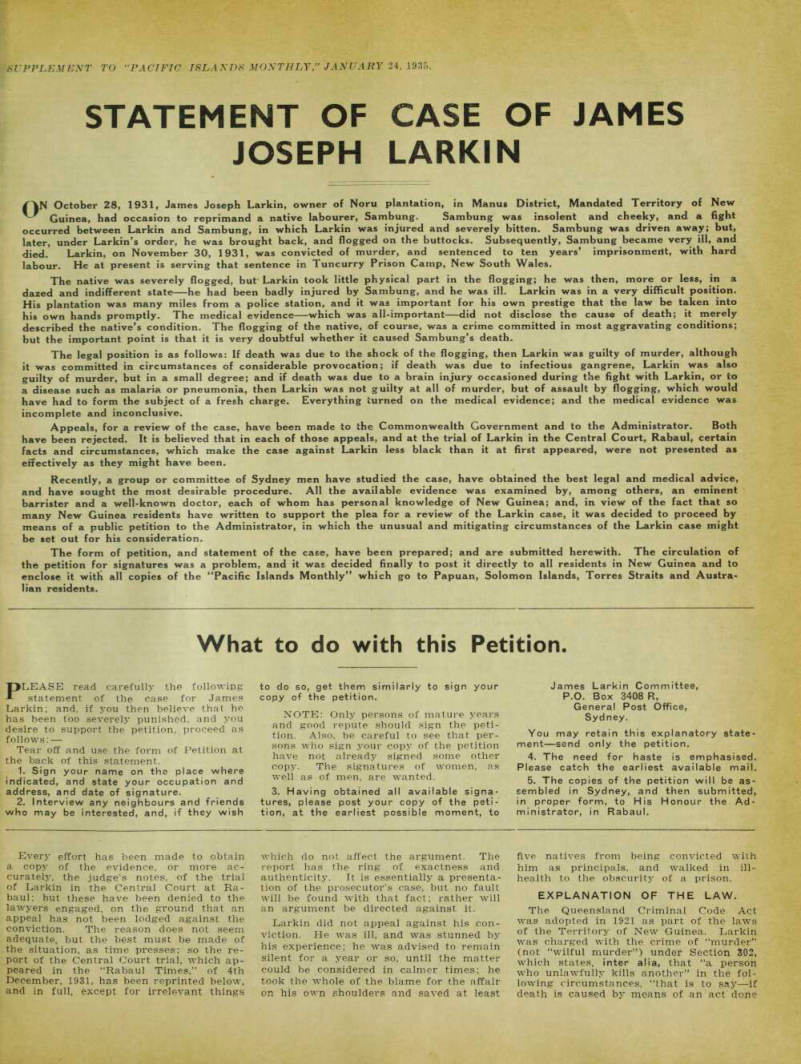
Statement Of Case Of James
October 28, 1931, James Joseph Larkin, owner of Noru plantation, in Manus District, Mandated Territory of New Guinea, had occasion to reprimand a native labourer, Sambung. Sambung was insolent and cheeky, and a fight occurred between Larkin and Sambung, in which Larkin was injured and severely bitten. Sambung was driven away; but, later, under Larkin’s order, he was brought back, and flogged on the buttocks. Subsequently, Sambung became very ill, and died. Larkin, on November 30, 1931, was convicted of murder, and sentenced to ten years’ imprisonment, with hard labour. He at present is serving that sentence in Tuncurry Prison Camp, New South Wales.
The native was severely flogged, but Larkin took little physical part in the flogging; he was then, more or less, in a dazed and indifferent state he had been badly injured by Sambung, and he was ill. Larkin was in a very difficult position.
His plantation was many miles from a police station, and it was important for his own prestige that the law be taken into his own hands promptly. The medical evidence —which was all-important—did not disclose the cause of death; it merely described the native’s condition. The flogging of the native, of course, was a crime committed in most aggravating conditions; but the important point is that it is very doubtful whether it caused Sambung’s death.
The legal position is as follows: If death was due to the shock of the flogging, then Larkin was guilty of murder, although it was committed in circumstances of considerable provocation; if death was due to infectious gangrene, Larkin was also guilty of murder, but in a small degree; and if death was due to a brain injury occasioned during the fight with Larkin, or to a disease such as malaria or pneumonia, then Larkin was not guilty at all of murder, but of assault by flogging, which would have had to form the subject of a fresh charge. Everything turned on the medical evidence; and the medical evidence was incomplete and inconclusive.
Appeals, for a review of the case, have been made to the Commonwealth Government and to the Administrator. Both have been rejected. It is believed that in each of those appeals, and at the trial of Larkin in the Central Court, Rabaul, certain facts and circumstances, which make the case against Larkin less black than it at first appeared, were not presented as effectively as they might have been.
Recently, a group or committee of Sydney men have studied the case, have obtained the best legal and medical advice, and have sought the most desirable procedure. All the available evidence was examined by, among others, an eminent barrister and a well-known doctor, each of whom has personal knowledge of New Guinea; and, in view of the fact that so many New Guinea residents have written to support the plea for a review of the Larkin case, it was decided to proceed by means of a public petition to the Administrator, in which the unusual and mitigating circumstances of the Larkin case might be set out for his consideration.
The form of petition, and statement of the case, have been prepared; and are submitted herewith. The circulation of the petition for signatures was a problem, and it was decided finally to post it directly to all residents in New Guinea and to enclose it with all copies of the “Pacific Islands Monthly” which go to Papuan, Solomon Islands, Torres Straits and Austra lian residents.