N. Guinea Goldfields
p. 58 · Read in the full issue
Notes
Edie Ck., Dec. 30.
NOAH had nothing on this part of the world for rain. For five weeks it has never ceased —during the last three days we had seven inches—and, in consequence, serious washaways have occurred on the road up from Wau. The motor lorries have had to suspend operations, and those who trekked to Wau for the festivities had to trek home again, only unlike “Peter Henry," they didn’t trek back down again. The climb up took five hours. Something should be done by the Government about this road —in its present condition it is definitely dangerous.
The manager of Day Dawn is busy supervising the installation of the new cyanide plant which will mean big things at the mine; an electric power scheme is also to be installed in the New Year.
Edie Creek Hotel, which is 7000 ft. above sea level and 4000 ft. above the malarial zone, put on a great show for the Xmas holidays—turkey, plum pudding, everything “a la Australia,” and in the evening blazing log fires and a dance made things merry.
By bush wireless we hear that young Moresby Gofton, son of Mrs. Stewart, of Wau is having a royal time down South. Moresby is 6ft. 2ins. and as he was born at the Port after which he is named, he is a good advertisement for the Territory.
Mrs. W. W. Clarke left for Sydney by the last mail-steamer and will be much missed from Kaindi until she returns about March.
Since the advent of “Snow” Blackley into the sporting life of the New Guinea goldfields things have been happening fast and furiously. Soon after his arrival he startled the populace by scor ing 145 n.o., of a total of 202 for Kaindi against Wau and then by taking six wickets was the means of Wau’s first defeat by Kaindi in the history of Morobe cricket. “Snow” topped the fowling averages for the season and for this feat received a trophy of a cricket bat.
It is difficult to say who are the more delighted with the latest innovation on the goldfields, the “boys” or the European settlers. Golden Ridges now has a golf course. It is a new interest and means lots of fun at little expense, except that in this rough country a ball is very likely to be lost at every hole.
Not so long ago a form of aerial golf was intro duced at the Aero Club in Sydney. The player in an aeroplane flew low over the course, dropped a golf ball with parachute attached, which when landed was played to the hole by the pilot’s ground partner. This might be a good idea for the Ridges.
A bit of tree lopping might help, or is New Guinea “air-minded” enough now?
Exploring New Guinea is indeed an expensive business. “Mick” Leahy spends £7 on a pair of boots from Sydney and £10 a pair for them from America, and they do not last six weeks. The
boots evidently resent the work of climbing mountains, braving treacherous rivers, and walk ing hundreds of miles, so they take the line of least resistance, and willingly give up the ghost.
Dave Lyall is now recuperating after a severe bout of duodenal ulcers, which meant weeks in the Wau Hospital. Dave is a friend to all on the goldfields and should he carry out his present plans of going South to take up aviation, he will be sadly missed.
Mr. W. H. Bird, who was appointed Patrol Officer of the New Guinea Service in 1932 and who had a fine record of efficient service, died at Salamaua from a severe bout of fever on January 15. He was married, his wife being at present in Auckland, N. Zealand.
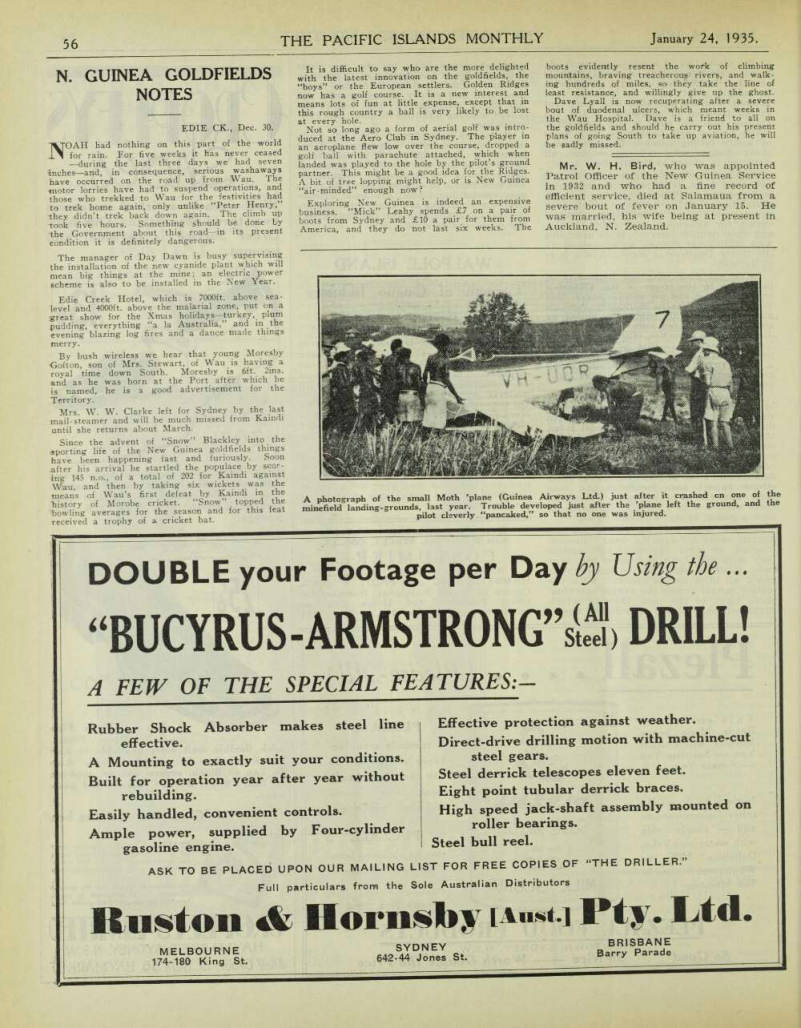
A photograph of the small Moth ’plane (Guinea Airways Ltd.) just after it clashed on one of the minefield landing-grounds, last year. Trouble developed just after the plane left the ground, and the pilot cleverly “pancaked,” so that no one was injured.