Evolution Of The
p. 39 · Read in the full issue
Fijians
Cannibals of 100 Years Ago Take Readily to New Agriculture
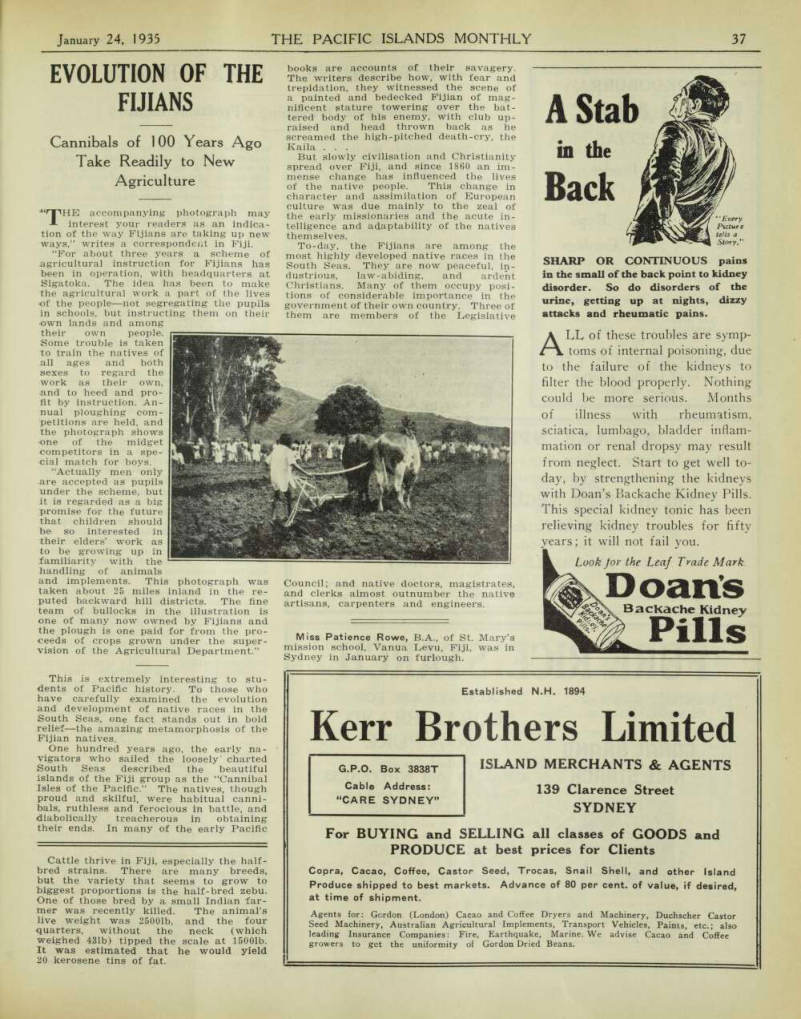
"THE accompanying photograph may interest your readers as an indica tion of the way Fijians are taking up new ways,” writes a correspondent in Fiji.
“For about three years a scheme of agricultural instruction for Fijians has been in operation, with headquarters at Sigatoka. The idea has been to make the agricultural work a part of the lives of the people—not segregating the pupils in schools, but instructing them on their own lands and among
their own people.
Some trouble is taken to train the natives of all ages and both sexes to regard the work as their own, to heed and pro fit by instruction. An nual ploughing com petitions are held, and the photograph shows one of the midget competitors in a spe cial match for boys.
“Actually men only are accepted as pupils under the scheme, but it is regarded as a big promise for the future that children should be so interested in their elders’ work as to be growing up in familiarity with the handling of animals
and implements. This photograph was taken about 25 miles inland in the re puted backward hill districts. The fine team of bullocks in the illustration is one of many now owned by Fijians and the plough is one paid for from the pro ceeds of crops grown under the super vision of the Agricultural Department.”
This is extremely interesting to stu dents of Pacific history. To those who have carefully examined the evolution and development of native races in the South Seas, one fact stands out in bold relief —the amazing metamorphosis of the Fijian natives.
One hundred years ago, the early na vigators who sailed the loosely charted South Seas described the beautiful islands of the Fiji group as the “Cannibal Isles of the Pacific.” The natives, though proud and skilful, were habitual canni bals, ruthless and ferocious in battle, and diabolically treacherous in obtaining their ends. In many of the early Pacific
books are accounts of their savagery.
The writers describe how, with fear and trepidation, they witnessed the scene of a painted and bedecked Fijian of mag nificent stature towering over the bat tered body of his enemy, with club up raised and head thrown back as he screamed the high-pitched death-cry, the Kaila . . .
But slowly civilisation and Christianity spread over Fiji, and since 1860 an im mense change has influenced the lives of the native people. This change in character and assimilation of European culture was due mainly to the zeal of the early missionaries and the acute in telligence and adaptability of the natives themselves.
To-day, the Fijians are among the most highly developed native races in the South Seas. They are now peaceful, in dustrious, law-abiding, and ardent Christians. Many of them occupy posi tions of considerable importance in the government of their own country. Three of them are members of the Legislative
Council; and native doctors, magistrates, and clerks almost outnumber the native artisans, carpenters and engineers.
Miss Patience Rowe, B.A., of St. Mary’s mission school, Vanua Levu, Fiji, was in Sydney in January on furlough.
Cattle thrive in Fiji, especially the half bred strains. There are many breeds, but the variety that seems to grow to biggest proportions is the half-bred zebu.
One of those bred by a small Indian far mer was recently killed. The animal’s live weight was 2500lb. and the four quarters, without the neck (which weighed 43lb) tipped the scale at 1500lb.
It was estimated that he would yield 20 kerosene tins of fat.