Why Suva Council Was Abolished
pp. 16-17 · Read in the full issue
Interesting Phase of the Indian Common Roll Problem
From Our Own Correspondent.
Suva, Dec. 24.
IN a world which is swinging rapidly from democracy to dictatorship, the micocosm which is Suva must needs re flect the spirit of the times.
One by one, the countries of Europe are discarding their systems of demago gic government for popular dictatorships —a reversion to the benevolent despotism of Elizabethan days. Thus the impending changes in the constitution of the Suva Municipal Council are not without in terest.
At present, the Suva Municipal Council consists of eight members elected by about 700 ratepayers of all nationalities, the franchise being given to any person who pays rates on any property within the town area, and who can read, speak and write the English language. Ten years ago the population, within this area was estimated at about 7000 —to-day, it has grown to nearer 13,000.
The necessary revenue for the admini stration of the various services of Suva is provided by a rate upon the unim proved capital value of the lands within the Municipality, and their value is es timated at over £ 500,000. The rate struck by the Council for 1935 was 8¼d in the £. The administration of the Council’s varied activities has been con ducted efficiently and economically and Suva, to-day can point with pride to many miles of tar macadam, with con
crete pavements or concrete kerbing; to an electricity undertaking which is treat ed as a commercial proposition and was rapidly paying itself off—although the price of current has been reduced year after year; and, above all, to the con tinual inspection which ensures that the many dwellings, etc. of the coloured population are kept in sanitary condition.
The total expenditure is in the neigh bourhood of £50,000 per annum, and the check on outgoings is so keen that rates have shown a yearly tendency to decline.
It is obvious that the ratepayers of Suva have been well served by their Municipal Councillors and staff. There is no suggestion that the present method of civic government has produced in efficiency or extravagance—definitely the reverse. Much credit must be given to these public spirited citizens who have occupied the Mayoral chair —names such as those of Sir Henry Scott, Sir Henry Marks, Mr. Grahame and the present Mayor, Honourable Alport Barker, come to one’s mind as those upon whom the responsibility for the direction of affairs has fallen.
What, therefore, is the reason for a change in the system? Broadly speaking, it is the necessity for broadening the present Municipal franchise by the in clusion of languages other than English in the qualifications test.
For the higher body, the Legislative Council, the principle of the inclusion of five Indian languages in the literacy test of electors has already been accepted and incorporated in the Letters Patent of the Colony. It could not, therefore, be denied in a subsidiary body.
The result of such a change is not difficult to gauge—the European popu lation of Suva has increased in ten years by perhaps a couple of hundred; but the Indian and other population has jumped well over a couple of thousands. As Sir Maynard Hedstrom said in Legislative Council: “I think there is no doubt that with the introduction of a bill to establish a Municipal Common Roll, the majority of the names on the electoral roll, within a period of five or six years, will be non- European.”
Even if the literacy test were not ex tended to include the Indian language, there can be no doubt that with the in creased facilities for learning English, the non-Europeans would in the course of a decade or two swamp the Europeans on the electoral roll of Suva.
What was the alternative? To scrap the present democratic system of govern ment by people for on and behalf of the people, and to revert to a system of gov ernment by bureaucracy. What a lovely dish to set before an Elected Legislative Council!
It takes more than courage to raise such an issue—it requires that discretion which is much more than valour to settle it peacefully. Sir Murchison Fletcher deserves to live in the history books of Fiji as the statesman who by the sheer logic of his arguments persuaded the people of Suva to give up governing themselves and to hand the job over to him —a remarkable achievement. The action of Sir Henry Scott in assembling the electors of Suva in the Town Hall, and pleading an obviously unpopular
cause, was noteworthy and decided the issue in the minds of most responsible folk.
However, the governor prudently left it to the three communities themselves to make their own choice of their municipal future government. On October, 1933, he told the European, Fijian and Indian communities, through their elected rep resentatives in the Legislative Council, that there were two alternatives: (a) The introduction of the Common Roll for electors in all Munici palities; or (b) The acceptance of government control of Municipalities through Municipal Councils with nomin ated representatives of the three communities.
He said it was impossible to allow matters to remain as they were, and that the communities must choose for them selves that alternative which they pre ferred. The government officials would take no part in the discussion, nor in the voting upon the decision.
The debate brought forth an interest ing expression of views. Four out of the six European members, and all three Fijian members plumped unhesitatingly for government control; the other Euro peans and the two Indian members, for widely different reasons, voted for the first alternative.
The Secretary of State has now been Informed of the decision of the Colony— for it is a decision in which the whole Colony is involved by reason of the major political issue (to have, or not to have, a Common Roll). Legislation will shortly be introduced abolishing the ex isting Municipal Councils and substitut ing in Suva a Municipal Commission of thirteen (what a tactful choice of num bers!) of which the chairman and six members will be government officials.
Two members each from the Fijian, European and Indian communities, se lected by the governor, will form the unofficial element.
And so Suva joins the rest of the world in voluntarily destroying her little demo cratic institution and setting up, of her own free will, her own little dictatorship!
Mr. Harry Hemus, travelling inspector for the well-known Auckland firm of A. B. Donald, Ltd., recently returned to New Zealand by the Makura, after a stay of several months in Tahiti.
Mr. Lewis Armstrong, general mana ger of Messrs. Burns Philp & Co., Ltd. returned to Sydney by the Monterey on December 3, after a trip to Europe and the United States.
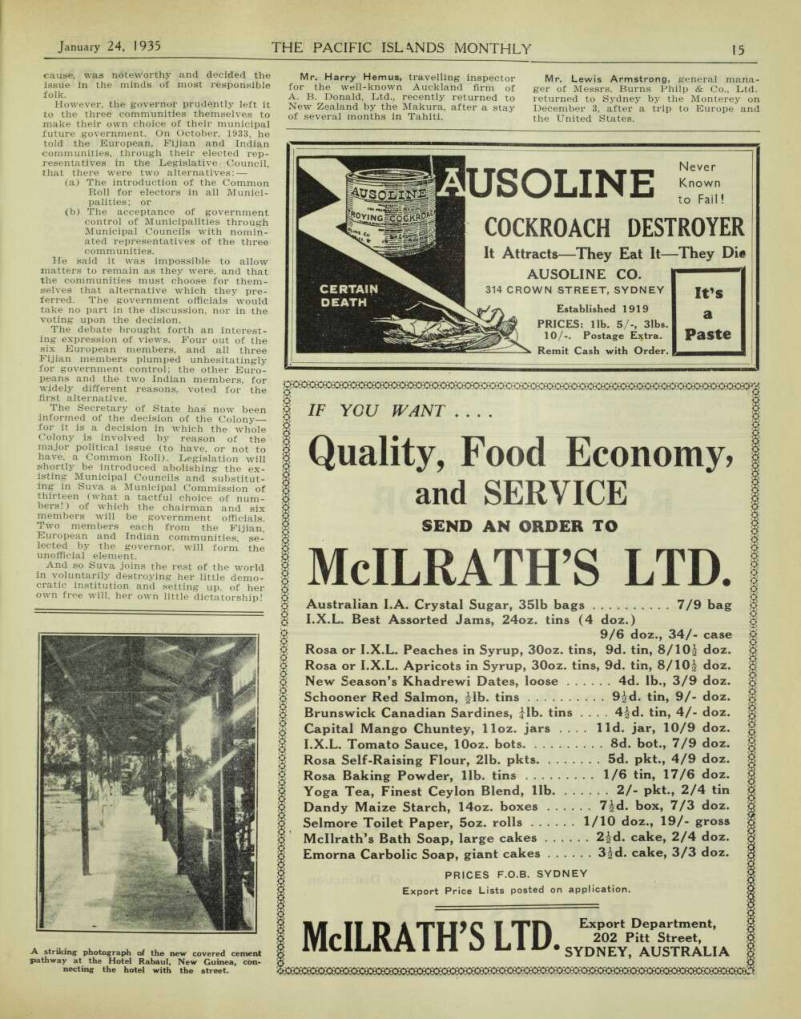
A striking photograph of the new covered cement pathway the Hotel Rabaul, New Guinea, con necting the hotel with the street.