to Sydney
p. 11 · Read in the full issue
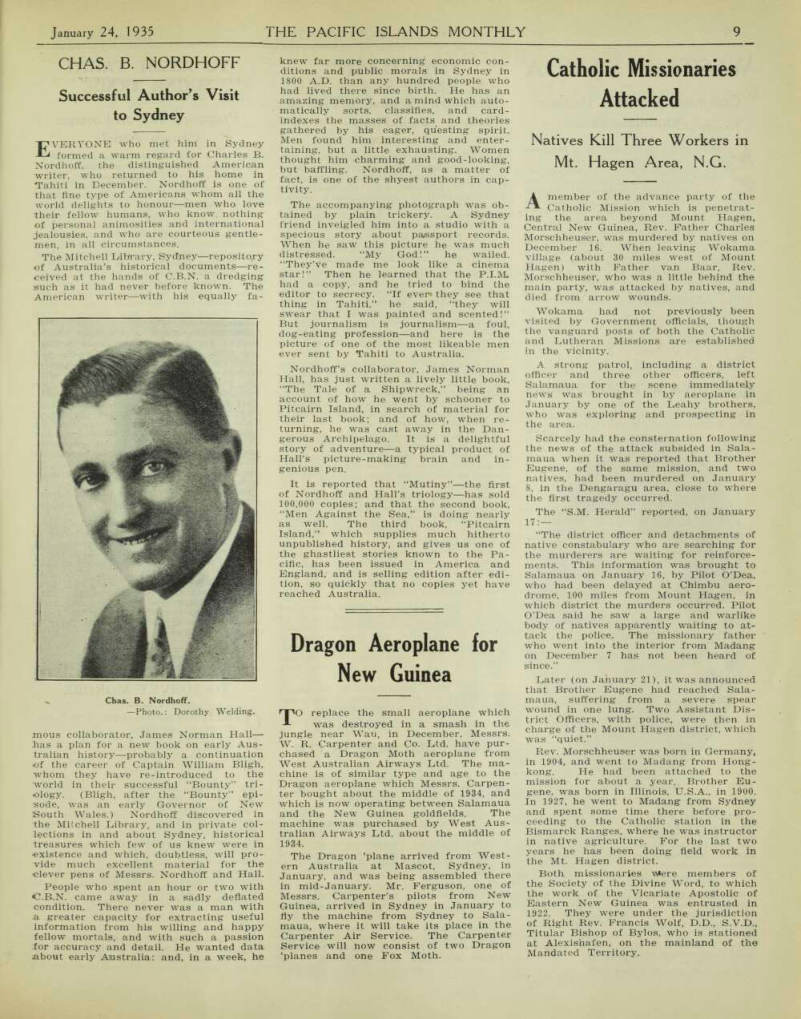
Chas. B. Nordhoff
Successful Author’s Visit to Sydney
EVERYONE who met him in Sydney formed a warm regard for Charles B.
Nordhoff, the distinguished American writer, who returned to his home in Tahiti in December. Nordhoff is one of that fine type of Americans whom all the world delights to honour —men who love their fellow humans, who know, nothing of personal animosities and international jealousies, and who are courteous gentle men, in all circumstances.
The Mitchell Library, Sydney—repository of Australia’s historical documents—re ceived at the hands of C.B.N. a dredging such as it had never before known. The American writer —with his equally fa-
mous collaborator, James Norman Hall— has a plan for a new book on early Aus tralian history—probably a continuation of the career of Captain William Bligh, whom they have re-introduced to the world in their successful “Bounty” tri ology. (Bligh, after the “Bounty” epi sode, was an early Governor of New South Wales.) Nordhoff discovered in the Mitchell Library, and in private col lections in and about Sydney, historical treasures which few of us knew were in existence and which, doubtless, will provide much excellent material for the clever pens of Messrs. Nordhoff and Hall.
People who spent an hour or two with C.B.N. came away in a sadly deflated condition. There never was a man with a greater capacity for extracting useful information from his willing and happy fellow mortals, and with such a passion tor accuracy and detail. He wanted data about early Australia: and, in a week, he
knew far more concerning economic con ditions and public morals in Sydney in 1800 A.D. than any hundred people who had lived there since birth. He has an amazing memory, and a mind which auto matically sorts, classifies, and card indexes the masses of facts and theories gathered by his eager, questing spirit.
Men found him interesting and enter taining, but a little exhausting. Women thought him charming and good-looking, but baffling. Nordhoff, as a matter of fact, is one of the shyest authors in cap tivity.
The accompanying photograph was ob tained by plain trickery. A Sydney friend inveigled him into a studio with a specious story about passport records.
When he saw this picture he was much distressed. “My God!” he wailed.
“They’ve made me look like a cinema star!” Then he learned that the P.I.M. had a copy, and he tried to bind the editor to secrecy. “If ever* they see that thing in Tahiti,” he said, “they will swear that I was painted and scented!”
But journalism is journalism—a foul, dog-eating profession—and here is the picture of one of the most likeable men ever sent by Tahiti to Australia.
Nordhoff’s collaborator, James Norman Hall, has just written a lively little book, “The Tale of a Shipwreck,” being an account of how he went by schooner to Pitcairn Island, in search of material for their last book; and of how, when re turning, he was cast away in the Dan gerous Archipelago. It is a delightful story of adventure —a typical product of Hall’s picture-making brain and in genious pen.
It is reported that “Mutiny”—the first of Nordhoff and Hall’s triology—has sold 100,000 copies; and that the second book, “Men Against the Sea,” is doing nearly as well. The third book, “Pitcairn Island,” which supplies much hitherto unpublished history, and gives us one of the ghastliest stories known to the Pa cific, has been issued in America and England, and is selling edition after edi tion, so quickly that no copies yet have reached Australia.
Chas. B. Nordhoff. —Photo.: Dorothy Welding.