To Develop Dutch New Guinea
Plans of the New Guinea Committee
CONSIDERABLE activity is being dis played by the New Guinea Commit tee, which was appointed during the past year to encourage the development of Dutch New Guinea, and the headquarters of which are at The Hague, Holland.
The Committee is doing everything possible to encourage private enterprise to investigate and develop the immense and hitherto unexploited wealth of Dutch New Guinea.
An agreement has now been approved by the Government of the Netherland East Indies under which three of the big gest oil companies in the world have been permitted, under Government super vision, to form a company for the de velopment of the oil resources of the north-western portion of Dutch New Guinea. This region is in the shape of a vast peninsula, and it is believed that within its borders are very large natural reservoirs of mineral oil. The three com panies, who have formed what is called the New Guinea Oil Company, are the Shell Co. (which has large Dutch con nections), the Standard Oil Co. of New York, and the Atlantic Oil Co. (which is known in Java as the Colonial Petrol Co.). It is understood that the New Guinea Oil Co. will lose no time in under taking the exploitation of the area over which it has just secured this valuable concession.
Dr. W. C. Klein, who was formerly a well-known technologist in the service of the Shell Co., from which he has now retired, has made arrangements with the New Guinea Committee, under which he will carry out an economic and scientific survey of portion of Dutch New Guinea.
It is expected that Dr. Klein will arrive in Port Moresby by the Van Spilbergen in May and will travel in parts of Papua so as to familiarise himself with structures there. He will then proceed to Dutch
New Guinea, with a view to carefully looking over that country. His primary purpose is to find oil indications, but he will also keep a look out for indications of gold. The New Guinea Committee expects that Dr. Klein’s investigations and reports will be very valuable.
Important investigations were made last year by Mr. P. J. Jansen, who also worked under the auspices of the New Guinea Committee. Mr. Jansen’s main object was to find indications of gold in Dutch New Guinea; and in that connec tion he visited the Morobe goldfield, in the Mandated Territory of New Guinea, and studied structures and mining methods. Mr. Jansen’s report has not yet been issued.
It is understood that the Biliton Tin Company, which is an important cor poration interested in mining develop ment, is making an investigation in the north-eastern portion of Dutch New Guinea near the border of the Mandated Territory, with a view to locating the goldfield which is believed to exist there.
The New Guinea Committee is anxious to encourage private enterprise from all nations to make investigations and seek concessions in Dutch New Guinea. In that connection, it is likely to advance considerably during 1935 the plans for making a survey of this comparatively unknown region by means of aeroplanes.
The only foreign country which, up to date, has shown any interest in Dutch New Guinea is Japan. Already consider able numbers of Japanese are settled along the northern coast of Dutch New Guinea, where they are exploiting the country’s natural wealth. The Japanese are giving attention particularly to the marine and forest wealth of the country —and they are making a considerable success of the exportation of the valuable resin of the Dammar tree.
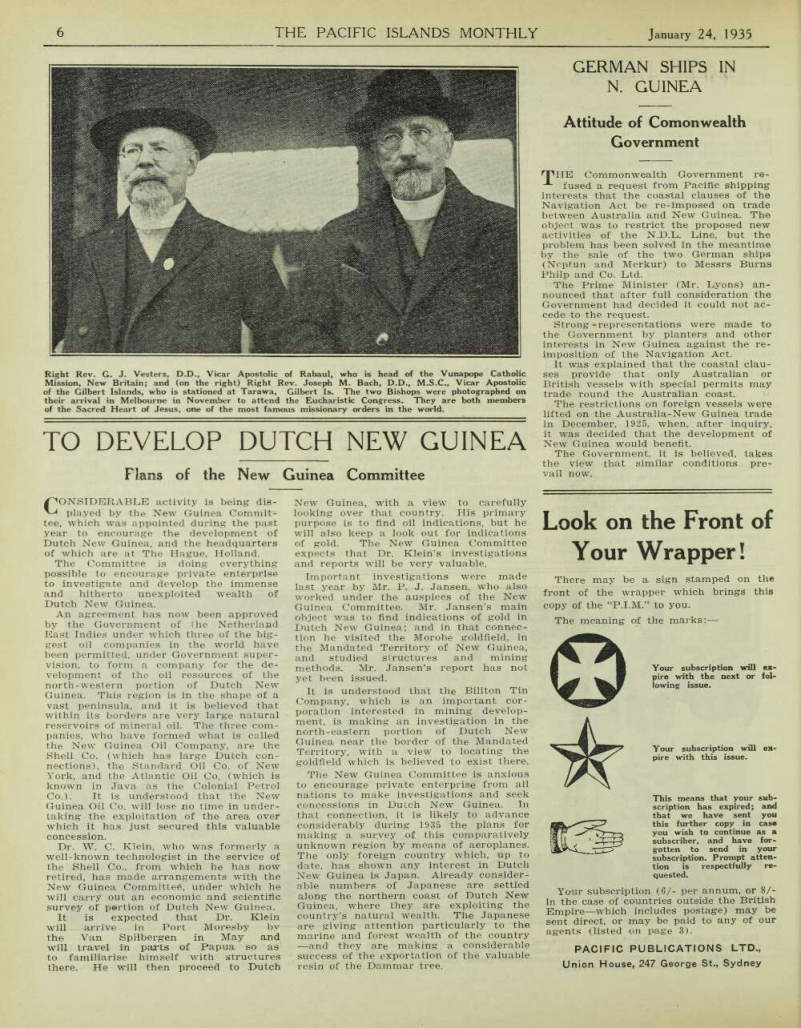
Right Rev. G. J. Vesters, D.D., Vicar Apostolic of Rabaul, who is head of the Vunapope Catholic Mission, New Britain; and (on the right) Right Rev. Joseph M. Bach, D.D., M.S.C., Vicar Apostolic of the Gilbert Islands, who is stationed at Tarawa, Gilbert Is. The two Bishops were photographed on their arrival in Melbourne in November to attend the Eucharistic Congress. They are both members of the Sacred Heart of Jesus, one of the most famous missionary orders in the world.