Mariner Of Tonga
pp. 26-29 · Read in the full issue
His Grandson is Resident of Sydney
By Eric Ramsden
AN interesting link with one of the most colourful characters in Pacific his tory is preserved by the descent of Mr. H.
McCulloch, a resident of Mosman, from William Charles Mariner, whose name will always be associated with Tonga.
Collectors of Pacific literature are always proud to possess a copy of Mariner’s “Tonga” in their libraries. Mr. McCulloch is the proud possessor of two volumes of that prized work in which his gandfather had inscribed his name. Curiously enough, the books were purchased in the second hand department of a Sydney bookshop.
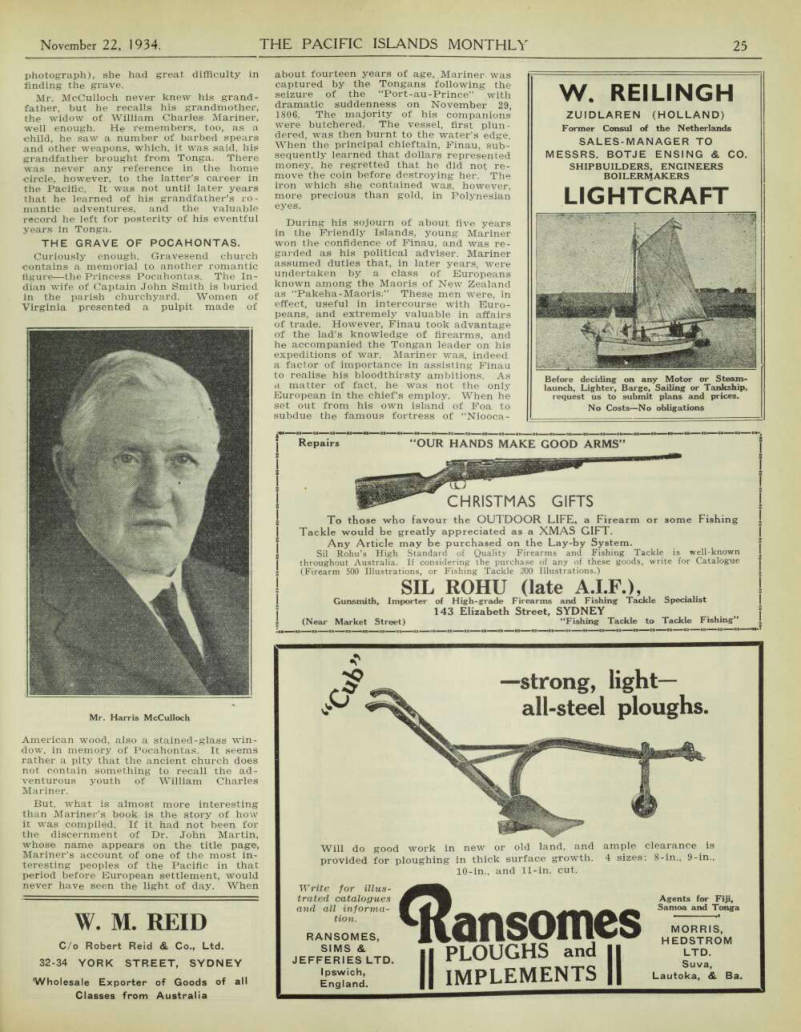
William Charles Mariner, when his body was recovered from the River Thames in 1858, was buried in a cemetery in Gravesend, not far from London. There is no inscription on his tomb to suggest his early association with Tonga. It would be a graceful action on the part of the Tongan Government if it placed an appropriately-worded tablet on the grave, particularly as the Prime Minister, Prince Tugi (Consort of Queen Salote), is said to be a direct descendant of the chieftain Finau, who befriended Mariner following the massacre of the majority of the mem bers of the crew of the “Port-au-Prince” in 1806. To-day, the visitor to the grave yard might pass the Mariner plot, un aware of the romantic career of the man buried there. Indeed, when one of Mr.
McCulloch’s relatives sought for it some time ago (to obtain the accompanying
A photograph of the headstone over Mariner’s grave, Gravesend, England.
photograph), she had great difficulty in finding the grave.
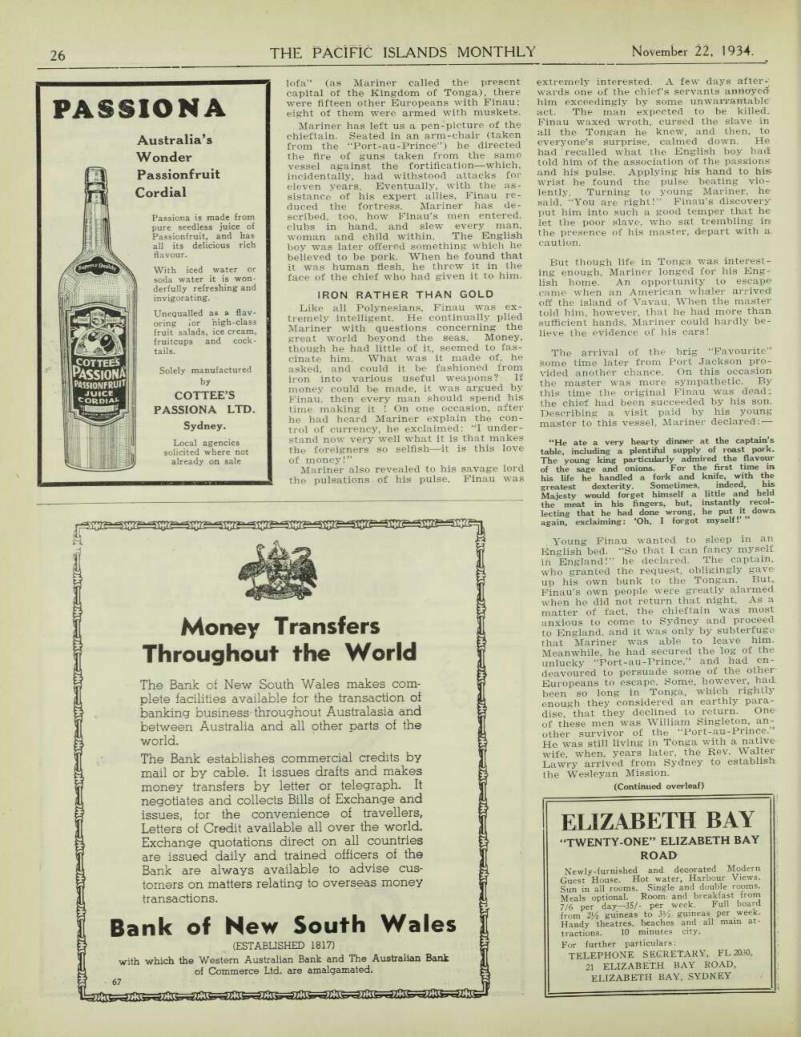
Mr. McCulloch never knew his grand father, but he recalls his grandmother, the widow of William Charles Mariner, well enough. He remembers, too, as a child, he saw a number of barbed spears and other weapons, which, it was said, his grandfather brought from Tonga. There was never any reference in the home circle, however, to the latter’s career in the Pacific. It was not until later years that he learned of his grandfather’s ro mantic adventures, and the valuable record he left for posterity of his eventful years in Tonga.
The Grave Of Pocahontas.
Curiously enough, Gravesend church contains a memorial to another romantic figure—the Princess Pocahontas. The In dian wife of Captain John Smith is buried in the parish churchyard. Women of Virginia presented a pulpit made of
American wood, also a stained-glass win dow, in memory of Pocahontas. It seems rather a pity that the ancient church does not contain something to recall the ad venturous youth of William Charles Mariner.
But, what is almost more interesting than Mariner’s book is the story of how it was compiled. If it had not been for the discernment of Dr. John Martin, whose name appears on the title page, Mariner’s account of one of the most in teresting peoples of the Pacific in that period before European settlement, would never have seen the light of day. When
about fourteen years of age, Mariner was captured by the Tongans following the seizure of the “Port-au-Prince” with dramatic suddenness on November 29, 1806. The majority of his companions were butchered. The vessel, first plun dered, was then burnt to the water’s edge.
When the principal chieftain, Finau, sub sequently learned that dollars represented money, he regretted that he did not re move the coin before destroying her. The iron which she contained was, however, more precious than gold, in Polynesian eyes.
During his sojourn of about five years in the Friendly Islands, young Mariner won the confidence of Finau, and was re garded as his political adviser. Mariner assumed duties that, in later years, were undertaken by a class of Europeans known among the Maoris of New Zealand as “Pakeha-Maoris.” These men were, in effect, useful in intercourse with Euro peans, and extremely valuable in affairs of trade. However, Finau took advantage of the lad’s knowledge of firearms, and he accompanied the Tongan leader on his expeditions of war. Mariner was, indeed a factor of importance in assisting Finau to realise his bloodthirsty ambitions. As a matter of fact, he was not the only European in the chief’s employ. When he set out from his own island of Foa to subdue the famous fortress of “Niooca
Mr. Harris McCulloch
lofa” (as Mariner called the present capital of the Kingdom of Tonga), there were fifteen other Europeans with Finau: eight of them were armed with muskets.
Mariner has left us a pen-picture of the chieftain. Seated in an arm-chair (taken from the “Port-au-Prince”) he directed the fire of guns taken from the same vessel against the fortification —which, incidentally, had withstood attacks for eleven years. Eventually, with the as sistance of his expert allies, Finau re duced the fortress. Mariner has de scribed. too, how Finau’s men entered, clubs in hand, and slew every man, woman and child within. The English boy was later offered something which he believed to be pork. When he found that it was human flesh, he threw it in the face of the chief who had given it to him.
Iron Rather Than Gold
Like all Polynesians, Finau was ex tremely intelligent. He continually plied Mariner with questions concerning the great world beyond the seas. Money, though he had little of it, seemed to fas cinate him. What was it made of, he asked, and could it be fashioned from iron into various useful weapons? If money could be made, it was argued by Finau. then every man should spend his time making it ! On one occasion, after he had heard Mariner explain the con trol of currency, he exclaimed: “I under stand now very well what it is that makes the foreigners so selfish —it is this love of money!”
Mariner also revealed to his savage lord the pulsations of his pulse. Finau was
extremely interested. A few days after wards one of the chief’s servants annoyed him exceedingly by some unwarrantable act. The man expected to be killed.
Finau waxed wroth, cursed the slave in all the Tongan he knew, and then, to everyone’s surprise, calmed down. He had recalled what the English boy had told him of the association of the passions and his pulse. Applying his hand to his wrist he found the pulse beating vio lently. Turning to young Mariner, he said, “You are right!” Finau’s discovery put him into such a good temper that he let the poor slave, who sat trembling in the presence of his master, depart with a caution.
But though life in Tonga was interest ing enough, Mariner longed for his Eng lish home. An opportunity to escape came when an American whaler arrived off the island of Vavau. When the master told him, however, that he had more than sufficient hands, Mariner could hardly be lieve the evidence of his ears!
The arrival of the brig “Favourite" some time later from Port Jackson pro vided another chance. On this occasion the master was more sympathetic. By this time the original Finau was dead; the chief had been succeeded by his son.
Describing a visit paid by his young master to this vessel, Mariner declared: “He ate a very hearty dinner at the captain’s table, including a plentiful supply of roast pork.
The young king particularly admired the flavour of the sage and onions. For the first tune in his life he handled a fork and knife, with the greatest dexterity. Sometimes, indeed, his Majesty would forget himself a little and held the meat in his fingers, but, instantly recol lecting that he had done wrong, he put it down again, exclaiming: ‘Oh, I forgot myself!
Young Finau wanted to sleep in an English bed. “So that I can fancy myself in England!” he declared. The captain, who granted the request, obligingly gave up his own bunk to the Tongan. But, Finau’s own people were greatly alarmed when he did not return that night. As a matter of fact, the chieftain was most anxious to come to Sydney and proceeds to England, and it was only by subterfuge that Mariner was able to leave him.
Meanwhile, he had secured the log of the unlucky “Port-au-Prince,” and had en deavoured to persuade some of the other- Europeans to escape. Some, however, had been so long in Tonga, which rightly enough they considered an earthly para dise, that they declined to return. One of these men was William Singleton, an other survivor of the “Port-au-Prince.”
He was still living in Tonga with a native wife, when, years later, the Rev. Walter Lawry arrived from Sydney to establish, the Wesleyan Mission. (Continued overleaf)
“Port-Au-Prince” Survivor
Singleton is the subject of comment in several of Mr. Lawry’s letters preserved in the Hassall Correspondence in the Mitchell Library. In one, dated October 3, 1822, he mentioned Mariner’s account of Tonga. “I suppose the Tonga islands are some of the richest and prettiest in the world,” he commented in a letter to his brother-in-law, the Rev. Thomas Hassall, of Cobbitty. “Mr. Mariner’s ac count is far from a ‘Panegyriek’ that the half of Tonga’s Excellencies has not been told in his books. . . ” Singleton, he added, told him that in the wars prior to his arrival, “50,000 people fell in one week.” That rather sounds as if the ex sailor had been, to use a common phrase, pulling the missionary’s leg!
Mariner’s return to England quite natu rally excited considerable interest. A Dr.
Martin desired to test some of Mariner’s statements. So he arranged a meeting with another escapee, one Jeremiah Hig gins. “When they spoke the Tongan lan guage,” he declared, “I at once noticed the similarity of the pronunciation.” At the request of Martin, Mariner promised he would make some notes concerning his stay in Tonga, “in order that his memory might spontaneously furnish more.” He returned from a voyage to the West Indies with “a description of the more important religious ceremonies, and a vocabulary of between 4000 and 5000 words.”
Eventually, it was resolved that Dr.
Martin should undertake the composition and arrangement of the work he had in mind, while Mariner directed his atten tion “to the materials, noting down all that he had seen and heard such as had occurred to his mind.” Higgins was also called in to give the benefit of his mem ory. The result was one of the most fascinating records in the history of Pacific literature, a record, too,, that has since been of the utmost value to scien tists and other investigators. Mariner is still quoted. Only recently I came across references to his work in a critical study of Polynesian music by Johannes Ander sen, in the “Journal” of the Polynesian Society.
Mariner’s subsequent career in England does not appear to have been particularly interesting. His grandson says that he believed Mariner had an office in Throg morton Street, London, and was in busi ness as a stockbroker. The family lived for many years in Gravesend after his death.
The “Mataram” left Papua on Septem ber 28 for Cairns, Brisbane and Sydney.
The following cargo was taken from Port Moresby: 764 cases of desiccated coco nut, 1015 packages of rubber, 168 bags of coffee, and 200 bundles of sandalwood.