Tropicalities
p. 13 · Read in the full issue
HENRY DEXTER, of Milne Bay, Papua —now migrating Englandwards—told us that he overheard this in Tom McCrann’s hotel, in Port Moresby in 1910: Matt Crowe to Bill Sheehan (the local baker); “So you’re against the Govern ment, Bill?”
“Av coorse I’m agin the Government, Matt!”
“And are you in favor of Home Rule Bill?”
“Av coorse I’m in favor of Home Rule.
Matt! ”
“And if Home Rule was brought in, would you be agin the Government, Bill?”
“Av coorse I’d be agin the Govern ment, Matt!” * * * Writing to renew his subscription to the P.I.M.. an old Island trader adds: “Our mail usually arrives late on Satur day night. Two oldtimers usually blow along on Sunday morning. There are no less than nine publications to choose from. But I wish I could pick the win ner of the Melbourne Cup as easily as I can guess which of the above nine will be monopolised for the next hour —it is in variably my two copies of the P.I.M.” * * * TWO curious proclamations are made in the Western Pacific High Commission Gazette of September 26. They are in identical terms, except that one refers to the Solomon Islands, and the other to the Gilbert and Ellice Islands Colony. They mean, in ordinary language, that it is now unlawful to ship munitions of war and aeroplanes, or parts thereof, from the Solo mon or Gilbert and Ellice Islands to Bo livia and Paraguay. There is no smoke without fire. Who is the enterprising trader who has been countering the copra market depression by selling war material to the South American republics? Or have those quiet islands been used as transhipment ports by European dealers in munitions?
Stranger things have happened. Firms in Tahiti, during American prohibition, made tens of thousands of pounds by acting as transhipment agents for international
bootleggers.”
* * * I ASKED Frank Pryke the other day how Edie Creek got its name. He thought it was a mutilation of a native name— "Eti” or “Eudi.” Mr. Pryke, however, gave me with more certainty the origin of another name—he said that it was old Matt Crowe who christened the discoverer of Edie Creek “Sharkeye”
Park. * * * THE following sentences, which refer to the vessel upon which Western Samoa depends mainly for its communica tion with the outside world, are taken from a letter written by an Australian to a friend in the East Indies, and submitted to editor of this journal: The Maui Pomare is a perfectly wretched vessel owned by the New Zea land Government. It is the most poorly equipped passenger ship on which I have ever travelled; and the quantity and quality of the food are extremely poor.
You people believe in good food and plenty of it; the New Zealand Govern merit believes in poor food and little of it. And fancy having the lavatory next door to the pantry!”
“THE King of Apamama said it all when he divided the whites into three classes: ‘First, him cheat a litty; second, him cheat plenty; and, third, him cheat too much.’ ” —From Frederick O’Brien’s “Mystic Isles.” * * * AFTER completing his usual pains taking preparations. Sir Charles Kingsford Smith, accompanied by Cap tain P. G. Taylor as navigator, left Brisbane for Suva early on October 21, in the Lady Southern Cross on the first hop of a trans-Pacific flight to San Francisco, America. He landed safely at Albert Park, Suva, the same evening.
The airmen left Suva on October 24 for Naselai Beach, Fiji, where they were to take off on the second hop to Hono lulu. Exceedingly bad weather, how ever, delayed their departure for several days. Leaving Naselai for Hawaii on October 29, they covered the 3150 miles hop in 25 hours.
The final hop was completed when the Lady Southern Cross left Hawaii on Saturday, November 3, and landed at Oakland, California, the following morn ing after an eventless flight. * * * AN appeal to the Commonwealth Government and the New Guinea Administration for a remission of part of the sentence of ten years’ imprison ment imposed on James Larkin has been prepared, and will be submitted, probably in the form of a petition.
The facts of the case, and of several other cases which have a bearing upon the Larkin case, have been very care fully examined set out, and the point is made that, whatever may have been the circumstances when the sen tence was imposed, a good deal has happened in the last two or three years to justify a review of the sentence.
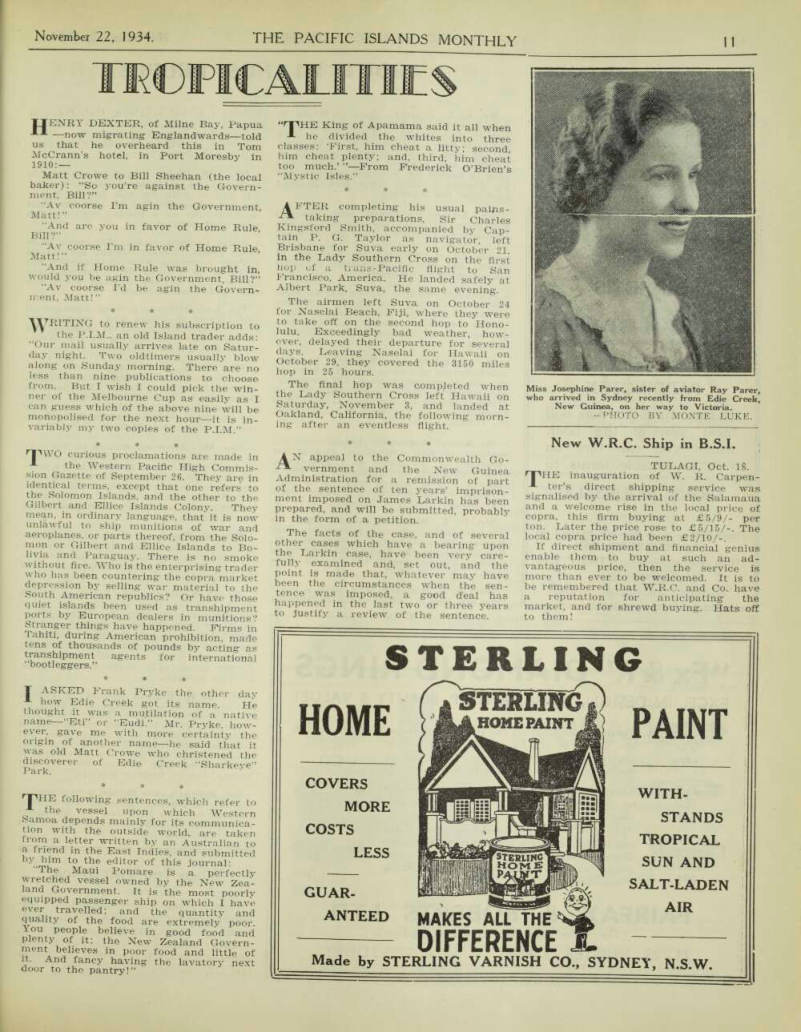
Miss Josephine Parer, sister of aviator Ray Parer, who arrived in Sydney recently from Edie Creek, New Guinea, on her way to Victoria.