Tahitian Chief’S
pp. 60-61 · Read in the full issue
Bravery
When “Ville de Papeete” Was Wrecked in Tuamotu Archipelago
From Our Own Correspondent.
PAPEETE, August 6.
OUR newly inaugurated inter-island steamer service, which was only just beginning to be properly appreciated, has been brought to an abrupt standstill by the wreck of the “Ville de Papeete” in the Tuamotu Archipelago. The catastrophe occurred late in the night of July 8 in nasty weather, apparently, the commence ment of the tempest of which Papeete was
advised by the “City of Los Angeles,” when the vessel was proceeding from Hikuoru to Anaa.
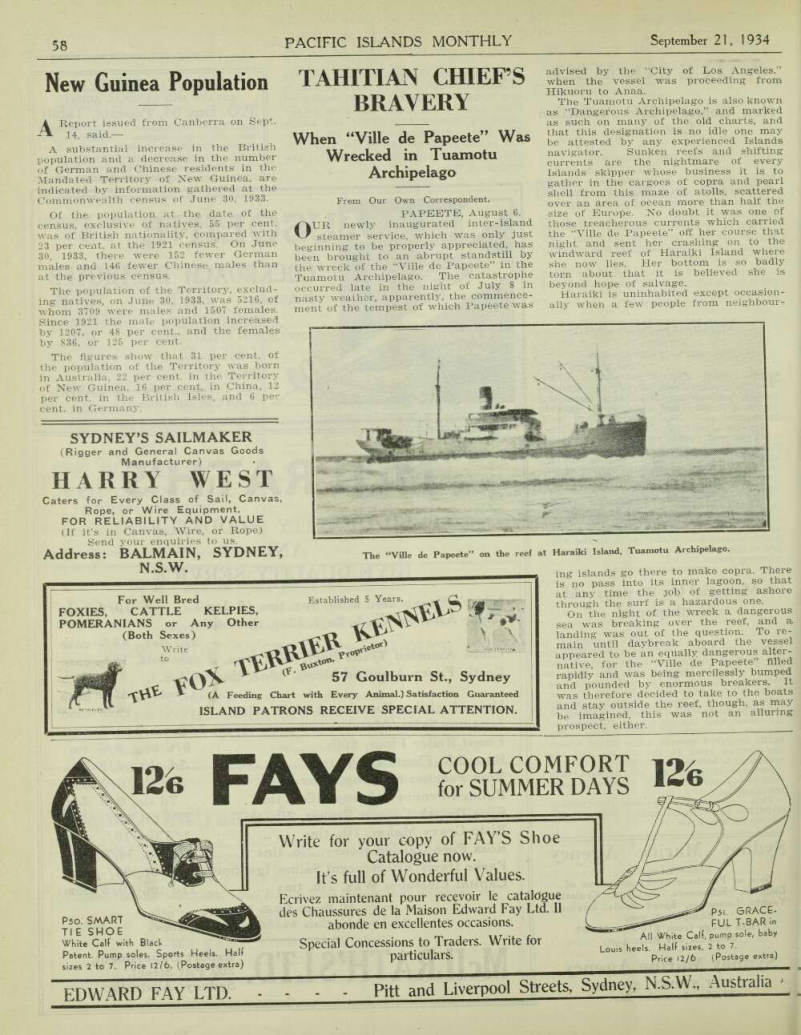
The Tuamotu Archipelago is also known as “Dangerous Archipelago,” and marked as such on many of the old charts, and that this designation is no idle one may be attested by any experienced Islands navigator. Sunken reefs and shifting currents are the nightmare of every Islands skipper whose business it is to gather in the cargoes of copra and pearl shell from this maze of atolls, scattered over an area of ocean more than half the size of Europe. No doubt it was one of those treacherous currents which carried the “Ville de Papeete” off her course that night and sent her crashing on to the windward reef of Haraiki Island where she now lies. Her bottom is so badly torn about that it is believed she is beyond hope of salvage, Haraiki is uninhabited except occasion ally when a few people from neighbour-
ing islands go there to make copra. There is no pass into its inner lagoon, so that at any time the job of getting ashore through the surf is a hazardous one.
On the night of the wreck a dangerous sea was breaking over the reef, and a landing was out of the question. To re main until daybreak aboard the vessel appeared to be an equally dangerous alter native, for the “Ville de Papeete” filled rapidly and was being mercilessly bumped and pounded by enormous breakers. It was therefore decided to take to the boats and stay outside the reef, though, as may be imagined, this was not an alluring prospect, either.
The “Ville de Papeete” on the reef at Haraiki Island, Tuamotu Archipelago.
The disembarkation of the vessel’s per sonnel and her dozen passengers was very capably and courageously managed by Capt. Vincent and Capt. L’Hotellier (super cargo for the Messageries Company).
With one exception, a mechanic, who sus tained some minor injuries, the whole party was successfully got into the boats and beyond the reach of immediate dan ger, though the situation was still any thing but an enviable one. For their fine behaviour throughout the disembarkment the following members of the ship’s per sonnel deserve special mention: Captain L’Hotellier, Captain Faivre (second cap tain), M. Snow (wireless operator), M.
Flosse (purser), M. Perreau (chief en gineer), and loria lori (mate).
The following dawn revealed an ugly and menacing reef which no ordinary man would dare to tackle; but, luckily for the people in the boats, one of the passengers was Nohorai Sue, the Chief of Hikueru, a fine type of native of the old school, who, like all Tuamotu natives, is as much at home in the sea as on land.
Nohorai Sue took a cord, and, watching his chance, was shot over the craggy reef of Haraiki on the crest of a comber. He swam the intervening distance to the shore and took a bight around the nearest coconut tree. After this it was a com paratively easy matter to haul a good sized cable ashore, by means of which the whole party eventually were landed. The conspicuous courage displayed by the brave Chief of Hikuaru has been officially recognised by the Government.
When the news of the wreck reached Papeete, the schooner Huahutu was des patched at once to the scene, and brought the whole party away, none the worse for their adventure.
The interruption of this much needed service owing to the wreck naturally has caused a good deal of local concern, for it is known that a considerable number of tourists were awaiting the return of the vessel in order feo make a tour of the Leeward Group and other places of in terest. Representations have been made on the subject to the Government by seve ral public bodies, including the Chamber of Agriculture, the Economic and Finan cial Delegation, and the Syndicate dTni tiative (Tourist Bureau). The Messageries Maritimes Company is at present actively engaged with the problem of finding a substitute vessel for the “Ville de Papeete” and it is hoped that a definite announce ment will be made shortly.
The “Ville de Papeete” is a steel screw coal burning steamer of 615 tons gross, and was built by the Ailsa Shipbuilding Company at Troon, Scotland, in 1928; she was classed 100 A.I. at Lloyds. At the time of the wreck she had on board about 115 tons of copra which were covered by insurance.