Samoan Mau
p. 56 · Read in the full issue
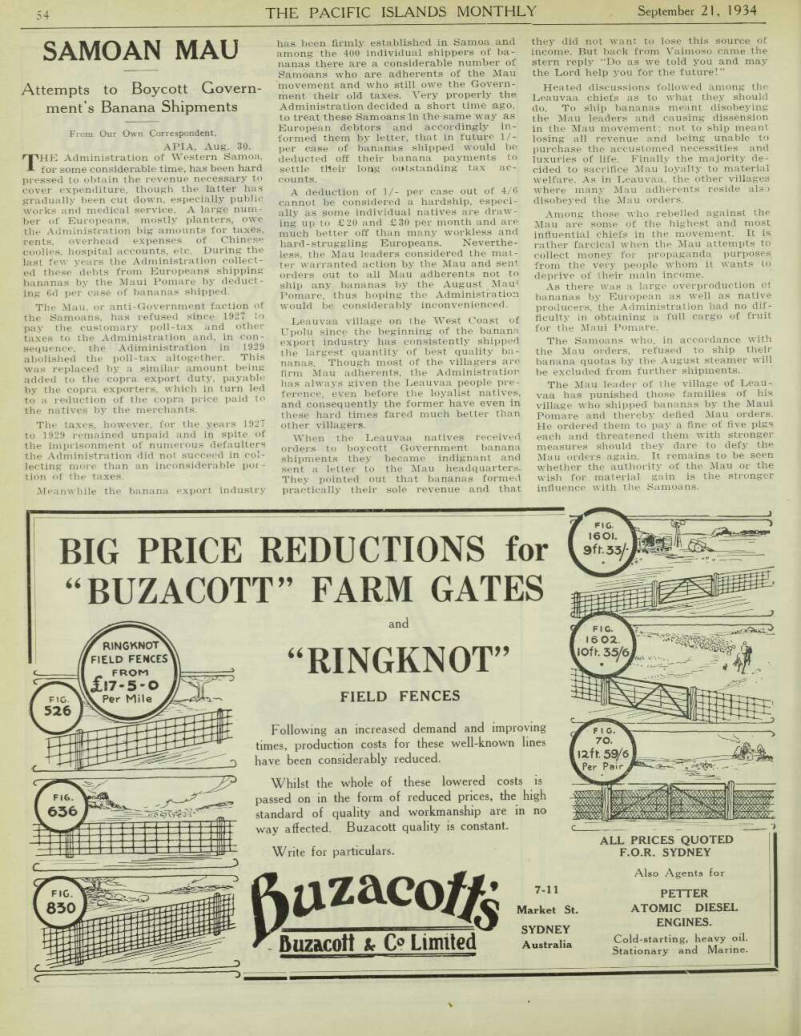
Attempts to Boycott Govern ment’s Banana Shipments
From Our Own Correspondent.
Apia, Aug. 30.
THE Administration of Western Samoa, for some considerable time, has been hard pressed to obtain the revenue necessary to cover expenditure, though the latter has gradually been cut down, especially public works and medical service. A large num ber of Europeans, mostly planters, owe the Administration big amounts for taxes, rents, overhead expenses of Chinese coolies, hospital accounts, etc. During the last few years the Administration collect ed these debts from Europeans shipping bananas by the Maui Pomare by deduct ing 6d per case of bananas shipped.
The Mau, or anti-Government faction of the Samoans, has refused since 1927 to pay the customary poll-tax and other taxes to the Administration and, in con sequence, the Adiministration in 1929 abolished the poll-tax altogether. This was replaced by a similar amount being added to the copra export duty, payable by the copra exporters, which in turn led to a reduction of the copra price paid to the natives by the merchants.
The taxes, however, for the years 1927 to 1929 remained unpaid and in spite of the imprisonment of numerous defaulters the Administration did not succeed in col lecting more than an inconsiderable por tion of the taxes.
Meanwhile the banana export industry
has been firmly established in Samoa and among the 400 individual shippers of ba nanas there are a considerable number of Samoans who are adherents of the Mau movement and who still owe the Govern ment their old taxes. Very properly the Administration decided a short time iago, to treat these Samoans in the same way as European debtors and accordingly in formed them by letter, that in future 1/per case of bananas shipped would be deducted off their banana payments to settle tlleir long outstanding tax ac counts.
A deduction of 1/- per case out of 4/6 cannot be considered a hardship, especi ally as some individual natives are draw ing up to £20 and £30 per month and are much better off than many workless and hard-struggling Europeans. Neverthe less, the Mau leaders considered the mat ter warranted action by the Mau and sent orders out to all Mau adherents not to ship any bananas by the August Maui Pomare, thus hoping the Administration would be considerably inconvenienced.
Leauvaa village on the West Coast of Upolu since the beginning of the banana export industry has consistently shipped the largest quantity of best quality ba nanas. Though most of the villagers are firm Mau adherents, the Administration has always given the Leauvaa people pre ference, even before the loyalist natives, and consequently the former have even in these hard times fared much better than other villagers.
When the Leauvaa natives received orders to boycott Government banana shipments they became indignant and sent a letter to the Mau headquarters.
They pointed out that bananas formed practically their sole revenue and that
they did not want to lose this source of income. But back from Vaimoso came the stern reply “Do as we told you and may the Lord help you for the future!”
Heated discussions followed among the Leauvaa chiefs as to what they should do. To ship bananas meant disobeying the Mau leaders and causing dissension in the Mau movement; not to ship meant losing all revenue and being unable to purchase the accustomed necessities and luxuries of life. Finally the majority de cided to sacrifice Mau loyalty to material welfare. As in Leauvaa, the other villages where many Mau adherents reside also disobeyed the Mau orders.
Among those who rebelled against the Mau are some of the highest and most influential chiefs in the movement. It is rather farcical when the Mau attempts to collect money for propaganda purposes from the very people whom it wants to deprive of their main income.
As there was a large overproduction of bananas by European as well as native producers, the Administration had no dif ficulty in obtaining a full cargo of fruit for the Maui Pomare.
The Samoans who. in accordance with the Mau orders, refused to ship their banana quotas by the August steamer will be excluded from further shipments.
The Mau leader of the village of Leau vaa has punished those families of his village who shipped bananas by the Maui Pomare and thereby defied Mau orders.
He ordered them to pay a fine of five pigs each and threatened them with stronger measures should they dare to defy the Mau orders again. It remains to be seen whether the authority of the Mau or the wish for material gain is the stronger influence with the Samoans.