To Colonise Lonely Sunday Is.
p. 32 · Read in the full issue
New Zealand Group’s Ambitious Plans
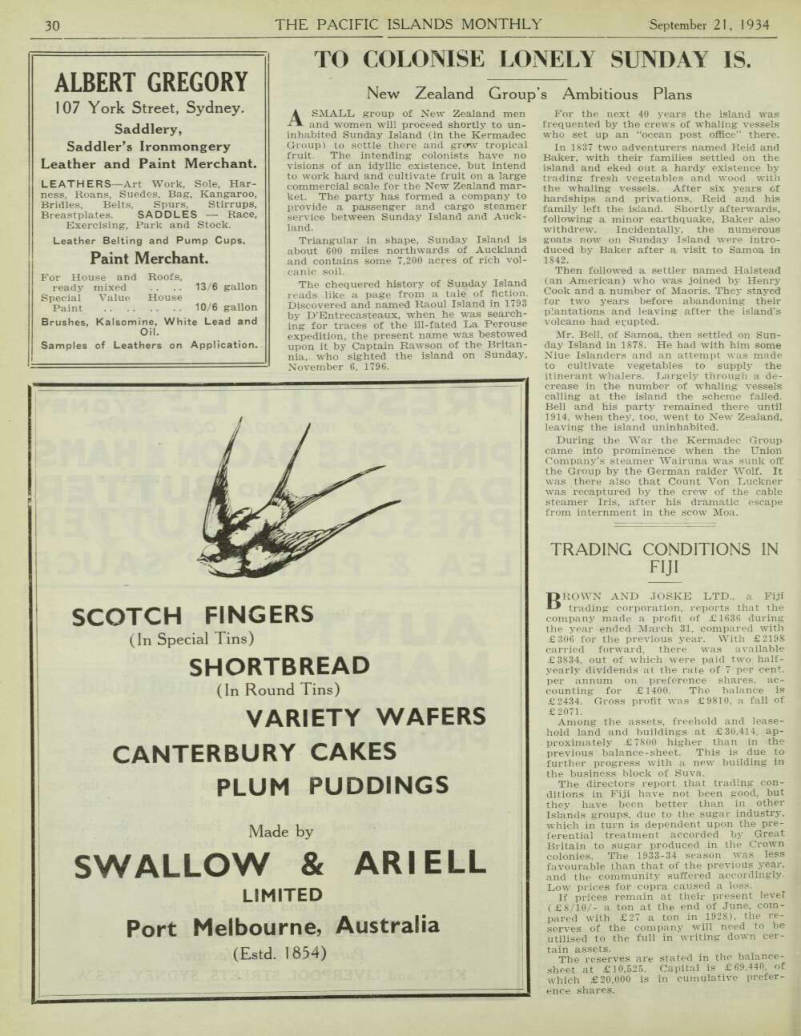
A SMALL group of New Zealand men and women will proceed shortly to un inhabited Sunday Island (in the Kermadec Group) to settle there and grow tropical fruit. The intending colonists have no visions of an idyllic existence, but intend to work hard and cultivate fruit on a large commercial scale for the New Zealand mar ket. The party has formed a company to provide a passenger and cargo steamer service between Sunday Island and Auck land.
Triangular in shape, Sunday Island is about 600 miles northwards of Auckland and contains some 7,200 acres of rich vol canic soil.
The chequered history of Sunday Island reads like a page from a tale of fiction.
Discovered and named Raoul Island in 1793 by D’Entrecasteaux, when he was search ing for traces of the ill-fated La Perouse expedition, the present name was bestowed upon it by Captain Rawson of the Britannia, who sighted the island on Sunday, November 6, 1796.
For the next 40 years the island was frequented by the crews of whaling vessels who set up an “ocean post office” there.
In 1837 two adventurers named Reid and Baker, with their families settled on the island and eked out a hardy existence by trading fresh vegetables and wood with the whaling vessels. After six years of hardships and privations, Reid and his family left the island. Shortly afterwards, following a minor earthquake, Baker also withdrew. Incidentally, the numerous goats now on Sunday Island were Intro duced by Baker after a visit to Samoa in 1842.
Then followed a settler named Halstead (an American) who was joined by Henry Cook and a number of Maoris. They stayed for two years before abandoning their plantations and leaving after the island’s volcano had erupted.
Mr. Bell, of Samoa, then settled on Sun day Island in 1878. He had with him some Niue Islanders and an attempt was made to cultivate vegetables to supply the itinerant whalers. Largely through a de crease in the number of whaling vessels calling at the island the scheme failed.
Bell and his party remained there until 1914, when they, too, went to New Zealand, leaving the island uninhabited.
During the War the Kermadec Group came into prominence when the Union Company’s steamer Wairuna was sunk off the Group by the German raider Wolf. It was there also that Count Von Luckner was recaptured by the crew of the cable steamer Iris, after his dramatic escape from internment in the scow Moa.