Uncoordinated Mission Effort
pp. 5-6 · Read in the full issue
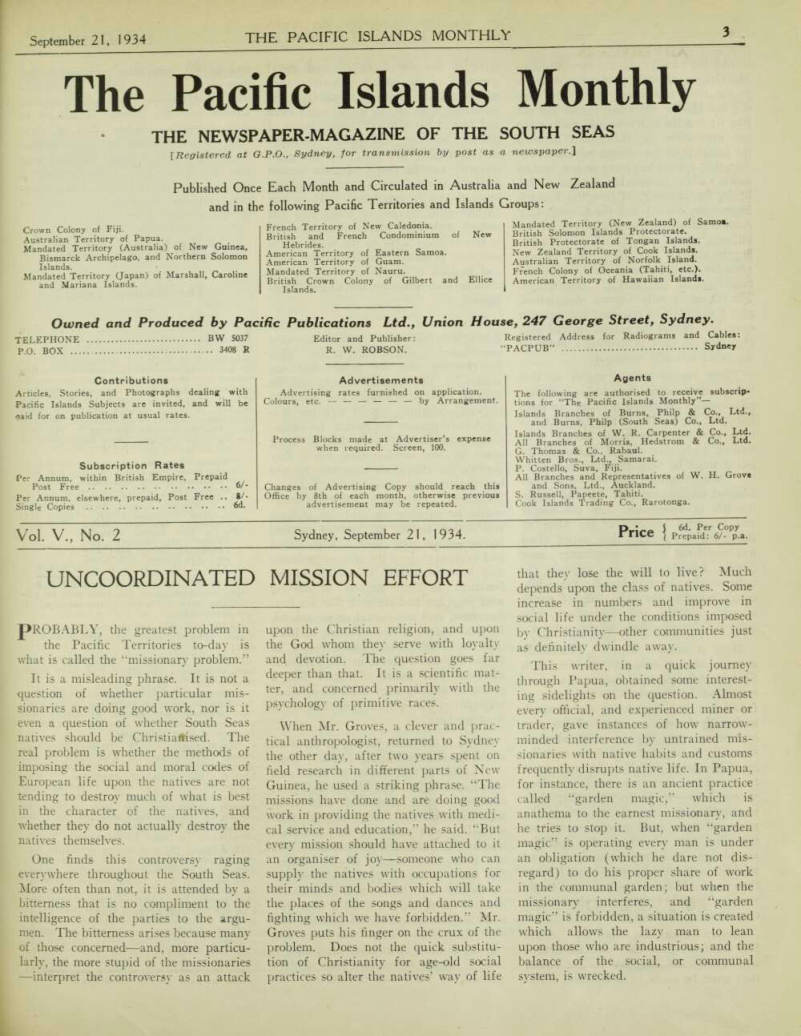
PROBABLY, the greatest problem in the Pacific Territories to-day is what is called the “missionary problem.”
It is a misleading phrase. It is not a question of whether particular mis sionaries are doing good work, nor is it even a question of whether South Seas natives should be Christiafiised. The real problem is whether the methods of imposing the social and moral codes of European life upon the natives are not tending to destroy much of what is best in the character of the natives, and whether they do not actually destroy the natives themselves.
One finds this controversy raging everywhere throughout the South Seas.
More often than not, it is attended by a bitterness that is no compliment to the intelligence of the parties to the argu men. The bitterness arises because many of those concerned —and, more particu larly, the more stupid of the missionaries —interpret the controversy as an attack
upon the Christian religion, and upon the God whom they serve with loyalty and devotion. The question goes far deeper than that. It is a scientific mat ter, and concerned primarily with the psychology of primitive races.
When Mr. Groves, a clever and prac tical anthropologist, returned to Sydney the other day, after two years spent on field research in different parts of New Guinea, he used a striking phrase. “The missions have done and are doing good work in providing the natives with medi cal service and education," he said. “But every mission should have attached to it an organiser of joy—someone who can supply the natives with occupations for their minds and bodies which will take the places of the songs and dances and fighting which we have forbidden.” Mr.
Groves puts his finger on the crux of the problem. Does not the quick substitu tion of Christianity for age-old social practices so alter the natives’ way of life
that they lose the will to live? Much depends upon the class of natives. Some increase in numbers and improve in social life under the conditions imposed by Christianity—other communities just as definitely dwindle away.
This writer, in a quick journey through Papua, obtained some interest ing sidelights on the question. Almost every official, and experienced miner or trader, gave instances of how narrow minded interference by untrained mis sionaries with native habits and customs frequently disrupts native life. In Papua, for instance, there is an ancient practice called “garden magic,” which is anathema to the earnest missionary, and he tries to stop it. But, when “garden magic” is operating every man is under an obligation (which he dare not dis regard) to do his proper share of work in the communal garden; but when the missionary interferes, and “garden magic” is forbidden, a situation is created which allows the lazy man to lean upon those who are industrious; and the balance of the social, or communal system, is wrecked.
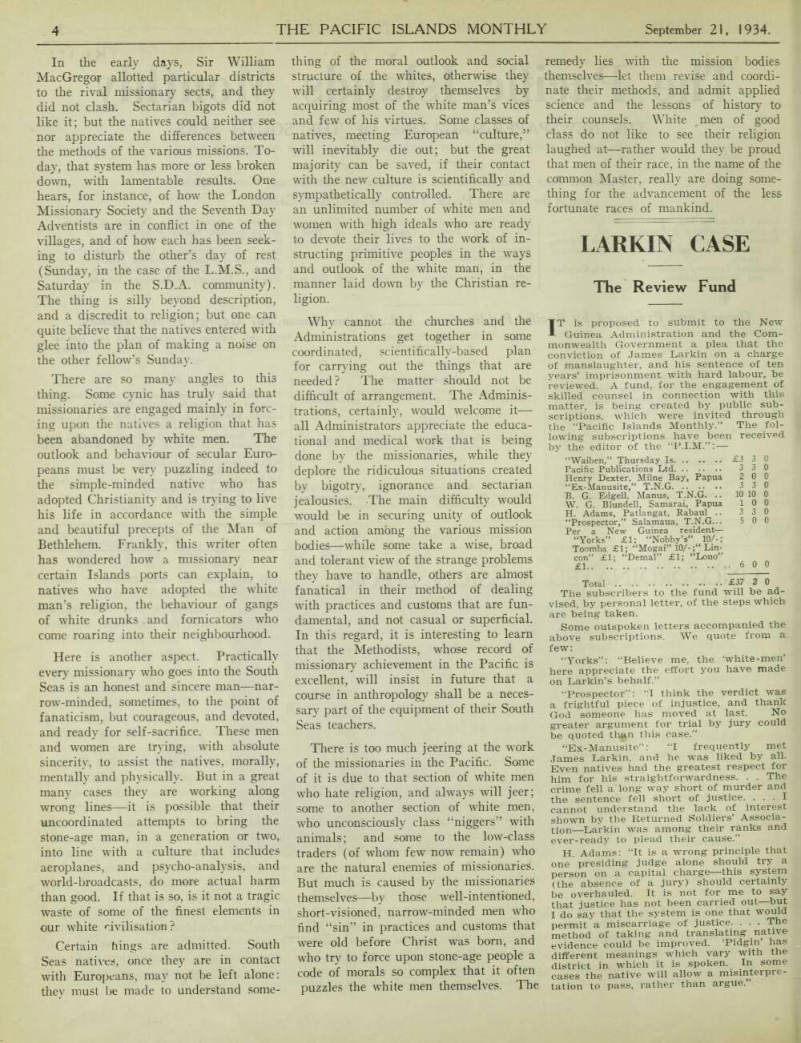
In the early days, Sir William MacGregor allotted particular districts to the rival missionary sects, and they did not clash. Sectarian bigots did not like it; but the natives could neither see nor appreciate the differences between the methods of the various missions. To day, that system has more or less broken down, with lamentable results. One hears, for instance, of how the London Missionary Society and the Seventh Day Adventists are in conflict in one of the villages, and of how each has been seek ing to disturb the other’s day of rest (Sunday, in the case of the L.M.S., and Saturday in the S.D.A. community).
The thing is silly beyond description, and a discredit to religion; but one can quite believe that the natives entered with glee into the plan of making a noise on the other fellow’s Sunday.
There are so many angles to this thing. Some cynic has truly said that missionaries are engaged mainly in forc ing upon the natives a religion that has been abandoned by white men. The outlook and behaviour of secular Euro peans must be very puzzling indeed to the simple-minded native who has adopted Christianity and is trying to live his life in accordance with the simple and beautiful precepts of the Man of Bethlehem. Frankly, this writer often has wondered how a missionary near certain Islands ports can explain, to natives who have adopted the white man’s religion, the behaviour of gangs of white drunks and fornicators who come roaring into their neighbourhood.
Here is another aspect. Practically every missionary who goes into the South Seas is an honest and sincere man —narrow-minded, sometimes, to the point of fanaticism, but courageous, and devoted, and ready for self-sacrifice. These men and women are trying, with absolute sincerity, to assist the natives, morally, mentally and physically. But in a great many cases they are working along wrong lines —it is possible that their uncoordinated attempts to bring the stone-age man, in a generation or two, into line with a culture that includes aeroplanes, and psycho-analysis, and world-broadcasts, do more actual harm than good. If that is so, is it not a tragic waste of some of the finest elements in our white civilisation?
Certain hings are admitted. South Seas natives, once they are in contact with Europeans, may not be left alone: they must be made to understand some
thing of the moral outlook and social structure of the whites, otherwise they will certainly destroy themselves by acquiring most of the white man’s vices and few of his virtues. Some classes of natives, meeting European “culture,” will inevitably die out; but the great majority can be saved, if their contact with the new culture is scientifically and sympathetically controlled. There are an unlimited number of white men and women with high ideals who are ready to devote their lives to the work of in structing primitive peoples in the ways and outlook of the white man, in the manner laid down by the Christian re ligion.
Why cannot the churches and the Administrations get together in some coordinated, scientifically-based plan for carrying out the things that are needed ? The matter should not be difficult of arrangement. The Adminis trations, certainly, would welcome it — all Administrators appreciate the educa tional and medical work that is being done by the missionaries, while they deplore the ridiculous situations created by bigotry, ignorance and sectarian jealousies. The main difficulty would would be in securing unity of outlook and action among the various mission bodies —while some take a wise, broad and tolerant view of the strange problems they have to handle, others are almost fanatical in their method of dealing with practices and customs that are fun damental, and not casual or superficial.
In this regard, it is interesting to learn that the Methodists, whose record of missionary achievement in the Pacific is excellent, will insist in future that a course in anthropology shall be a neces sary part of the equipment of their South Seas teachers.
There is too much jeering at the work of the missionaries in the Pacific. Some of it is due to that section of white men who hate religion, and always will jeer; some to another section of white men, who unconsciously class “niggers” with animals; and some to the low-class traders (of whom few now remain) who are the natural enemies of missionaries.
But much is caused by the missionaries themselves —by those well-intentioned, short-visioned, narrow-minded men who find “sin” in practices and customs that were old before Christ was born, and who try to force upon stone-age people a code of morals so complex that it often puzzles the white men themselves. The
remedy lies with the mission bodies themselves —let them revise and coordi nate their methods, and admit applied science and the lessons of history to their counsels. White men of good class do not like to see their religion laughed at —rather would they be proud that men of their race, in the name of the common Master, really are doing some thing for the advancement of the less fortunate races of mankind.