America
p. 33 · Read in the full issue
Soya Beans In
Possible Effect on Copra Trade
The following article appeared in the March (1934) issue of the “Malayan Agri cultural Journal.”
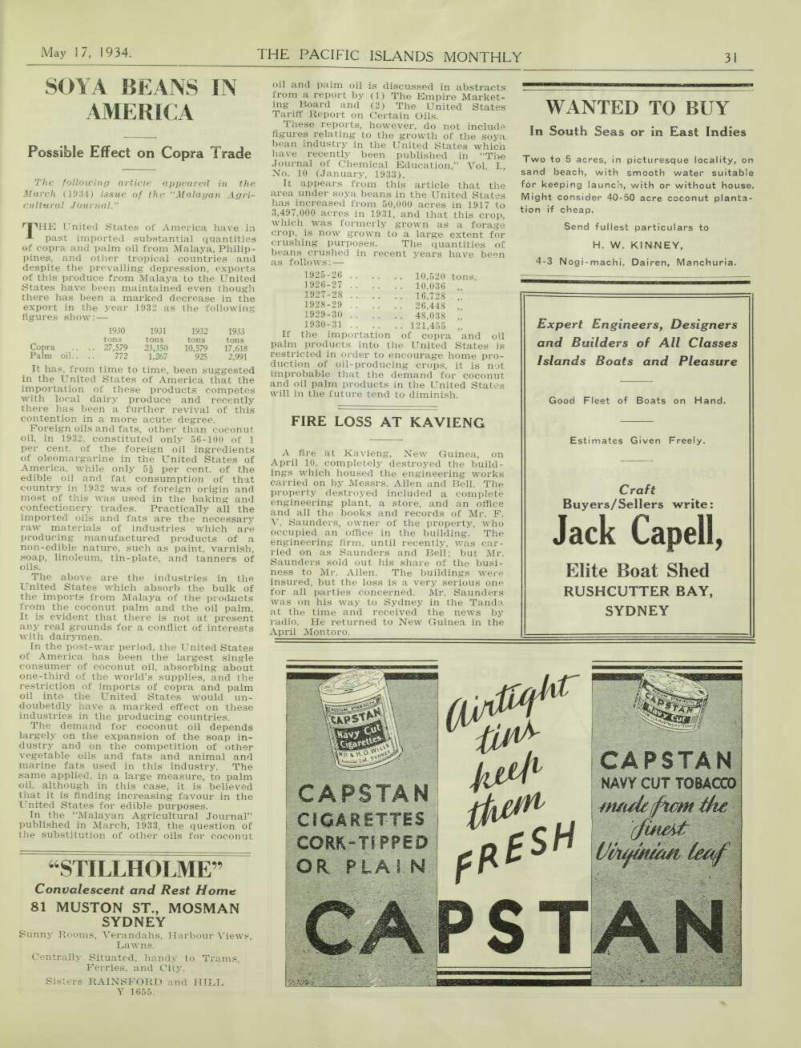
THE United States of America have in past imported substantial quantities of copra and palm oil from Malaya, Philip pines, and other tropical countries and despite the prevailing depression, exports of this produce from Malaya to the United States have been maintained even though there has been a marked decrease in the export in the year 1932 as the following figures show:
It has, from time to time, been suggested in the United States of America that the importation of these products competes with local dairy produce and recently there has been a further revival of this contention in a more acute degree.
Foreign oils and fats, other than coconut oil, in 1932, constituted only 56-100 of 1 per cent, of the foreign oil ingredients of oleomargarine in the United States of America, while only 5½ per cent, of the edible oil and fat consumption of that country in 1932 was of foreign origin and most of this was used in the baking and confectionery trades. Practically all the imported oils and fats are the necessary raw materials of industries which are producing manufactured products of a non-edible nature, such as paint, varnish, soap, linoleum, tin-plate, and tanners of oils.
The above are the industries in the United States which absorb the bulk of the imports from Malaya of the products from the coconut palm and the oil palm.
It is evident that there is not at present any real grounds for a conflict of interests with dairymen.
In the post-war period, the United States of America has been the largest single consumer of coconut oil, absorbing about one-third of the world’s supplies, and the restriction of imports of copra and palm oil into the United States would un doubetdly have a marked effect on these industries in the producing countries.
The demand for coconut oil depends largely on the expansion of the soap in dustry and on the competition of other vegetable oils and fats and animal and marine fats used in this industry. The same applied, in a large measure, to palm oil, although in this case, it is believed that it is finding increasing favour in the United States for edible purposes.
In the “Malayan Agricultural Journal” published in March, 1933, the question of the substitution of other oils for coconut
oil and palm oil is discussed in abstracts from a report by (1) The Empire Market ing Board and (2) The United States Tariff Report on Certain Oils.
These reports, however, do not include figures relating to the growth of the soya bean industry in the United States which have recently been published in “The Journal of Chemical Education,” Vol. L, No. 10 (January, 1933).
It appears from this article that the area under soya beans in the United States has increased from 50,000 acres in 1917 to 3,497,000 acres in 1931, and that this crop, which was formerly grown as a forage crop, is now grown to a large extent for crushing purposes. The quantities of beans crushed in recent years have been as follows: 1925- 10,520 tons. 1926- 10,036 „ 1927- 16,728 „ 1928- 26,448 „ 1929- 48,038 „ 1930- 121,455 „ If the importation of copra and oil palm products into the United States is restricted in order to encourage home pro duction of oil-producing crops, it is not improbable that the demand for coconut and oil palm products in the United States will in the future tend to diminish.
1930 1931 1932 1933 tons tons tons tons
Copra
27,579 23,350 10,579 17,618 Palm oil.. 772 1,267 925 2,991