N.G. Planter Raided Again
pp. 19-20 · Read in the full issue
Japanese Poachers Land and Carry off Shell
THE lonely Awinn Plantation, in the Ninigo Group, off the north coast of New Guinea, which is managed by Mr. S. C. Thompson, has again been raided by Japanese shell poachers. On the occasion of the last raid Mr. Thompson fired several shots at them, but without effect. This time, he boarded their sampan and spoke with the captain. A quantity of trocas and greensnail shell was taken before the raider departed.
Mr. Thompson’s own account of the in cident, which he sent to the “Pacific Islands Monthly,” under date March 18, is as follows: “I have again been raided at Awinn by Japanese shell poachers in a similar man ner to that of October 27, 1933. This raid occurred on the morning of Friday, Feb ruary 16, 1934; it was conducted in the usual manner as of previous visits, only this time I was successful in getting into conversation with them.
“When one of their fishing boats was within forty yards of my house I showed myself to them, and in each hand, held above my head, I had trocas shell. I waded out to them, and they in turn climbed into their boat and waited for me. There were eight divers in the boat, and when within five yards of them, 1 showed them the shell and they smiled and “talked place.” I reached their boat and spoke to them in Australian and pid gin, but they either could not speak or would not, they only smiled and shook hands with me.
“In the meantime the sampan seeing the boat stationary, came back quickly. I managed to make them understand that I wanted to see the captain of the sampan, so I got into their boat (amongst my own shell) and was rowed out to the sampan.
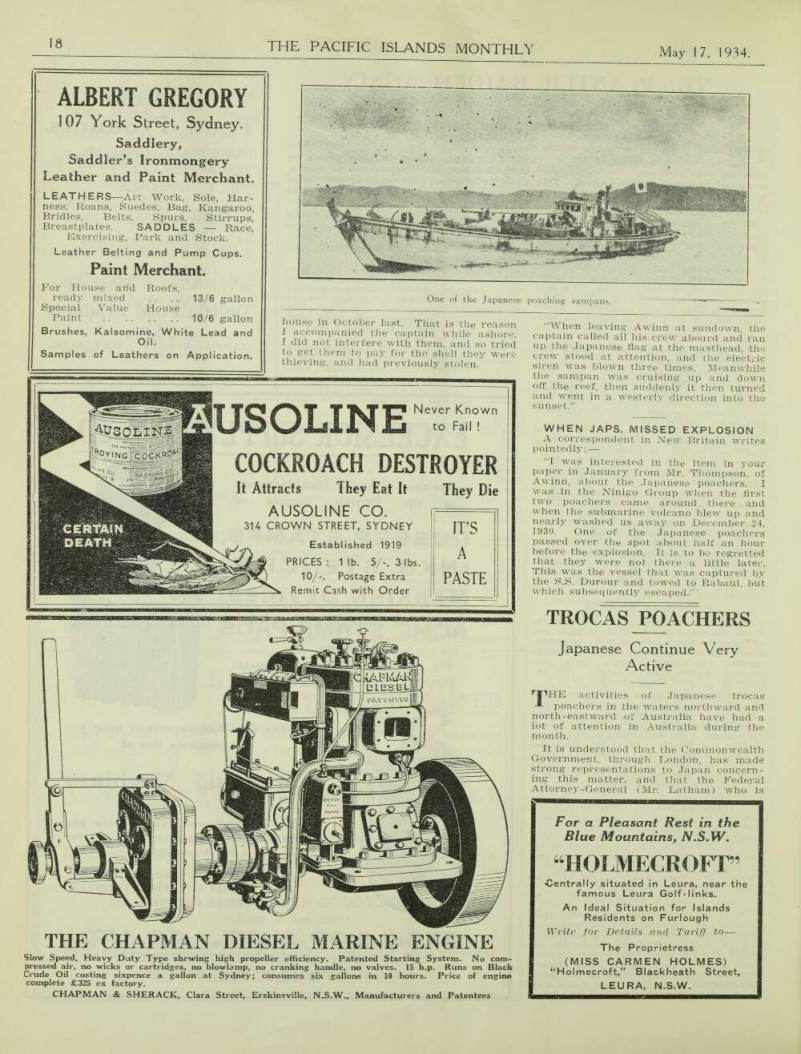
The sampan was of exactly the same type as that pictured in your article of Janu ary 23, 1934, only it had wireless masts up, and I saw a small receiving and transmitting set.
Pacific Is. Charts
“The captain received me politely, shook hands with me and saluted me, offering me refreshments and cigarettes.
There were only twenty-four Japanese aboard the sampan this time, the captain, bo’sun and engineer, the re mainder of crew being divers.
“The captain seemed anxious to know if there were any steamers due to call at islands of the Ninigo Group, and when I replied that I did not know, he looked hard at me. He had charts of the North Pacific and Manila, and of the Mainland of New Guinea and adjacent islands, North Queensland coast, and Torres Straits. He also had prominent marks on the charts showing positions of wireless stations.
“I requested him to cease diving and demanded payment for shell previously stolen upon three occasions at Awinn. I also pointed to the place where his crew had previously burnt my sun-plant on October 27, 1933, but he only smiled and shrugged his shoulders. He suggested that we go ashore, which we did (accompanied by eight of his divers).
Shell Stolen
“Near my house there was some shell (trocas and greensnail) lying upon the ground. He spoke to his men, and turn ing to me. said, “You” (meaning the shell), and I replied “Yes” (that the shell was mine). The captain then walked through to the other end of the atoll, which is 800 yards long by 50 yards wide in the centre. I went with him, and when
we returned to the house his crew had taken away the last of the shell that was lying on the ground. I was very angry, and tried to tell him so, but he only shrugged his shoulders.
“They were here from 9 a.m. till 5 p.m., and got about six bags of trocas and four of greensnail. While aboard the sampan I requested the captain to lift up the hatches, he agreed, and I saw that the hatches were three-quarters filled with trocas shell. The hatches were 15ft. in depth by 9ft. in width.
“At one end of Saboh Island I had a copra house with 360 tons of sun copra in it and I was afraid they might come ashore and ‘cook’ it, like they did the sun-
house in October last. That is the reason I accompanied the captain while ashore.
I did not interfere with them, and so tried to get them to pay for the shell they were thieving, and had previously stolen.
“When leaving Awinn at sundown, the captain called all his crew aboard and ran up the Japanese flag at the masthead, the crew stood at attention, and the electric siren was blown three times. Meanwhile the sampan was cruising up and down off the reef, then suddenly it then turned and went in a westerly direction into the sunset.”
When Japs. Missed Explosion
A correspondent in New Britain writes pointedly: “I was interested in the item in your paper in January from Mr. Thompson, of Awinn, about the Japanese poachers. I was in the Ninigo Group when the first two poachers came around there and when the submarine volcano blew up and nearly washed us away on December 24, 1930. One of the Japanese poachers passed over the spot about half an hour before the explosion. It is to be regretted that they were not there a little later.
This was the vessel that was captured by the S.S. Durour and towed to Rabaul, but which subsequently escaped.”
One of the Japanese poaching sampans.