Anthropologizing!
pp. 16-18 · Read in the full issue
Eight Months Among the Tabar Islanders.
By Wm. C. Groves.
I HAVE just returned to Rabaul after eight months of anthropological work in Tatau village, in the Tabar Islands, which lie about 30 miles east of the coast of New Ireland, and between 60 and 80 miles from the district administrative centre at Kavieng. What are my memories of the people and the place? A trifle confused as yet, requiring a careful over haul and sorting-out. From out of the melange, however, a few high-lights emerge.
A cold and miserable landing, shortly after dawn, at an uninviting mangrove enclosed inlet, in the pouring, tropical rain.
A feeling of desolation as the trim little schooner “Veilomani” passed beyond our vision to leave us (my wife and two little girls were with me; there are untold ad vantages in settling down to anthropolo gical work en famille. Not the least is the fact that the tongue of unkind report and gossip is effectively silenced), squat ting amongst our innumerable packages —boxes of kai-kai, tabak, trunks, kitchen and camp equipment, and a hundred essential odds and ends —on the narrow, dirty beach at Topinaminda, the “head or mouth of the waters.”
The kindly Malay (in the employ of the ever-hospitable Col. Mackellar) offered us shelter in his house, his native wife hastening to prepare us a cup of sugar less tea. Then three miles of plodding, with an endless line of native carriers (who had appeared miraculously from goodness knew where); my little girls
pick-a-back astride a couple of volunteer “marys”; my wife and I squelching along, through sac sac swamp and over kunai plain. The cheerless arrival at the house kiap, dismal and uninviting, standing up on high stilts in a shallow sea of rain
water and mud. And then the days of set tling in.
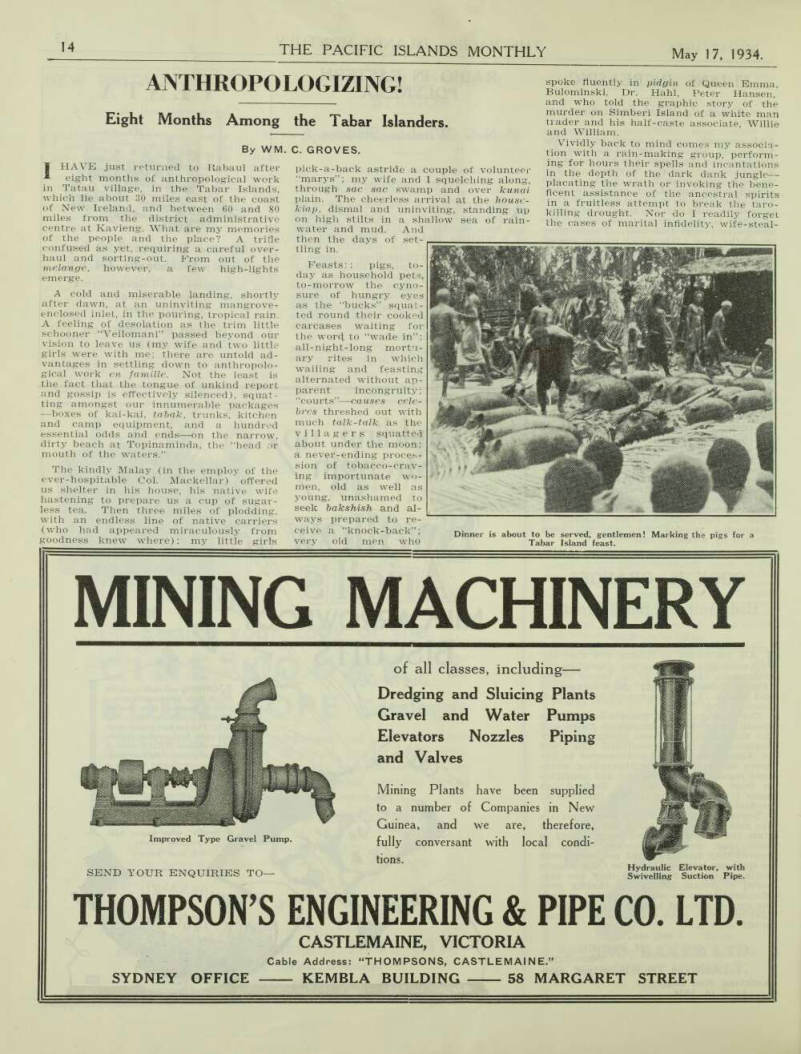
Feasts; : pigs, to day as household pets, to-morrow the cyno sure of hungry eyes as the “bucks” squat ted round their cooked carcases waiting for the word to “wade in”; all-night-long mortu ary rites in which wailing and feasting alternated without ap parent incongruity; “courts” —causes cele bres threshed out with much talk-talk as the villagers squatted about under the moon: a never-ending proces sion of tobacco-crav ing importunate wo men, old as well as young, unashamed to seek bakshish and al ways prepared to re ceive a “knock-back”; very old men who
spoke fluently in pidgin of Queen Emma, Bulominski, Dr. Hahl, Peter Hansen, and w r ho told the graphic story of the murder on Simberi Island of a white man trader and his half-caste associate, Willie and William.
Vividly back to mind comes my associa tion with a rain-making group, perform ing for hours their spells and incantations in the depth of the dark dank jungle— placating the wrath or invoking the bene ficent assistance of the ancestral spirits in a fruitless attempt to break the taro killing drought. Nor do I readily forget the cases of marital infidelity, wife-steal-
Dinner is about to be served, gentlemen! Marking the pigs for a Tabar Island feast.
ing and almost indiscriminate mating amongst the young people.
Other recollections there are, too: An attitude of suspician, an “unapproach ableness” on the part of the natives in the first few weeks, giving way gradually to an eventual basis of complete and un reserved understanding, a sense of being en rapport with the people; the fact be coming evident that the natives had learned from early painful experience to regard with distrust the blandishments of the European.
Then there were the lewd and sugges tively boisterous dances of the married women on the occasion of a birth to a woman of opposite clan-group; and a three-week cycle, in association with malagan, of rites, observed in all their intimate detail, in connection with the circumcision of two lads; a blind old woman who cannot forget the loss of her son who died after being taken away by the government for “education.”
I recollect vividly how a luluai flogged until great weals and breaks appeared on her bruised back with a passion that knew no mercy, his sister’s daughter, who had brought shame on the maternal group and lowered its prestige by sharing the bed of one of her own clansmen—the horrible crime of incest in Melanesia society; and the anti-climax when I learned, as my wife put soothing oil on the broken flesh of the girl, that the aggrieved luluai had himself “married crooked,” in disregard of the law of exogamy.
I remember, too, the conch shells’ loud blowing to herald the return with a large catch, of the canoe-loads of men who had
been out all night fishing for sharks; and rheumatic old men—and women, too — unashamedly baring their bony buttocks for a brisk rubbing application of oil and eucalyptus, in whose curative properties they exhibited a faith that was sublime, because, as they themselves put it ‘‘this fella marasin (medicine) ’e stink (smell) good: ’e more sitrong.”
Old “leg-broke” Kasiliu, hobbling hap pily along on his stick in spite of the loss of a leg kai-kai’d by a shark in his early youth; sessions of potschpotchpil (story telling), at night, natives crowding on to the steps of the little thatch and bamboo house-kiap; Sunday morning lotu (mis-
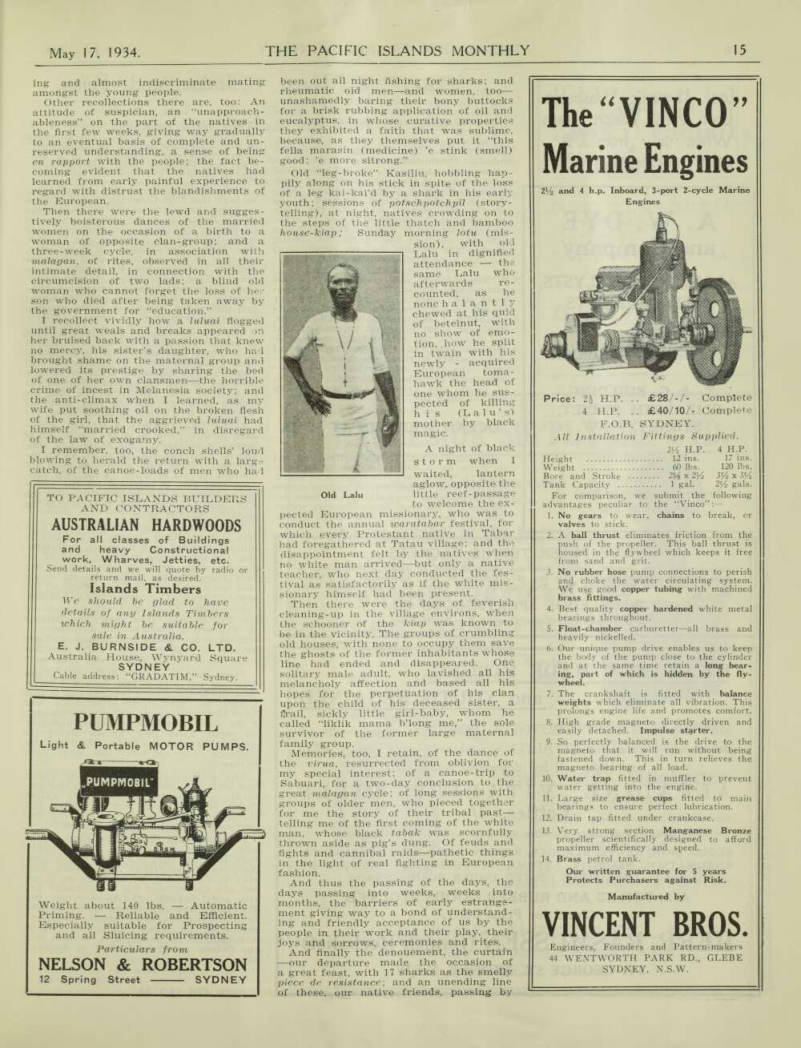
sion), with old Lain in dignified attendance the same Lain who afterwards re counted, as he nonchalantly chewed at his quid of betelnut, with no show of emo tion, how he split in twain with his newly - acquired European toma hawk the head of one whom he sus pected of killing his (Lalu’s) mother by black magic.
A night of black storm when I waited, lantern aglow, opposite the little reef-passage to welcome the ex
pected European missionary, who was to conduct the annual waratabar festival, for which every Protestant native in Tabar had foregathered at Tatau village; and the disappointment felt by the natives when no white man arrived —but only a native teacher, who next day conducted the fes tival as satisfactorily as if the white mis sionary himself had been present.
Then there were the days of feverish cleaning-up in the village environs, when the schooner of the kiap was known to be in the vicinity. The groups of crumbling old houses, with none to occupy them save the ghosts of the former inhabitants whose line had ended and disappeared. One solitary male adult, who lavished all his melancholy affection and based all his hopes for the perpetuation of his clan upon the child of his deceased sister, a frail, sickly little girl-baby, whom he called “liklik mama b’long me,” the sole survivor of the former large maternal family group.
Memories, too, I retain, of the dance of the virua, resurrected from oblivion for my special interest; of a canoe-trip to Sabuari, for a two-day conclusion to the great malagan cycle; of long sessions with groups of older men, who pieced together for me the story of their tribal past— telling me of the first coming of the white man, whose black tabak was scornfully thrown aside as pig’s dung. Of feuds and fights and cannibal raids —pathetic things in the light of real fighting in European fashion.
And thus the passing of the days, the days passing into weeks, weeks into months, the barriers of early estrange ment giving way to a bond of understand ing and friendly acceptance of us by the people in their work and their play, their joys and sorrows, ceremonies and rites.
And finally the denouement, the curtain —our departure made the occasion of a great feast, with 17 sharks as the smelly piece de resistance ; and an unending line of these, our native friends, passing by
Old Lalu
(Continued from page 15.) to bid us individually au revoir, each offer ing some simple token of friendly remem brance—a dog’s tooth, a shell, a carved miniature malagan, a woman’s taro-peel ing shell.
Carriers on the move again; a laughing, heavily-laden line making for Topina minda. Ceremonial wailing on the beach as we made our way to the schooner. And a recurrence of that early feeling of deso lation and sorrow of the day of our land ing, as we stood against the back railing of the “Veilomani” watching the fast disappearing, mangrove and sago swampy shores of Tabar. Somehow one felt that one had been permitted, during those eight months, the rare privilege of sharing a primitive people’s life. * * * “You measure skulls and collect curios and all that sort of thing, you anthropolo gists, don’t you?” asked an enquiring lady tourist on our voyage home. And, absent mindedly, I answered in the affirmative.
For how could I explain to madam that we measure, not skulls, but human emo tions and motives; that, by the nature of our approach to them, we came to appre ciate the ethos of a primitive people— something of their racial spirit; to know, in short, and knowing, understand, the way of their life.