Tropicalties
p. 10 · Read in the full issue
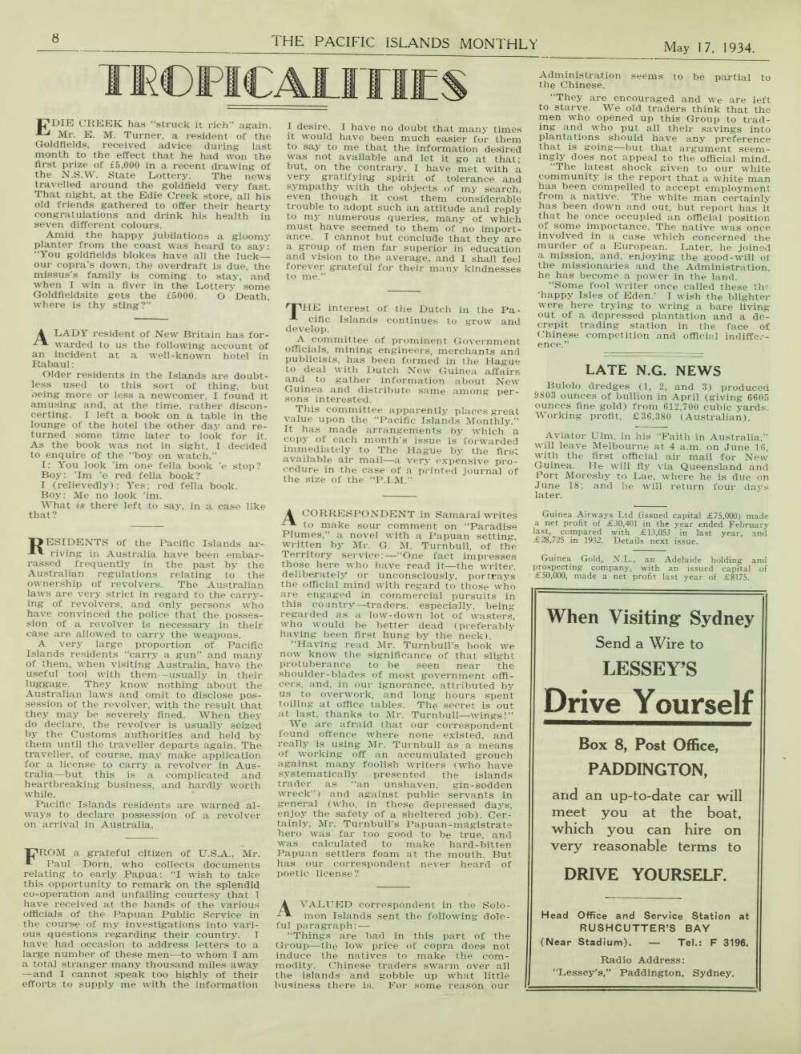
DIE CREEK has “struck it rich” again.
Mr. E. M. Turner, a resident of the Goldfields, received advice during last month to the effect that he had won the first prize of £5,000 in a recent drawing of the N.S.W. State Lottery. The news travelled around the goldfield very fast.
That night, at the Edie Creek store, all his old friends gathered to offer their hearty congratulations and drink his health in seven different colours.
Amid the happy jubilations a gloomy planter from the coast was heard to say: “You goldfields blokes have all the luck— our copra’s down, the overdraft is due, the missus’s family is coming to stay, and when I win a fiver in the Lottery some Goldfieldsite gets the £5000. O Death, where is thy sting?”
A LADY resident of New Britain has for warded to us the following account of an incident at a well-known hotel in Rabaul : Older residents in the Islands are doubt less used to this sort of thing, but being more or less a newcomer, I found it amusing and, at the time, rather discon certing. I left a book on a table in the lounge of the hotel the other day and re turned some time later to look for it.
As the book was not in sight, I decided to enquire of the “boy on watch.”
I: You look ’im one fella book ’e stop?
Boy: ’lm ’e red fella book?
I (relievedly): Yes; red fella book.
Boy: Me no look ’im.
What is there left to say, in a case like that?
RESIDENTS of the Pacific Islands arriving in Australia have been embar rassed frequently in the past by the Australian regulations relating to the ownership of revolvers. The Australian laws are very strict in regard to the carry ing of revolvers, and only persons who have convinced the police that the posses sion of a revolver is necessary in their case are allowed to carry the weapons.
A very large proportion of Pacific Islands residents “carry a gun” and many of them, when visiting Australia, have the useful tool with them—usually in their luggage. They know nothing about the Australian laws and omit to disclose pos session of the revolver, with the result that they may be severely fined. When they do declare, the revolver is usually seized by the Customs authorities and held by them until the traveller departs again. The traveller, of course, may make application for a license to carry a revolver in Aus tralia —but this is a complicated and heartbreaking business, and hardly worth while.
Pacific Islands residents are warned al ways to declare possession of a revolver on arrival in Australia.
From a grateful citizen of U.S.A., Mr.
Paul Dorn, who collects documents relating to early Papua; “I wish to take this opportunity to remark on the splendid co-operation and unfailing courtesy that I have received at the hands of the various officials of the Papuan Public Service in the course of my investigations into vari ous questions regarding their country. I have had occasion to address letters to a large number of these men—to whom I am a total stranger many thousand miles away —and I cannot speak too highly of their efforts to supply me with the information
I desire. I have no doubt that many times it would have been much easier for them to say to me that the information desired was not available and let it go at that; but, on the contrary, I have met with a very gratifying spirit of tolerance and sympathy with the objects of my search, even though it cost them considerable trouble to adopt such an attitude and reply to my numerous queries, many of which must have seemed to them of no import ance. I cannot but conclude that they are a group of men far superior in education and vision to the average, and I shall feel forever grateful for their many kindnesses to me.”
THE interest of the Dutch in the Pa cific Islands continues to grow and develop.
A committee of prominent Government officials, mining engineers, merchants and publicists, has been formed in the Hague to deal with Dutch New Guinea affairs and to gather information about New Guinea and distribute same among per sons interested.
This committee apparently places great value upon the “Pacific Islands Monthly.”
It has made arrangements by which a copy of each month’s issue is forwarded immediately to The Hague by the first available air mail—a very expensive pro cedure in the case of a printed journal of the size of the “P.I.M.”
A CORRESPONDENT in Samarai writes to make sour comment on “Paradise Plumes,” a novel with a Papuan setting, written by Mr. G. M. Turnbull, of the Territory service:—“One fact impresses those here who have read it—the writer, deliberately or unconsciously, portrays the official mind with regard to those who are engaged in commercial pursuits in this country—traders, especially, being regarded as a low-down lot of wasters, who would be better dead (preferably having been first hung by the neck).
“Having read Mr. Turnbull’s book now know the significance of that slight protuberance to be seen near the shoulder-blades of most government offi cers, and, in our ignorance, attributed by us to overwork, and long hours spent toiling at office tables. The secret is out at last, thanks to Mr. Turnbull—wings!”
We are afraid that our correspondent found offence where none existed, and really is using Mr. Turnbull as a means of working off an accumulated grouch against many foolish writers (who have systematically presented the islands trader as “an unshaven, gin-sodden wreck”) and against public servants in general (who, in these depressed days, enjoy the safety of a sheltered job). Cer tainly, Mr. Turnbull’s Papuan-magistrate hero was far too good to be true, and was calculated to make hard-bitten Papuan settlers foam at the mouth. But has our correspondent never heard of poetic license?
A VALUED correspondent in the Solomon Islands sent the following dole ful paragraph:— “Things are bad in this part of the Group—the low price of copra does not induce the natives to make the com modity. Chinese traders swarm over all the islands and gobble up what little business there is. For some reason our
Administration seems to be partial to the Chinese.
“They are encouraged and we are left to starve. We old traders think that the men who opened up this Group to trad ing and who put all their savings into plantations should have any preference that is going—but that argument seem ingly does not appeal to the official mind.
“The latest shock given to our white community is the report that a white man has been compelled to accept employment from a native. The white man certainly has been down and out, but report has it that he once occupied an official position of some importance. The native was once involved in a case which concerned the murder of a European. Later, he joined a mission, and, enjoying the good-will of the missionaries and the Administration, he has become a power in the land.
“Some fool writer once called these the ‘happy Isles of Eden.’ I wish the blighter were here trying to wring a bare living out of a depressed plantation and a de crepit trading station in the face of Chinese competition and official indiffer ence.”