Clashes With New Guinea Natives
pp. 11-13 · Read in the full issue
Official Police Kill 19 When Seeking Murderers in “Uncontrolled” Areas
There has been a series of clashes between New Guinea administrative forces and wild bush natives in the region that lies north-west of the Morobe goldfield. One well-known mining man has been killed and, in a six hours’ battle between official police and the natives, 19 natives were killed. 17 wounded and District Officer E. Taylor and three of his native police were wounded by arrows.
NORTH-WESTWARD of the Morobe goldfield is the wild, rough, partly explored country that lies around the headwaters of three rivers—the Purari, which flows south-westward into Papua and on into the Gulf of Papua; the Ramu, which flows north-westward through New Guinea and reaches the sea far to the north of Madang; and the smaller Markham, which flows south-eastward into Huon Gulf. This region is labelled “uncontrolled” by the Administration; which means that Europeans enter it at their own risk.
During the past couple of years Euro peans have been pushing out into this country from the Morobe goldfield in in creasing numbers. It is believed that there is rich gold in the watersheds of the upper Purari and upper Ramu. The country, although officially uncontrolled, has been regarded as reasonably safe. It has been penetrated by a considerable number of prospectors and, since landing places have been cleared in various re mote spots, it has been flown over to an increasing extent by the aeroplanes which carry on the goldfields transport services, and keep in touch with prospectors.
In recent months, there was formed in Melbourne a company called Purari Al luvials (New Guinea), N.L., with head
quarters in Melbourne. This company recently sent to New Guinea a small prospecting expedition, led by Captain Ber nard McGrath, mining engineer. Captain McGrath lost no time in pushing through to the company’s claim on the Dunantima River, on the Purari Divide, north-west of Morobe. He was accompanied by a miner, Mr. Robert Dugan, and at least a dozen natives. Captain McGrath, at the end of February, reported to headquarters in Melbourne that he had reached the Du nantima (otherwise called the Karuma nantina) River, and that he expected to commence boring operations immediately.
It was reported that an option had been given to an influential company and an agreement posted.
The next development was tragic. On February 17, while Mr. Dugan and some of the native laborers were absent, Cap tain McGrath and the remainder of his natives were suddenly attacked by a large party of bush natives, and the leader was killed. Some of his laborers escaped.
The first news of the tragedy appears to have come from Messrs. Mick and Dan Leahy, well-known prospectors, who are leading a prospecting expedition in that region. They had found the body of Captain McGrath. It was then reported
that Mr. Dugan was missing, and it was feared that he had been killed. Imme diately thereafter Cadet T. H. Aitchison, in charge of a small patrol, met Leahy Bros.’ expedition, and they jointly appear to have made some move against the hos tile natives.
Immediately he got the news, District Officer E. Taylor flew from Salamaua, over the affected district. He located the camp of Mr. Aitchison and Messrs. Leahy, and communicated with them by signal, and was informed that Mr. Dugan was safe with them.
D.O. Taylor immediately organised a small expedition, consisting of himself, Cadet Black and 16 native police, and they joined the party led by Cadet Aitchi son and Messrs. Leahy.
(Continued overleaf.)
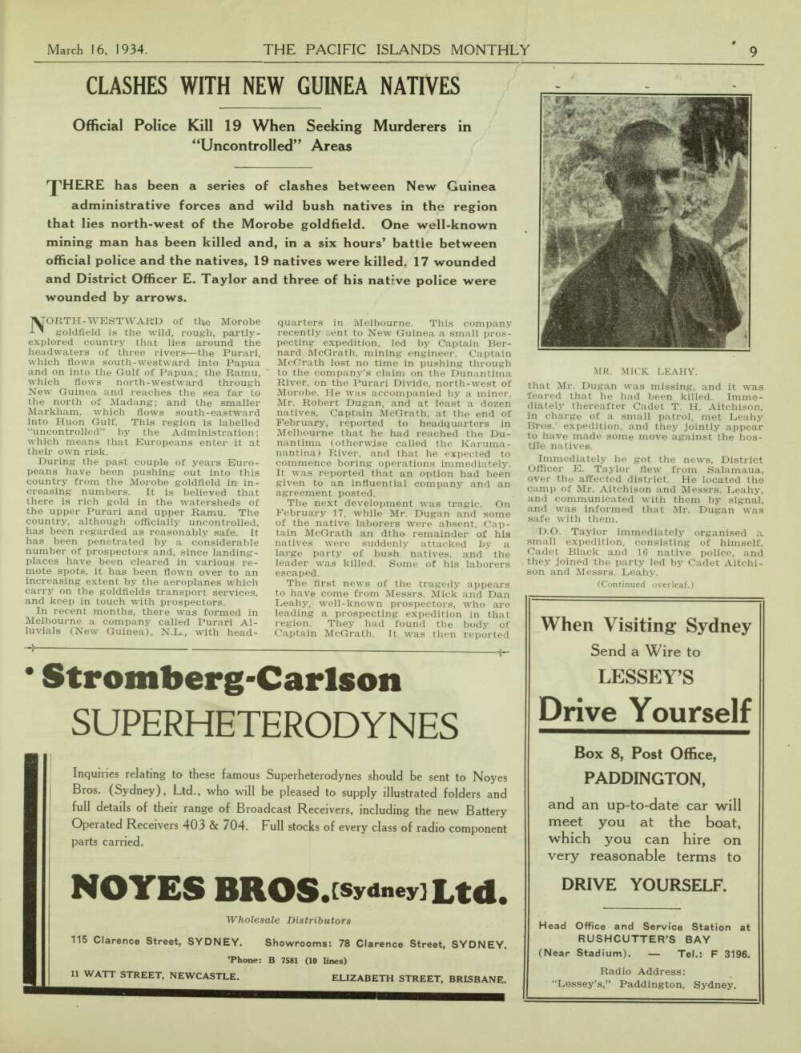
Mr. Mick Leahy.
Some other miners gave assistance; and the whole party then advanced to deal with the native position as it had developed.
They appear immediately to have met with hostility, and they soon found the bush natives in a natural stronghold, to which they retreated with every indica tion that they intended to offer resist ance.
D.O. Taylor, skilfully assisted by Messrs. Leahy and the two young Cadets, deployed his police so that he was able to confine the natives to their stronghold, and attack them there. This was on Feb ruary 22—only five days after Captain McGrath was murdered.
The fight lasted for six hours. The natives used only their primitive weapons, but they were present in large numbers and they fought with great resolution.
The official party, however, gradually overwhelmed them, and, finally, after suffering severe losses, the natives sur rendered.
It was then found that 19 bush natives had been killed and 17 wounded. District Officer Taylor and three of his native police were wounded by arrows, but not seriously.
The bush natives then obeyed instruc
tions to report at the Government camp; and D.O. Taylor held an official enquiry into the whole of the circumstances sur rounding the murder of Captain McGrath and the subsequent fighting. It is un ders f ood that, as a result, certain natives were taken into custody.
Cadet Black, with a force of 10 native police, remained in the locality; and D.O.
Taylor and his party returned to the coast.
The latest report was that the natives had returned to their villages and normal conditions prevailed.
The Minister for Territories, Major C. W.
C. Marr, warmly praised the achievement of D.O. Taylor. “He is one of our most reliable and trustworthy officers,” said Major Marr. “He was sent from Kokopo to take charge of the Morobe district be cause of his great experience, tact and ability.” Mr. Marr laid emphasis on the fact that the district in which the fight occurred is officially labelled “uncon trolled,” and Europeans enter it at their own risk.
Our Rabaul correspondent referring to this matter, praises the good service given to the Administration on this and other occasions, by Messrs. Leahy.
The Melbourne office of Purari Alluvi als, N.L., has been advised of Captain
McGrath’s death; and Mr. J. O’Neill, who was formerly associated with Captain McGrath, has been instructed to take charge of the expedition.
Previous Attack
Writing in the Melbourne “Star” on February 21, Mr. Alan W. Dawes says: The exact scene of the murder of Ber nard McGrath, the latest victim, is not indicated in messages from Rabaul, but it is reported that it is in the same area as that in which the prospector Eric Baum met his death in 1931, and in which the Leahy brothers were attacked about a year ago.
Baum was clubbed to death by the Kukukukus, the most savage natives in New Guinea. They felled him with stone clubs after some trifling argument about payment for food supplies—yams and taro —they were bringing to his camp.
They cut off his head and opened up his body, and danced triumphantly around it.
His native carriers—“boys” from distant parts—stood apart shivering with fear and surrounded by menacing Kukukukus, who, on a sudden impulse, leapt upon them also with spears and clubs. Only three of the 12 natives escaped.
The country which the intractable Kukukukus people occupy is perhaps the roughest in the world. The broken moun tains are torn with bottomless gorges hidden treacherously by the calamus bound jungle, and boiling torrents foam turgidly through crevasse-like valleys.
The Kukukuku warriors roam these mountain fastnesses, garbed from head to toe in strange capes of tapa cloth and in short grass petticoats like those the women wear in more accessible parts of the Territory.
The most unaccountable feature of many of these murders at the hands of natives is their apparent motivelessness.
A white man who has seemingly done no harm and threatened no harm is sud denly spitted with a black palm spear or savaged with a club, while a surging throng of natives yell their approval and delight.
The fact is that the motive is often deep-seated and logical only from the simple viewpoint of the savage. One white man is as good as another to mur der when revenge for some ancient wrong is sought, and the innocent often suffers for the guilty—the recruiter who has forced unwanted labour upon a tribe, the degenerate who has not scrupled to seize a native woman, the weakling who has allowed his native servants to pillage and rape in their progress through the vil lages, the unscrupulous trader or planter
who has swindled the native of his copra or his land. “An eye for an eye and a tooth for a tooth” is still good Blackstone in the jungle.
And any eye will do, so long as it is a white man’s.
Once in Madang, on the north-east coast, a missionary unwittingly endan gered a district officer’s life by telling newly met natives that it was a “kiap” (magistrate) who had sentenced the Saviour to be crucified. The only “kiap" they knew was the district officer, so they laid in wait for him with spears, and were only dissuaded with the greatest difficulty!
The Kukukukus range the easterly part of a tract 200 miles of more in length through the mountain heart of New Guinea. It has never been explored, and has only in recent months been visited by white men—prospectors and patrol officers —who, with the aid of the aero plane, which is now one of civilisation’s greatest instruments in these remote out posts, will doubtless succeed eventually in making it a country where murder no longer stalks at noon.