Midnight Pounce On Village
pp. 7-8 · Read in the full issue
How Papuan Official Took 15 Murderers and Marched Them 250 Miles
One of the most interesting feats in the history of Aus tralian-Pacific administration was performed recently in Papua, when a patrol officer penetrated into the heart of untamed Papua, sprang into a village at midnight, seized three chiefs and 15 commoners on charges of murder and cannibalism, and marched them 250 miles into Port Moresby. This is the story.
From Our Own Correspondent
Pt. Moresby, Feb. 26.
WHEN Patrol Officer Jack Hides ar rived in Port Moresby early in Feb ruary, with his little band of police and fifteen prisoners, overland from the Lolo ipa Valley, 250 miles away in the wild in terior of Papua, he brought with him a breath of primitive simplicity and strength even though it came in shackles.
Accused of killing and eating members of a neighbouring tribe, these men showed no signs of guilt, but only a mild and wondering surprise at the unforeseen re sult of what they considered a common place procedure of their lives.
Port Moresby, to them, was a perplex ity, incomprehensible. They gazed round in wonder at the motor cars, houses and white people, for it was their first intro duction to civilisation. Only once had they seen a white man, and then at a distance, long ago, when a patrol made its way slowly past their valley, for the north.
On being asked what they thought of Port Moresby, their chief, Gopa, replied that he had thought and thought about all the things he saw, until he could not think any more, so bewildered he was by the Court of Justice, the white men and their ways. But before he left, under es cort, on the return to his valley, he had gathered clearly that killing and eating other men were “not done” and he gave promises to the Government for himself and his people that there would be no more massacres in his district.
The Loloipa Valley, a large fertile dis trict, lies S.E. of Mt. Strong, near the
border of New Guinea, running parallel to the Kunimaipa Valley, though more to the south. It lies among difficult country, where ranges tower one above another and torrents of wind tortuously in and out through the precipitous ravines, until they meet the larger streams flowing down to the coast.
The whole area is inhabited by virile tribes, at war with one another, but gradually coming under control, as of ficial patrols, with steady persistence, penetrate ever further among them, Mr. Hides was on patrol in search of murderers at Karipa, further to the east, when word reached him of the raiding at Kariarita, in the Loloipa Valley; and, as his easiest route to the district lay by the Mission Station at Mafula, inland from Yule Island, he set off with his police to attend to this matter first, de ciding to visit Kariapa later, on his re turn journey.
He struck across country to the east, until he reached the Aurope River, near the Pole Range. Here, he climbed over steep broken limestone country, until the village of Kalibulu was reached. There, he found food prepared for his patrol by members of the injured tribe, who had sought help from the Government, From Kalibulu, the patrol climbed to the crown of the spur, at an altitude of 7000 ft., and pushed on by scattered dwel lings until they reached the village of Kariarita, the scene of the raid. From Kariarita, a magnificent view of the Lo loipa Valley could be seen, stretching for mile upon mile, until it became lost to view behind limestone ridges and hills.
Here, Chief Gapelu waited, with a large crowd of natives, to escort the patrol to the village of the raiders.
On being questioned, Gapelu swore that his people had been eaten by the people of Lanivave, of the Loloipa tribe, and amongst those slain were their two chiefs, who controlled the villages of Poreta and Kariarita. He, Gapelu, after the raid, had taken their place as chief of the tribe.
At once, the patrol moved off for Lani vave, accompanied by Chief Gapelu and six of his tribesmen. Towards dusk, they reached a spot where they looked down across a deep ravine onto the home of the raiders and they hid among a growth of Pandanus palm until late in the even ing. Then they climbed down, and com menced the steep ascent to the village, which they reached about midnight.
The moon was high and, in its clear light, the stockade surrounding the vil lage showed plainly. But the entrance was blocked by stout poles, driven well into the ground and lashed firmly to gether. These had to be removed, and grave risk of awakening the slumbering raiders.
Chief Gapelu worked them loose, and then the patrol crawled silently through the opening. Each policeman, according to instructions, stationed himself at the barred doors of each dwelling.
Soon, as the inhabitants awakened and realised there was something unusual abroad, there was chaos and confusion.
Bedlam broke loose. Spears rained from all directions. Chief Gapelu, making a desperate attempt to gain an advantage, received an arrow in his brain and died almost immediately.
The important position in the village, Chief Gopa’s house, was guarded by three police, and was held well, though Gopa and his men made frantic attempts to escape through the walls and the roof.
They slashed at the police with long
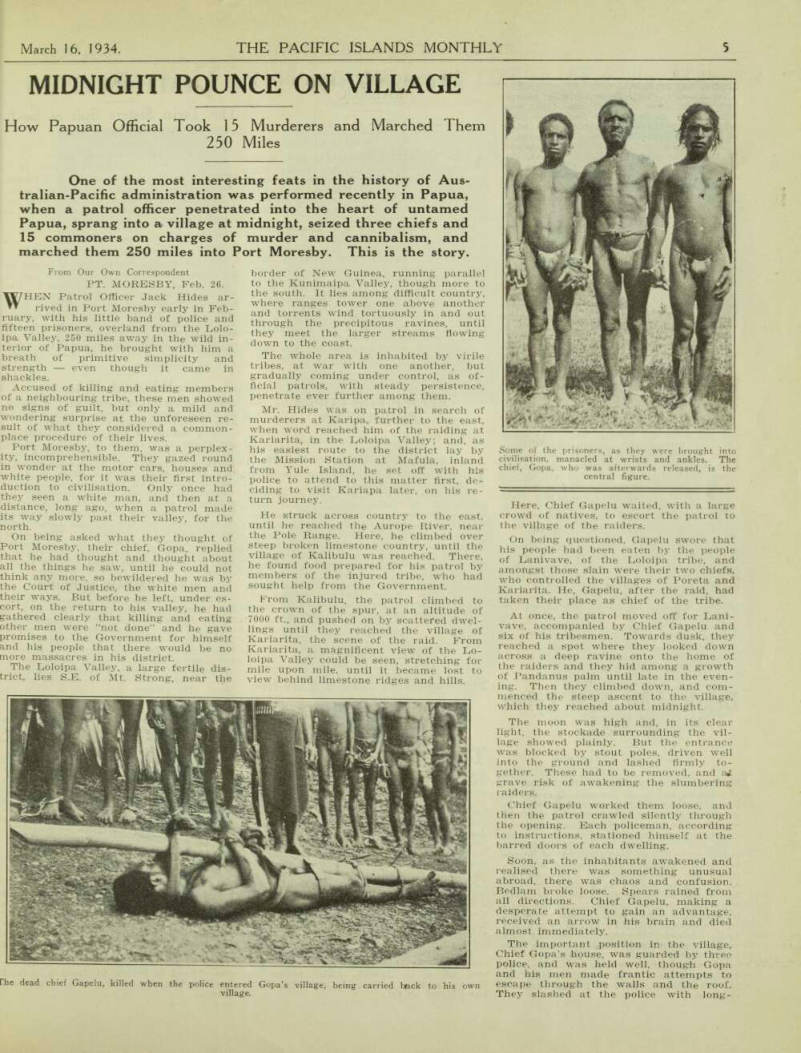
The dead chief Gapelu, killed when the police entered Gopa’s village, being carried black to his own village.
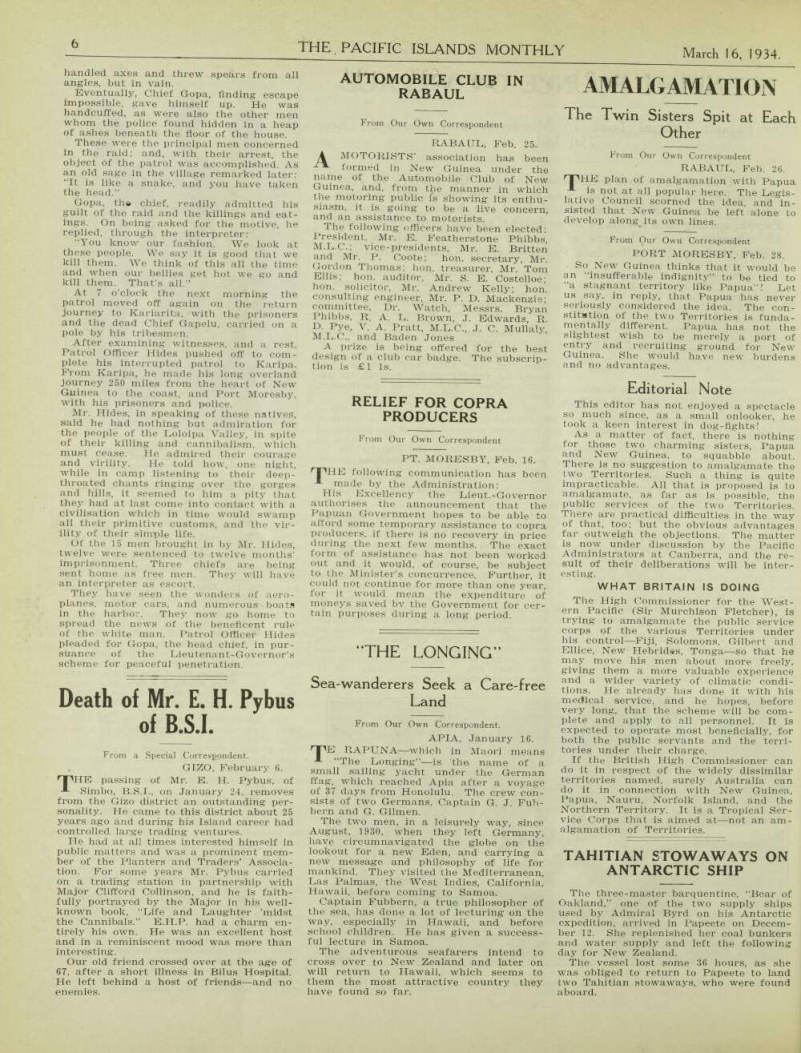
Some of the prisoners, as they were brought into civilisation, manacled at wrists and ankles. The chief, Gopa, who was afterwards released, is the central figure.
handled axes and threw spears from all angles, but in vain.
Eventually, Chief Gopa, finding escape impossible, gave himself up. He was handcuffed, as were also the other men whom the police found hidden in a heap of ashes beneath the floor of the house.
These were the principal men concerned in the raid; and, with their arrest, the object of the patrol was accomplished. As an old sage in the village remarked later: “It is like a snake, and you have taken the head.”
Gopa, the chief, readily admitted his guilt of the raid and the killings and eat ings. On being asked for the motive, he replied, through the interpreter: “You know our fashion. We look at these people. We say it is good that we kill them. We think of this all the time and when our bellies get hot we go and kill them. That’s all.”
At 7 o’clock the next morning the patrol moved off again on the return journey to Kariarita, with the prisoners and the dead Chief Gapelu, carried on a pole by his tribesmen.
After examining witnesses, and a rest, Patrol Officer Hides pushed off to com plete his interrupted patrol to Karipa.
From Karipa, he made his long overland journey 250 miles from the heart of New Guinea to the coast, and Port Moresby, with his prisoners and police.
Mr. Hides, in speaking of these natives, said he had nothing but admiration for the people of the Loloipa Valley, in spite of their killing and cannibalism, which must cease. He admired their courage and virility. He told how, one night, while in camp listening to their deep throated chants ringing over the gorges and hills, it seemed to him a pity that they had at last come into contact with a civilisation which in time would swamp all their primitive customs, and the vir ility of their simple life.
Of the 15 men brought in by Mr. Hides, twelve were sentenced to twelve months’ imprisonment. Three chiefs are being sent home as free men. They will have an interpreter as escort.
They have seen the wonders of aero planes, motor cars, and numerous boats in the harbor. They now go home to spread the news of the beneficent rule of the white man. Patrol Officer Hides pleaded for Gopa, the head chief, in pur suance of the Lieutenant-Governor’s scheme for peaceful penetration.