Concerning Monopolies
pp. 5-6 · Read in the full issue
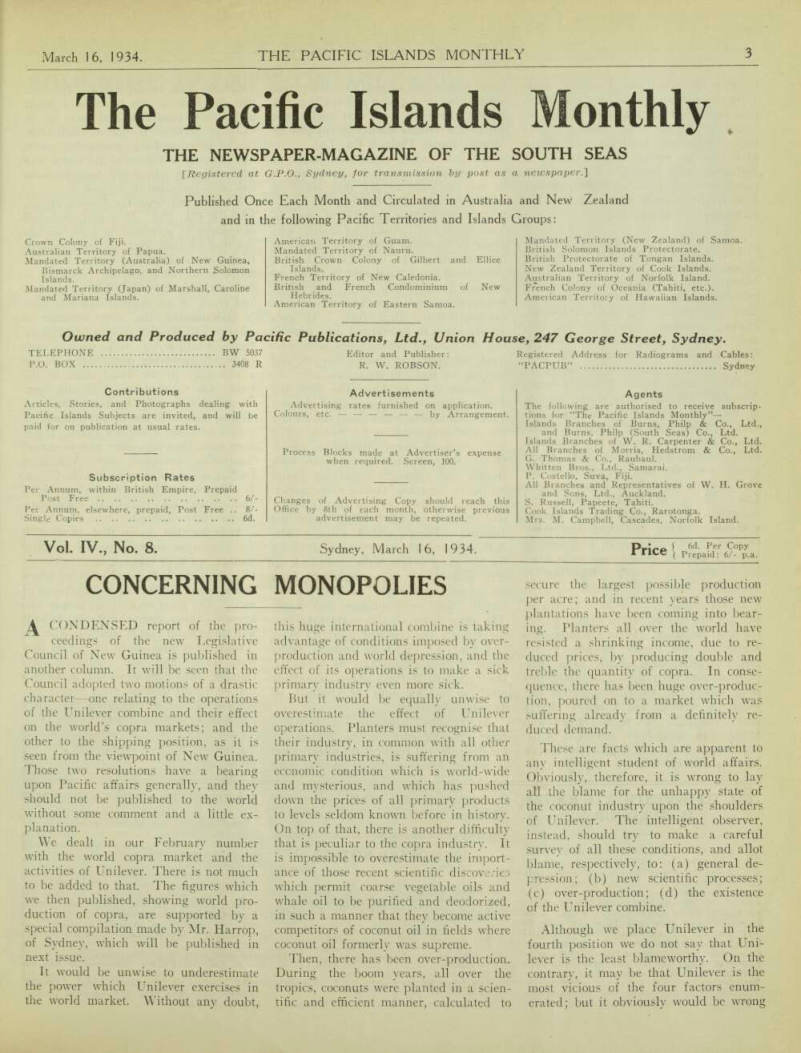
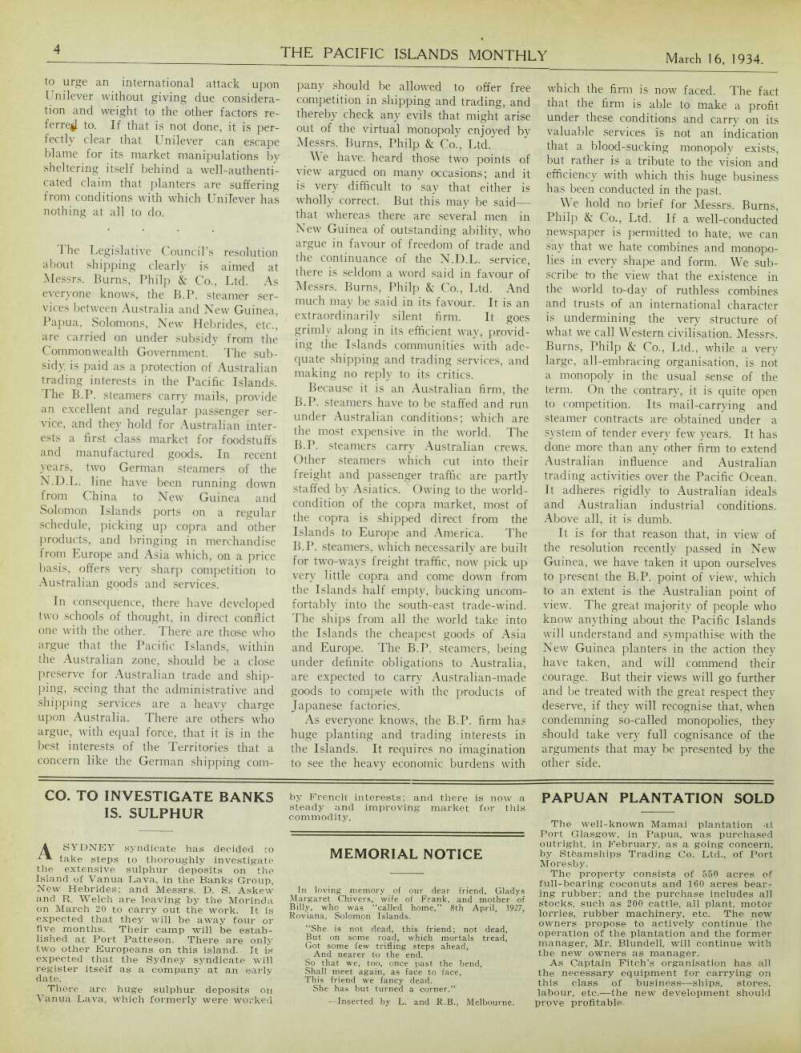
CONDENSED report of the pro ceedings of the new Legislative Council of New Guinea is published in another column. It will be seen that the Council adopted two motions of a drastic character —one relating to the operations of the Unilever combine and their effect on the world’s copra markets; and the other to the shipping position, as it is seen from the viewpoint of New Guinea.
Those two resolutions have a bearing upon Pacific affairs generally, and they should not be published to the world without some comment and a little ex
planation.
We dealt in our February number with the world copra market and the activities of Unilever. There is not much to be added to that. The figures which we then published, showing world pro duction of copra, are supported by a special compilation made by Mr. Harrop, of Sydney, which will be published in next issue.
It would be unwise to underestimate the power which Unilever exercises in the world market. Without any doubt,
this huge international combine is taking advantage of conditions imposed by over production and world depression, and the effect of its operations is to make a sick primary industry even more sick.
But it would be equally unwise to overestimate the effect of Unilever operations. Planters must recognise that their industry, in common with all other primary industries, is suffering from an economic condition which is world-wide and mysterious, and which has pushed down the prices of all primary products to levels seldom known before in history, On top of that, there is another difficulty that is peculiar to the copra industry. It is impossible to overestimate the import ance of those recent scientific discoveries which permit coarse vegetable oils and whale oil to be purified and deodorized, in such a manner that they become active competitors of coconut oil in fields where coconut oil formerly was supreme.
Then, there has been over-production, During the boom years, all over the tropics, coconuts were planted in a scien tific and efficient manner, calculated to
secure the largest possible production per acre; and in recent years those new plantations have been coming into bear ing. Planters all over the world have resisted a shrinking income, due to re duced prices, by producing double and treble the quantity of copra. In conse quence, there has been huge over-produc tion, poured on to a market which was suffering already from a definitely re duced demand.
These are facts which are apparent to any intelligent student of world affairs.
Obviously, therefore, it is wrong to lay all the blame for the unhappy state of the coconut industry upon the shoulders of Unilever. The intelligent observer, instead, should try to make a careful survey of all these conditions, and allot blame, respectively, to: (a) general de pression; (b) new scientific processes; (c) over-production; (d) the existence of the Unilever combine.
Although we place Unilever in the fourth position we do not say that Uni lever is the least blameworthy. On the contrary, it may be that Unilever is the most vicious of the four factors enum erated; but it obviously would be wrong
to urge an international attack upon Unilever without giving due considera tion and weight to the other factors re ferred to. If that is not done, it is per fectly clear that Unilever can escape blame for its market manipulations by sheltering itself behind a well-authenti cated claim that planters are suffering from conditions with which Unilever has nothing at all to do.
The Legislative Council’s resolution about shipping clearly is aimed at Messrs. Burns, Philp & Co., Ltd. As everyone knows, the B.P. steamer ser vices between Australia and New Guinea, Papua, Solomons, New Hebrides, etc., are carried on under subsidy from the Commonwealth Government. The sub sidy is paid as a protection of Australian trading interests in the Pacific Islands.
The B.P. steamers carry mails, provide an excellent and regular passenger ser vice, and they hold for Australian inter ests a first class market for foodstuffs and manufactured goods. In recent years, two German steamers of the N.D.L. line have been running down from China to New Guinea and Solomon Islands ports on a regular schedule, picking up copra and other products, and bringing in merchandise from Europe and Asia which, on a price basis, offers very sharp competition to Australian goods and services.
In consequence, there have developed two schools of thought, in direct conflict one with the other. There are those who argue that the Pacific Islands, within the Australian zone, should be a close preserve for Australian trade and ship ping, seeing that the administrative and
shipping services are a heavy charge
upon Australia. There are others who argue, with equal force, that it is in the best interests of the Territories that a concern like the German shipping com
pany should be allowed to offer free competition in shipping and trading, and thereby check any evils that might arise out of the virtual monopoly enjoyed by Messrs. Burns, Philp & Co., Ltd.
We have, heard those two points of view argued on many occasions; and it is very difficult to say that either is wholly correct. But this may be said — that whereas there are several men in New Guinea of outstanding ability, who argue in favour of freedom of trade and the continuance of the N.D.L. service, there is seldom a word said in favour of Messrs. Burns, Philp & Co., Ltd. And much may be said in its favour. It is an extraordinarily silent firm. It goes grimly along in its efficient way, provid ing the Islands communities with ade quate shipping and trading services, and making no reply to its critics.
Because it is an Australian firm, the B.P. steamers have to be staffed and run under Australian conditions; which are the most expensive in the world. The B.P. steamers carry Australian crews.
Other steamers which cut into their freight and passenger traffic are partly staffed by Asiatics. Owing to the world condition of the copra market, most of the copra is shipped direct from the Islands to Europe and America. The B.P. steamers, which necessarily are built for two-ways freight traffic, now pick up very little copra and come down from the Islands half empty, bucking uncom fortably into the south-east trade-wind.
The ships from all the world take into the Islands the cheapest goods of Asia and Europe. The B.P. steamers, being under definite obligations to Australia, are expected to carry Australian-made goods to compete with the products of Japanese factories.
As everyone knows, the B.P. firm has huge planting and trading interests in the Islands. It requires no imagination to see the heavy economic burdens with
which the firm is now faced. The fact that the firm is able to make a profit under these conditions and carry on its valuable services is not an indication that a blood-sucking monopoly exists, but rather is a tribute to the vision and efficiency with which this huge business has been conducted in the past.
We hold no brief for Messrs. Burns, Philp & Co., Ltd. If a well-conducted newspaper is permitted to hate, we can say that we hate combines and monopo lies in every shape and form. We sub scribe to the view that the existence in the world to-day of ruthless combines and trusts of an international character is undermining the very structure of what we call Western civilisation. Messrs.
Burns, Philp & Co., Ltd., while a very large, all-embracing organisation, is not a monopoly in the usual sense of the term. On the contrary, it is quite open to competition. Its mail-carrying and steamer contracts are obtained under a system of tender every few years. It has done more than any other firm to extend Australian influence and Australian trading activities over the Pacific Ocean.
It adheres rigidly to Australian ideals and Australian industrial conditions.
Above all, it is dumb.
It is for that reason that, in view of the resolution recently passed in New Guinea, we have taken it upon ourselves to present the B.P. point of view, which to an extent is the Australian point of view. The great majority of people who know anything about the Pacific Islands will understand and sympathise with the New Guinea planters in the action they have taken, and will commend their courage. But their views will go further and be treated with the great respect they deserve, if they will recognise that, when
condemning so-called monopolies, they
should take very full cognisance of the arguments that may be presented by the other side.