Workers And Non
p. 36 · Read in the full issue
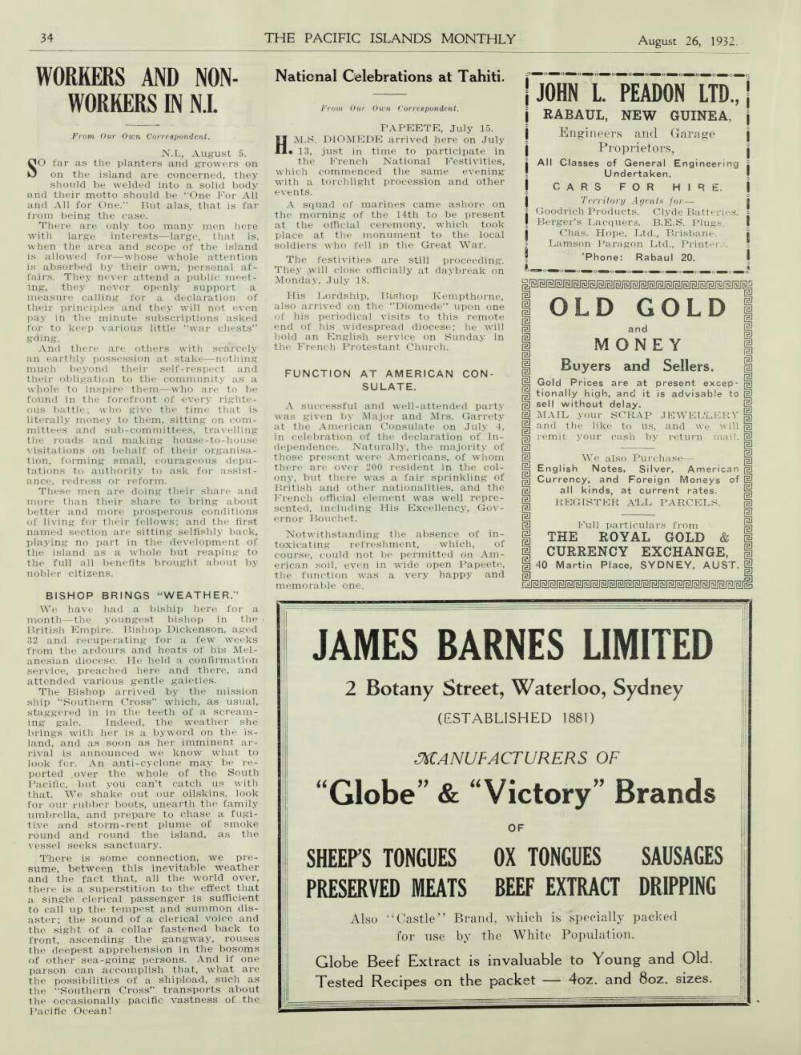
Workers In N.I.
From Our Own Correspondent.
N.I., August 5.
SO far as the planters and growers on on the island are concerned, they should be welded into a solid body and their motto should be ‘‘One For All and All for One.” But alas, that is far from being the case.
There are only too many men here with large interests—large, that is, when the area and scope of the island is allowed for—whose whole attention is absorbed by their own, personal af fairs. They never attend a public meet ing, they never openly support a measure calling for a declaration of their principles and they will not even pay in the minute subscriptions asked for to keep various little “war chests” going.
And there are others with scarcely an earthly possession at stake —nothing much beyond their self-respect and their obligation to the community as a whole to inspire them —who are to be found in the forefront of every righte ous battle; who give the time that is literally money to them, sitting on com mittees and sub-committees, travelling the roads and making house-to-house visitations on behalf of their organisa tion, forming small, courageous depu tations to authority to ask for assist ance, redress or reform.
These men are doing their share and more than their share to bring about better and more prosperous conditions of living for their fellows; and the first named section are sitting selfishly back, playing no part in the development of the island as a whole but reaping to the full all benefits brought about by nobler citizens.
Bishop Brings “Weather.”
We have had a biship here for a month —the youngest bishop in the British Empire. Bishop Dickenson, aged 32 and recuperating for a few weeks from the ardours and heats of his Mel anesian diocese. He held a confirmation service, preached here and there, and attended various gentle gaieties.
The Bishop arrived by the mission ship “Southern Cross” which, as usual, staggered in in the teeth of a scream ing gale. Indeed, the weather she brings with her is a byword on the is land, and as soon as her imminent ar rival is announced we know what to look for. An anti-cyclone may be re ported .over the whole of the South Pacific, but you can’t catch us with that. We shake out our oilskins, look for our rubber boots, unearth the family umbrella, and prepare to chase a fugi tive and storm-rent plume of smoke round and round the island, as the vessel seeks sanctuary.
There is some connection, we pre sume, between this inevitable weather and the fact that, all the world over, there is a superstition to the effect that a single clerical passenger is sufficient to call up the tempest and summon dis aster; the sound of a clerical voice and the sight of a collar fastened back to front, ascending the gangway, rouses the deepest apprehension in the bosoms of other sea-going persons. And if one parson can accomplish that, what are the possibilities of a shipload, such as the “Southern Cross” transports about the occasionally pacific vastness of the Pacific Ocean!