Copra Tax.
p. 16 · Read in the full issue
New Basis Causes Confusion In New Guinea.
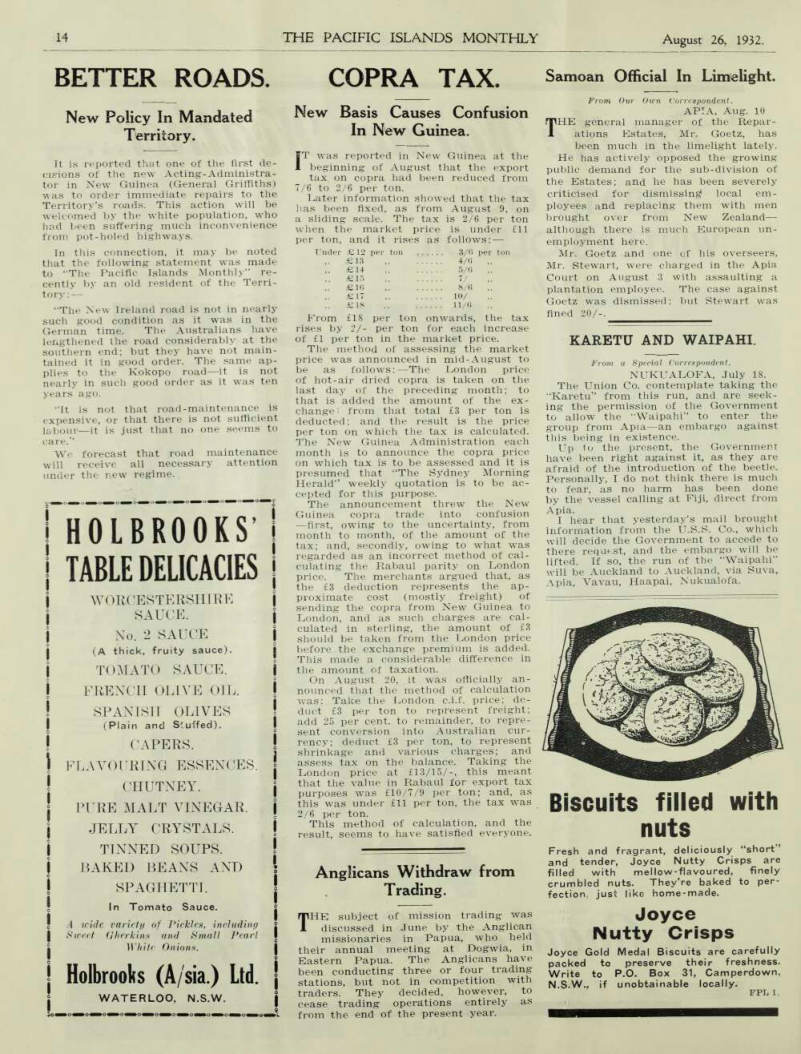
IT was reported in New Guinea at the beginning of August that the export tax on copra had been reduced from 7/6 to 2/6 per ton.
Later information showed that the tax has been fixed, as from August 9, on a sliding scale. The tax is 2/6 per ton when the market price is under £11 per ton, and it rises as follows: Under £12 per ton 3/6 per ton £13 4/6 „ £14 5/6 £15 7/ £16 .. 8/6 £17 10/ £18 11/6 From £18 per ton onwards, the tax rises by 2/- per ton for each increase of £1 per ton in the market price.
The method of assessing the market price was announced in mid-August to be as follows: —The London price of hot-air dried copra is taken on the last day of the preceding month; to that is added the amount of the ex change; from that total £3 per ton is deducted; and the result is the price per ton on which the tax is calculated.
The New Guinea Administration each month is to announce the copra price on which tax is to be assessed and it is presumed that “The Sydney Morning Herald” weekly quotation is to be ac cepted for this purpose.
The announcement threw the New Guinea copra trade into confusion —first, owing to the uncertainty, from month to month, of the amount of the tax; and, secondly, owing to what was regarded as an incorrect method of cal culating the Rabaul parity on London price. The merchants argued that, as the £3 deduction represents the ap proximate cost (mostly freight) of sending the copra from New Guinea to London, and as such charges are cal culated in sterling, the amount of £3 should be taken from the London price before the exchange premium is added.
This made a considerable difference in the amount of taxation.
On August 20, it was officially an nounced that the method of calculation was: Take the London c.i.f. price; de duct £3 per ton to represent freight; add 25 per cent, to remainder, to repre sent conversion into Australian cur rency; deduct £3 per ton, to represent shrinkage and various charges; and assess tax on the balance. Taking the London price at £13/15/-, this meant that the value in Rabaul for export tax purposes was £10/7/9 per ton; and, as this was under £11 per ton, the tax 2/6 per ton.
This method of calculation, and the result, seems to have satisfied everyone.