“Tropicalia” And Other Things In New Guinea And Papua.
pp. 5-7 · Read in the full issue
(By R. W. Robson.)
IT is impossible, within the compass of one magazine article, to deal adequately with the numerous subjects which came under my notice during a recent visit to Papua and New Guinea. At this stage, I can only summarise my impressions.
My chief feeling is one of relief that there has been a change in the Administratorship of New Guinea.
General Wisdom triumphed over so many of his earlier difficulties, and has left with so good a record, and is personally such a courteous, likeable man, that I should have been a most unwilling critic of his administration. As it is, he has retired, and a new policy is taking shape—so we may leave the past to bury its dead, and concern ourselves only with seeing that certain conditions which have developed in Rabaul in recent years are not perpetuated.
And, now, for some generalities.
The natural wealth of New Guinea has been barely touched, as yet.
The N.G. Administration has been singularly suc cessful in creating an efficient personnel out of nothing, within eleven years, and in bringing numer
ous large districts of dangerous savages under con trol. I went from one end of the Territory to the other, and I heard not one word impugning the per sonal honour and integrity of an official. I heard men, here and there, criticised for officiousness, fat headedness and tactlessness; but, for the most part, officials are esteemed, and almost all are personally respected. That is a remarkable record, and very creditable to Australia.
The N.G. Administration has done little, during eleven years, to encourage private enterprise to enter and develop the Territory. Its public works policy has been feeble, and its public health policy, insofar as it has sought to control the diseases which attack Europeans, is a wash-out.
The N.G. Administration, in recent years, has fallen under the domination of bureaucracy. Bureauc racy, plus that climatic weariness called “Tropi calia,” produced the exasperating condition known as “Rabaul inertia.” It has been seen in various forms—in high officialdom’s insistence on its exclu siveness and privileges; in its discouragement of en terprise and enthusiasm among subordinate officers;
in its stubborn centralisation; and in its maddening refusal to give prompt, businesslike decisions.
A broad-visioned policy, in which the encourage ment of private enterprise is not necessarily excluded by considerations of native welfare, has animated the Administration of Papua, where there is a well trained and highly efficient personnel, and a remark able esprit de corps.
Had there been no “depression,” Papua’s increas ing production would long since have given the Territory a permanently favourable trade balance, and so justified the heavy administrative cost. Under present conditions, the Territory is top-heavy, and its future administration is a problem for Australia.
Taking the broad view, there is a good deal to be said for the amalgamation of these Territories. Why not one big Territory, governed by Australia, and including New Guinea, Papua and the whole of the Solomon Islands? Conditions throughout these three countries are almost identical. They could be easily administered from a central point, like Rabaul or Samarai.
It would be easier to bring the administrative con ditions of the three Territories into line, while care fully observing the terms of the Mandate, than it would be to create a homogeneous Tropical Corps, under which one body of administrative officials would have to deal with three separate and widely differing sets of laws and regulations.
One big administrative organisation would stimu late the developmental impulse now stirring in New Guinea, and solve the administrative problems rep resented by top-heavy Papua and the languishing Solomons. I have recently met thoughtful men who say it can’t be done. I have still to learn why.
The copra-producers of Papua and New Guinea are the most comfortably-placed of any in the Pacific.
They have little or no taxation; they have an abun dance of cheap labour; the N.G. men on expropriated plantations are enjoying a moratorium; and they are getting the advantage of the Australian exchange— equal to a premium of at least 20 per cent, on copra prices.
The western end of New Guinea, under the in fluence of the rapidly developing goldfield, is in a condition of eager, healthy activity and feverish op timism. This is affecting the whole Territory where, under the inevitable stimulus of big-scale gold pro duction, a boom is anticipated.
A new era is dawning in New Guinea. The arrival of the Acting Administrator, Brig.-General Tom Griffiths, has had the effect of a fresh wind blowing through the Departments. A new conception of the responsibility of the Administration —the combined effect of a new interest at Canberra, a new hand on the helm at Rabaul, and new economic forces operat ing from the goldfield—will surely uproot Bureauc racy and dissipate Rabaul’s deadly inertia. New Guinea, as is right and proper, in the early future will provide Australia with abundant opportunities for the enterprise of her young men and the invest ment of her spare capital.
The N.G. Administration is under a definite obliga tion to provide the Territory with better transport
facilities and more healthy conditions of living. In recent times, it has been collecting, in Salamaua, Lae, and the goldfields centres, revenue at the rate of £100,000 per annum, in taxes, customs revenue and gold bounty; and has given, in return, practically nothing beyond the bare minimum of ordinary de partmental services.
The N.G. Administration has left the gold-mining companies to provide their own transport services. It would not even permit its goldfields warden to cut a track from Wau to Bulolo. It has not provided the 40 white women and children in Wau with any nurs ing assistance; yet it has sent two highly qualified nurses out into the wilds beyond Kokopo, to teach “child welfare” to the bush Marys. There are only two or three white policemen to look after Salamaua, Lae, Wau and Bulolo; yet in Rabaul, where the Euro pean population is not much in excess of that of the goldfield, there are so many white policemen that the thing is a joke and a by-word. A little energy in pile-driving and concrete-construction during the past two years would have prevented much costly sea-erosion at Salamaua. Nothing was done —yet the Administration wasted some hundreds of pounds on some utterly futile pile-driving on the Rabaul-Kokopo road. However, the foregoing is merely the result of an unchecked bureaucracy, and I believe that that deplorable condition has ended.
There are a dozen subjects of this nature with which one might deal, all tempting one into a some what pettifogging discussion of the late Administra tion’s sins of omission and commission. I think we should be more concerned with the future —with the vigorous, intelligent development of this amazingly rich Territory that has been handed over to Aus tralian administration. Australia’s record there is not bad. It has been, in certain respects, feeble and footling to the point of purposelessness, but it is not discreditable. And, so far as the protection and wel fare of the native inhabitants are concerned, it has been very successful. But that by no means repre sents a discharge of Australia’s obligations as a Man datory of the League of Nations.
One point remains for attention in this brief sum mary of the position as I saw it.
The N.G. Administration, although it has not lacked funds, has done practically nothing in a big way to seek control of the diseases which attack Europeans, and the pests which menace agriculture.
Malaria is New Guinea’s scourge. It reduces in dustrial efficiency by anything up to 30 per cent.
Without malaria, European adults might live quite comfortably in the Territory. I have searched through the Administrator’s reports covering several years, and I have found nothing to show that the Administration has even visualised a Territory prob lem regarding malaria, let alone made any attempt to handle it. The subject is too big and important to be dealt with here. We shall give it attention in an early issue.
There is nothing much wrong ivith New Guinea —nothing that cannot he easily remedied. But one gets the clear im pression that a few high officials have been a little too long in Rabaul. This ‘Tropicalia”!
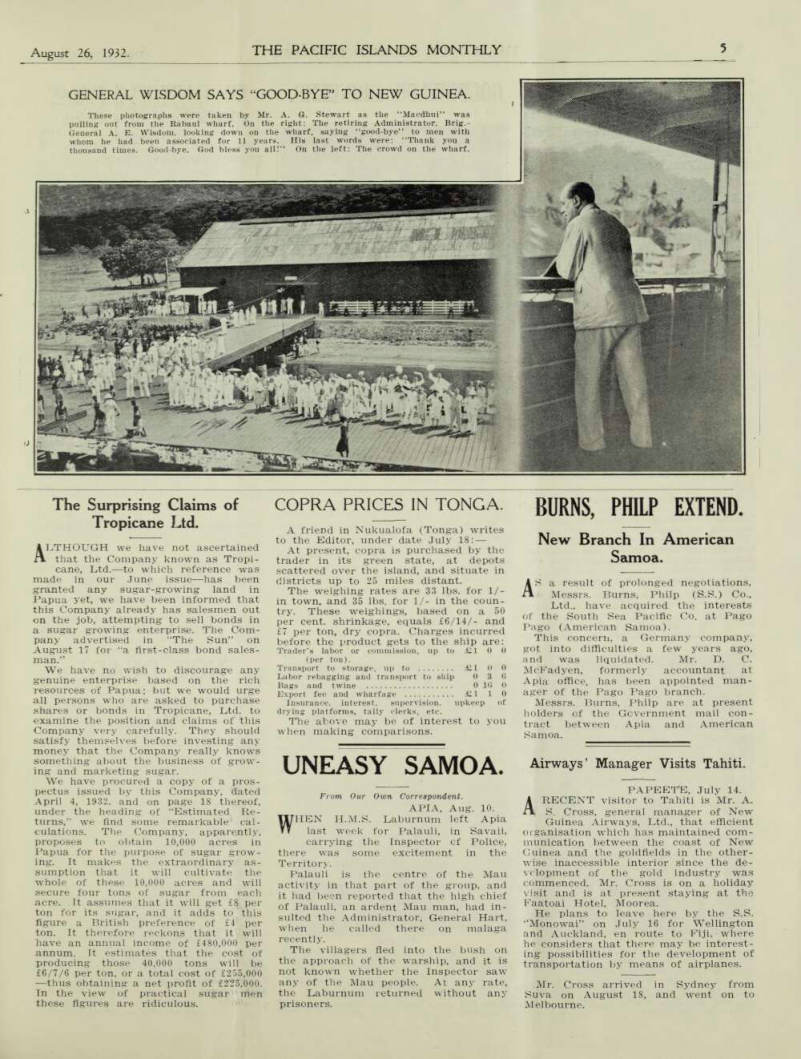
GENERAL WISDOM SAYS “GOOD-BYE” TO NEW GUINEA.
These photographs were taken by Mr. A. G. Stewart as the “Macdhui” was pulling out from the Rabaul wharf. On the right: The retiring Administrator, Brig.- General A. E. Wisdom, looking down on the wharf, saying “good-bye” to men with whom he had been associated for 11 years. His last words were: “Thank you a thousand times. Good-bye. God bless you all!” On the left: The crowd on the wharf.