Burns, Philp, Ltd.
p. 45 · Read in the full issue
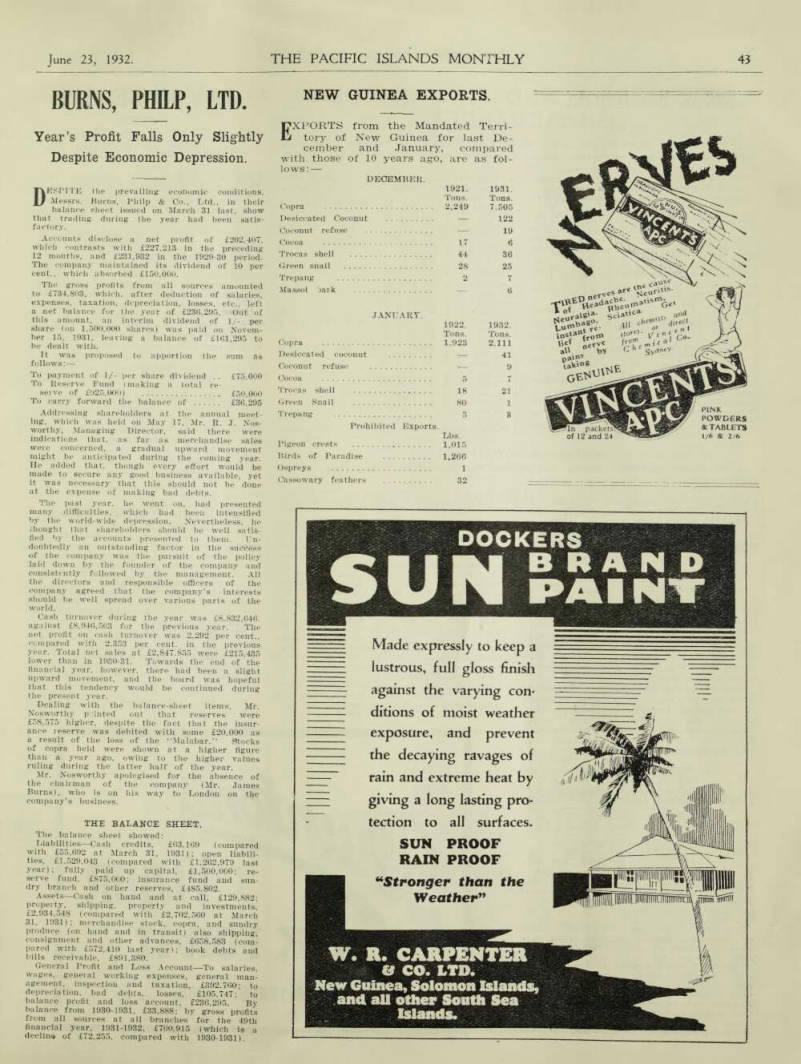
Year’s Profit Falls Only Slightly Despite Economic Depression.
DESPITE the prevailing economic conditions, Messrs. Burns, Philp & Co., Ltd., in their balance sheet issued on March 31 last, show that trading during the year had been satis factory.
Accounts disclose a net profit of £202,407, which contrasts with £227,213 in the preceding 12 months, and £231,932 in the 1929-30 period.
The company maintained its dividend of 10 per cent., which absorbed £150,000.
The gross profits from all sources amounted to £734,803, which, after deduction of salaries, expenses, taxation, depreciation, losses, etc., left a net balance for the year of £236,295. Out of this amount, an interim dividend of 1/- per share (on 1.500,000 shares) was paid on Novem ber 15, 1931, leaving a balance of £161,295 to be dealt with.
It was proposed to apportion the sum as follows: To payment of 1/- per share dividend . . £75,000 To Reserve Fund (making a total re serve of £925,000) £50,000 To carry forward the balance of £36,295 Addressing shareholders at the annual meet ing, which was held on May 17, Mr. R. J. Nos worthy, Managing Director, said there were indications that, as far as merchandise sales were concerned, a gradual upward movement might be anticipated during the coming year.
He added that, though every effort would be made to secure any good business available, yet it was necessary that this should not be done at the expense of making bad debts.
Tire past year, he went on, had presented many difficulties, which had been intensified by the world-wide depression. Nevertheless, he thought that shareholders should be well satis fied by the accounts presented to them. Un doubtedly an outstanding factor in the success of the company was the pursuit of the policy laid down by the founder of the company and consistently followed by the management. All the directors and responsible officers of the company agreed that the company’s interests should be well spread over various parts of the world.
Cash turnover during the year was £8,832,646. against £8,946,563 for the previous year. The net profit on cash turnover was 2,292 per cent., compared with 2.353 per cent, in the previous year. Total net sales at £2,847,855 were £215,435 lower than in 1930-31. Towards the end of the financial year, however, there had been a slight upward movement, and the board was hopeful that this tendency would be continued during the present year.
Dealing with the balance-sheet items, Mr.
Nosworthy pointed out that reserves were £58,575 higher, despite the fact that the insur ance reserve was debited with some £20,000 as a result of the loss of the “Malabar.” Stocks of copra held were shown at a higher figure than a year ago, owing to the higher values ruling during the latter half of the year.
Mr. Nosworthy apologised for the absence of the chairman of the company (Mr. James Burns), who is on his way to London on the company’s business.
The Balance Sheet.
The balance sheet showed: Liabilities—Cash credits, £63,169 (compared with £55,692 at March 31, 1931); open liabili ties, £1,529,043 (compared with £1,262,979 last year); fully paid up capital, £1,500,000; re serve fund, £875,000; insurance fund and sun dry branch and other reserves, £485.802.
Assets—Cash on hand and at call, £129,882; property, shipping, property and investments. £2,934,548 (compared with £2.702,560 at March 31, 1931); merchandise stock, copra, and sundry produce (on hand and in transit) also shipping, consignment and other advances, £658,583 (com pared with £572,410 last year); book debts and bills receivable, £891,380.
General Profit and Loss Account—To salaries, wages, general working expenses, general man agement, inspection and taxation, £392.760; to depreciation, bad debts, losses, £105,747; to balance profit and loss account, £236,295. By balance from 1930-1931, £33,888; by gross profits from all sources at all branches for the 49th financial year. 1931-1932, £700,915 (which is a decline of £72,255, compared with 1930-1931).