Power Fuel Distribution In Pacific.
p. 42 · Read in the full issue
J)URING the past 20 years, two public utilities have been introduced to the Pacific Islands, and have revolutionised life there.
One is the internal combustion engine—the other is radio.
They have both been responsible for removing the “deadly isolation” of the Islands.
The internal combustion engine has made possible the wide use of launches, of motor cars on all the bigger islands, and of power plants for doing a score of necessary things. The next big development in the Islands will be the wide use of aeroplanes: and the internal combustion engine, again, makes
this possible.
THE general and increasing use of in ternal combustion engines has created a great demand for oil fuel, and the need has been met by the oil companies, who have provided a most complete organisation for supplying the Pacific territories with spirit and oil fuel. The Vacuum Oil Co., Ltd. was the pioneer of this field; and the fol lowing is the story of its enterprise.
This company has given to the com munities of the Pacific Islands practi cally the same facilities of bulk storage and quick distribution as are enjoyed by the people of Australia and New Zealand.
Twenty-five years ago, representa tives of the Vacuum Oil Company, which was well established in Aus tralia, came to the Islands with in structions to make a survey of the con ditions, with the object of supplying a distributing organisation for petroleum products. In those days the planters relied upon various types of sailing vessels for the transportation of their products to main ports of transhipment.
Inter-island trading had its dangers, its risks and its delays. The unavoidable missing of a steamer working to schedule was sometimes a costly busi ness. But up-to-date engines on shore and on shipboard, with reliable fuel and oil supply, have removed those risks and speeded up the life and work
of the island communities, bringing them closer together and providing more of the amenities of life. Planters nowadays maintain quick communica tion by launch, instead of depending on slow and erratic sailing vessels.
Only recently an aeroplane conveyed a sick patient from a distant island to medical assistance in Suva. In Suva and Noumea, nowadays, hundreds of motor cars busily pass through the streets, while Indian and native police direct the traffic.
From the early days the Vacuum Company demonstrated its faith in the islands in a score of ways. It spent thousands of pounds on the purchase of land, and in building warehouses at all principal ports, believing that the future would amply justify the expen diture.
In 1928, kerbside petrol pumps made their appearance in several of the Is lands centres. To-day, age-old palm trees, that once waved their fronds above the war-canoes of the islanders’ ancestors, now cast their shadows on this symbol of civilisation awheel.
Then, to widen the use of mechanical transport in the Islands, bulk supplies were inaugurated.
Vessels under both sail and steam were chartered to bring petroleum pro ducts direct to the Islands from Am erica. In keeping with its ideals of
service, the Company always sought to make its products available as eco nomically and efficiently as possible.
One instance of this was the Company’s decision, many years ago, to eliminate the freight charges incurred on its products by transhipment via Sydney, by putting in direct vessels from Am erica.
This marketing innovation, which is still in force, removed a restriction on the use of automotive units throughout the Islands, because buyers of small quantities could thenceforth draw sup plies from stocks on the spot.
In addition, it ensured delivery of packages with the minimum of damage.
L<oss through leakage of damaged con tainers, generally unavoidable with the methods of handling cargoes in Island ports which then obtained, was another waste greatly reduced. Plantation owners have reaped the benefit of these savings because the price of petrol, as charged to them, became steadily less.
The bringing of ships to the islands with cargoes of petroleum products presented another boon, for when the chartered vessels discharged their oil cargoes they frequently lifted copra cargoes.
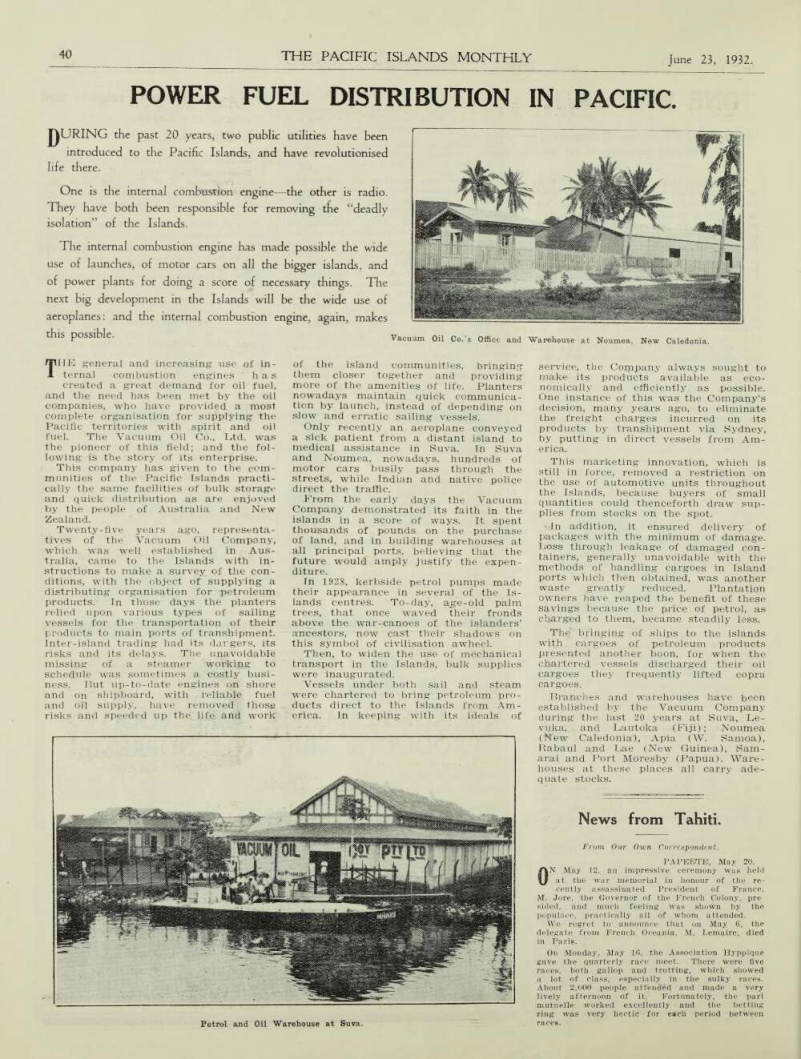
Branches and warehouses have been established by the Vacuum Company during the last 20 years at Suva, Le vuka, and Lautoka (Fiji); Noumea (New Caledonia), Apia (W. Samoa), Rabaul and Lae (New Guinea), Sam arai and Port Moresby (Papua). Ware houses at these places all carry ade quate stocks.
Petrol and Oil Warehouse at Suva.
Vacuum Oil Co. s Office and Warehouse at Noumea, New Caledonia.