Samoa And “Polarity”
p. 31 · Read in the full issue
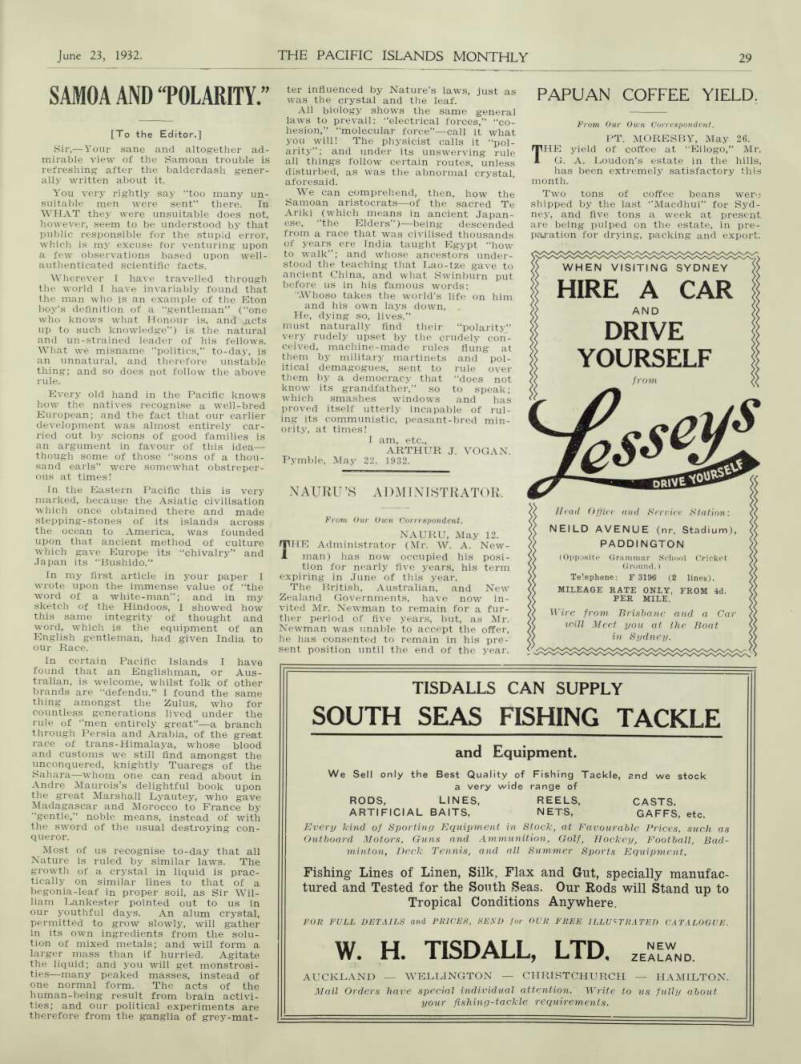
[To the Editor.] Sir, —Your sane and altogether ad mirable view of the Samoan trouble is refreshing after the balderdash gener ally written about it.
You very rightly say “too many un suitable men were sent” there. In WHAT they were unsuitable does not, however, seem to be understood by that public responsible for the stupid error, which is my excuse for venturing upon a few observations based upon well authenticated scientific facts.
Wherever I have travelled through the world I have invariably found that the man who is an example of the Eton boy’s definition of a “gentleman” (“one who knows what Honour is, and acts up to such knowledge”) is the natural and un-strained leader of his fellows.
What we misname “politics,” to-day, is an unnatural, and therefore unstable thing; and so does not follow the above rule.
Every old hand in the Pacific knows how the natives recognise a well-bred European; and the fact that our earlier development was almost entirely car ried out by scions of good families is an argument in favour of this idea — though some of those “sons of a thou sand earls” were somewhat obstreper ous at times!
In the Eastern Pacific this is very marked, because the Asiatic civilisation which once obtained there and made stepping-stones of its islands across the ocean to America, was founded upon that ancient method of culture which gave Europe its “chivalry” and Japan its “Bushido.”
In my first article in your paper I wrote upon the immense value of “the word of a white-man”; and in my sketch of the Hindoos, I showed how this same integrity of thought and word, which is the equipment of an English gentleman, had given India to our Race.
In certain Pacific Islands I have found that an Englishman, or Aus tralian, is welcome, whilst folk of other brands are “defendu.” I found the same thing amongst the Zulus, who for countless generations lived under the rule of “men entirely great”—a branch through Persia and Arabia, of the great race of trans-Himalaya, whose blood and customs we still find amongst the unconquered, knightly Tuaregs of the Sahara—whom one can read about in Andre Maurois’s delightful book upon the great Marshall Lyautey, who gave Madagascar and Morocco to France by “gentle,” noble means, instead of with the sword of the usual destroying con queror.
Most of us recognise to-day that all Nature is ruled by similar laws. The growth of a crystal in liquid is prac tically on similar lines to that of a begonia-leaf in proper soil, as Sir Wil liam Lankester pointed out to us in our youthful days. An alum crystal, permitted to grow slowly, will gather in its own ingredients from the solu tion of mixed metals; and will form a larger mass than if hurried. Agitate the liquid; and you will get monstrosi ties—many peaked masses, instead of one normal form. The acts of the human-being result from brain activi ties; and our political experiments are therefore from the ganglia of grey-mat
ter influenced by Nature’s laws, just as was the crystal and the leaf.
All biology shows the same general laws to prevail: “electrical forces,” “co hesion,” “molecular force” —call it what you will! The physicist calls it “pol arity” ; and under its unswerving rule all things follow certain routes, unless disturbed, as was the abnormal crystal, aforesaid.
We can comprehend, then, how the Samoan aristocrats—of the sacred Te Ariki (which means in ancient Japan ese, “the Elders”) —being descended from a race that was civilised thousands of years ere India taught Egypt “how to walk’’; and whose ancestors under stood the teaching that Lao-tze gave to ancient China, and what Swinburn put before us in his famous words: “Whoso takes the world’s life on him and his own lays down, He, dying so, lives.” must naturally find their “polarity” very rudely upset by the crudely con ceived, machine-made rules flung at them by military martinets and pol itical demagogues, sent to rule over them by a democracy that “does not know its grandfather,” so to speak; which smashes windows and has proved itself utterly incapable of rul ing its communistic, peasant-bred min ority, at times!
I am, etc.,
Arthur J. Vogan.
Pymble, May 22, 1932.