Cost Of Running A N. Guinea Plantation.
p. 20 · Read in the full issue
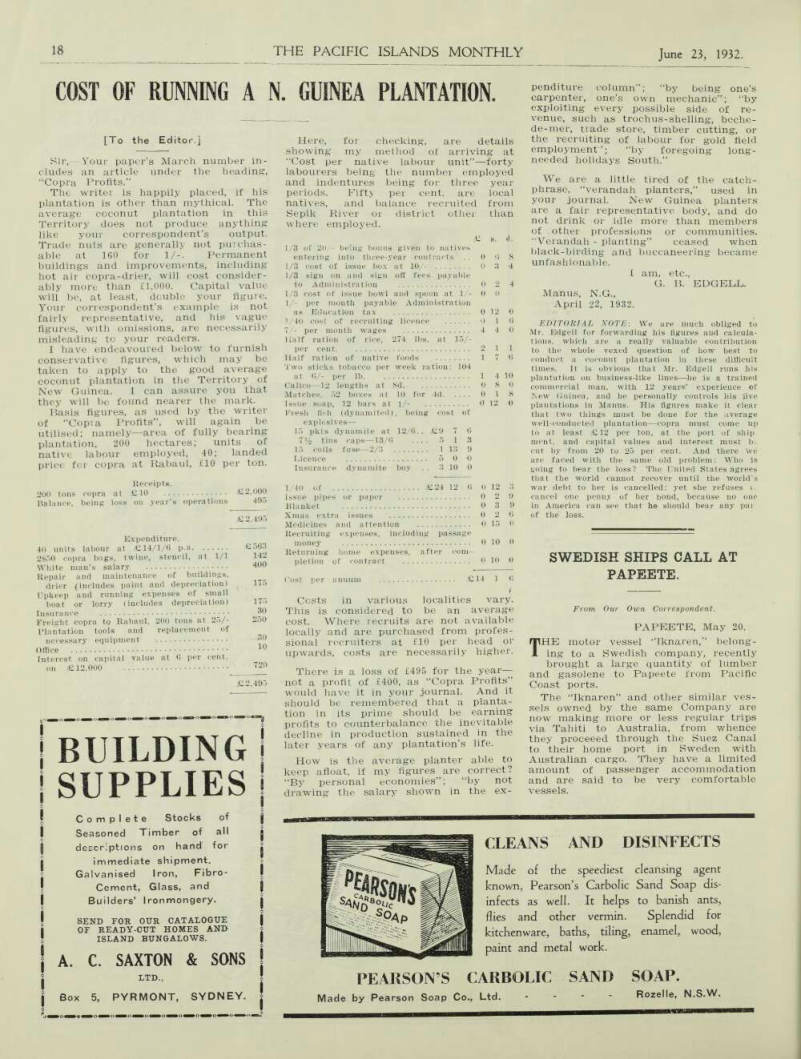
[To the Editor.] Sir, — Your paper’s March number in cludes an article under the heading, “Copra Profits.”
The writer is happily placed, if his plantation is other than mythical. The average coconut plantation in this Territory does not produce anything like your correspondent’s output.
Trade nuts are generally not purchas able at 160 for 1/-. Permanent buildings and improvements, including hot air copra-drier, will cost consider ably more than £1,000. Capital value will be, at least, double your figure.
Your correspondent’s example is not fairly representative, and his vague figures, with omissions, are necessarily misleading to your readers.
I have endeavoured below to furnish conservative figures, which may be taken to apply to the good average coconut plantation in the Territory of New Guinea. I can assure you that they will be found nearer the mark.
Basis figures, as used by the writer of ‘‘Copia Profits”, will again be utilised; namely—area of fully bearing plantation, 200 hectares; units of native labour employed, 40; landed price for copra at Rabaul, £10 per ton.
Here, for checking, are details showing my method of arriving at “Cost per native labour unit” —forty labourers being the number employed and indentures being for three year periods. Fifty per cent, are local natives, and balance recruited from Sepik River or district other than where employed.
Costs in various localities vary.
This is considered to be an average cost. Where recruits are not available locally and are purchased from profes sional recruiters at £10 per head or upwards, costs are necessarily higher.
There is a loss of £495 for the year— not a profit of £400, as “Copra Profits” would have it in your journal. And it should be remembered that a planta tion in its prime should be earning profits to counterbalance the inevitable decline in production sustained in the later years of any plantation’s life.
How is the average planter able to keep afloat, if my figures are correct?
“By personal economies”; “by not drawing the salary shown in the ex
penditure column”; “by being one’s carpenter, one’s own mechanic”; “by exploiting every possible side of re venue, such as trochus-shelling, beche de-mer, trade store, timber cutting, or the recruiting of labour for gold field employment’; “by foregoing long needed holidays South.”
We are a little tired of the catch phrase, “verandah planters,” used in your journal. New Guinea planters are a fair representative body, and do not drink or idle more than members of other professions or communities.
“Verandah - planting” ceased when black-birding and buccaneering became unfashionable.
I am, etc.,
G. B. Edgell.
Manus, N.G.,
April 22, 1932.
EDITORIAL NOTE: We are much obliged to Mr. Edgell for forwarding his figures and calcula tions, which are a really valuable contribution to the whole vexed question of how best to conduct a coconut plantation in these difficult times. It is obvious that Mr. Edgell runs his plantation on business-like lines —he is a trained commercial man, with 12 years’ experience of ftew Guinea, and he personally controls his five plantations in Manus. His figures make it clear that two things must be done for the average well-conducted plantation—copra must come up to at least £12 per ton, at the port of ship ment, and capital values and interest must b. cut by from 20 to 25 per cent. And there we are faced with the same old problem; Who is going to bear the loss? The United States agrees that the world cannot recover until the world’s war debt to her is cancelled: yet she refuses to cancel one penny of her bond, because no one in America can see that he should bear any par of the loss.
Receipts. 200 tons copra at £10 Balance, being loss on year’s operations £2,000 495 £2,495 Expenditure. 40 units labour at £14/1/6 p.a 2850 copra bags, twine, stencil, at 1/1 £563 142 400 Repair and maintenance of buildings, drier (includes paint and depreciation) Upkeep and running expenses of small boat or lorry (includes depreciation) 175 175 30 Freight copra to Rabaul, 200 tons at 2.»/- Plantation tools and replacement of 250 30 10 Interest on capital value at 6 per cent. on £12 000 720 £2,495
£ s. d. 1/3 of 20/- being bonus given to natives entering into three-year contracts 0 Q 8 0 3 4 1/3 sign on and sign off fees payable 0 2 4 1/3 cost of issue bowl and spoon at 1, - 0 0 1/- per month payable Administration as Education tax 0 0 12 0 1 40 cost of recruiting licence 1 6 4 4 0 Half ration of rice, 274 lbs. at 15/- 2 1 1 6 1 Two sticks tobacco per week ration: 104 1 4 10 0 s 0 Matches, 52 boxes at 10 for Id 0 1 8 0 12 0 Fresh fish (dynamited), being cost of explosives— 15 pkts dynamite at 12/6.. £9 7 6 7½ tins caps—13/6 ... 5 1 3 15 coils fuse—2/3 1 13 9 Licence 5 0 0 Insurance dynamite boy . . 3 10 0 1/40 of £24 12 6 0 12 3 Issue pipes or paper 0 9 Blanket 0 3 9 Xmas extra issues 0 2 6 Medicines and attention 0 15 0 Recruiting expenses, including passage money 0 10 0 Returning home expenses, after completion of contract 0 10 0 Cost ner annum £14 1 6