Early Papua.
p. 13 · Read in the full issue
An Old Newspaper and a Remarkable Coincidence.
THIS is the story of a somewhat re markable coincidence.
A friend in Melbourne sent to the editor of this journal a copy of a news paper, now defunct —The Australasian Sketcher, of December 16, 1885.
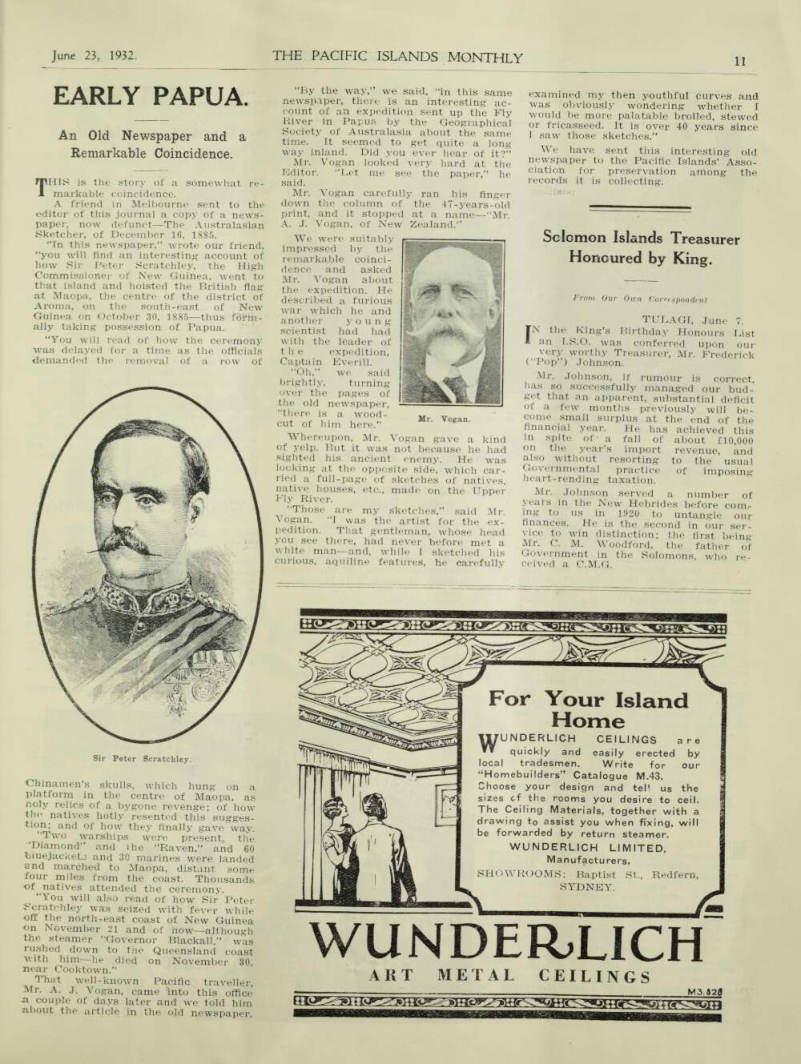
“In this newspaper,” wrote our friend, “you will find an interesting account of how Sir Peter Scratchley, the High Commissioner of New Guinea, went to that island and hoisted the British flag at Maopa, the centre of the district of Aroma, on the south-east of New Guinea on October 30, 1885 —thus form ally taking possession of Papua.
“You will read of how the ceremony was delayed for a time as the officials demanded the removal of a row of
Chinamen’s skulls, which hung on a platform in the centre of Maopa, as holy relics of a bygone revenge; of how the natives hotly resented this sugges tion; and of how they finally gave way.
“Two warships were present, the ‘Diamond” and ihe “Raven,” and 60 bluejackets and 30 marines were landed and marched to Maopa, distant some four miles from the coast. Thousands of natives attended the ceremony.
“You will also read of how Sir Peter Scratchley was seized with fever while off the north-east coast of New Guinea on November 21 and of how—although the steamer “Governor Blackall,” was rushed down to the Queensland coast with him—he died on November 30, near Cooktown.”
That well-known Pacific traveller, Mr. A. J. Vogan, came into this office a couple of days later and we told him about the article in the old newspaper.
“By the way,” we said, “in this same newspaper, there is an interesting ac count of an expedition sent up the Fly River in Papua by the Geographical Society of Australasia about the same time. It seemed to get quite a long way inland. Did you ever hear of it?”
Mr. Vogan looked very hard at the Editor. “Let me see the paper,” he said.
Mr. Vogan carefully ran his finger down the column of the 47-years-old print, and it stopped at a name—“ Mr.
A. J. Vogan, of New Zealand.”
We were suitably impressed by the remarkable coinci dence and asked Mr. Vogan about the expedition. He described a furious war which he and another young scientist had had with the leader of the expedition, Captain Everill.
“Oh,” we said brightly, turning over the pages of the old newspaper, “there is a wood cut of him here.”
Whereupon, Mr. Vogan gave a kind of yelp. But it was not because he had sighted his ancient enemy. He was looking at the opposite side, which car ried a full-page of sketches of natives, native houses, etc., made on the Upper Fly River.
“Those are my sketches,” said Mr.
Vogan. “I was the artist for the ex pedition. That gentleman, whose head you see there, had never before met a white man—and, while I sketched his curious, aquiline features, he carefully
examined my then youthful curves and was obviously wondering whether I would be more palatable broiled, stewed or fricasseed. It is over 40 years since I saw those sketches.”
We have sent this interesting old newspaper to the Pacific Islands’ Asso ciation for preservation among the records it is collecting.
Sir Peter Scratchley.
Mr. Vogan.