Fiji’S Strong Trade
p. 12 · Read in the full issue
Position.
RECENT reports disclose the extra ordinarily sound financial position of the Crown Colony of Fiji.
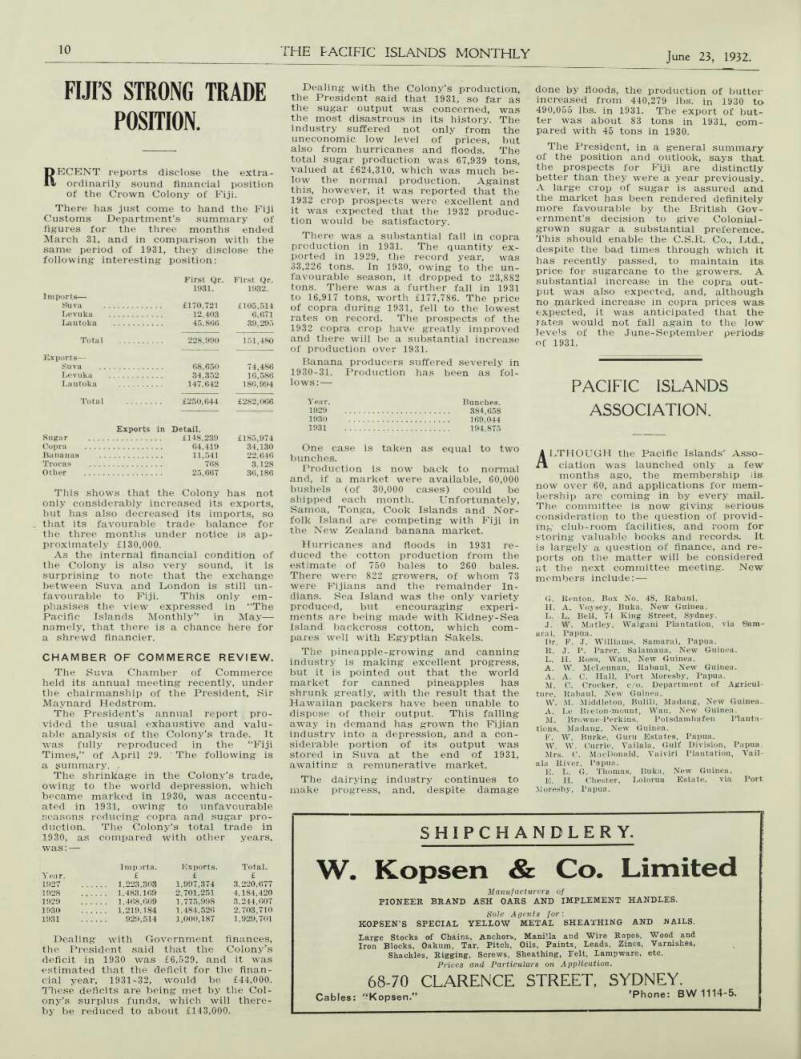
There has just come to hand the Fiji Customs Department’s summary of figures for the three months ended March 31, and in comparison with the same period of 1931, they disclose the following interesting position:
This shows that the Colony has not only considerably increased its exports, but has also decreased its imports, so that its favourable trade balance for the three months under notice is ap proximately £130,000.
As the internal financial condition of the Colony is also very sound, it is surprising to note that the exchange between Suva and London is still un favourable to Fiji. This only em phasises the view expressed in “The Pacific Islands Monthly” in May— namely, that there is a chance here for a shrewd financier.
Chamber Of Commerce Review.
The Suva Chamber of Commerce held its annual meeting recently, under the chairmanship of the President, Sir Maynard Hedstrom.
The President’s annual report pro vided the usual exhaustive and valu able analysis of the Colony’s trade. It was fully reproduced in the “Fiji Times,” of April 29. The following is a summary. .
The shrinkage in the Colony’s trade, owing to the world depression, which became marked in 1930, was accentu ated in 1931, owing to unfavourable seasons reducing copra and sugar pro duction. The Colony’s total trade in 1930, as compared with other years, was:
Dealing with Government finances, the President said that the Colony’s deficit in 1930 was £6,529, and it was estimated that the deficit for the finan cial year, 1931-32, would be £44,000.
These deficits are being met by the Col ony’s surplus funds, which will there by be reduced to about £143,000.
Dealing with the Colony’s production, the President said that 1931, so far as the sugar output was concerned, was the most disastrous in its history. The industry suffered not only from the uneconomic low level of prices, but also from hurricanes and floods. The total sugar production was 67,939 tons, valued at £624,310, which was much be low the normal production. Against this, however, it was reported that the 1932 crop prospects were excellent and it was expected that the 1932 produc tion would be satisfactory.
There was a substantial fall in copra production in 1931. The quantity ex ported in 1929, the record year, was 33,226 tons. In 1930, owing to the un favourable season, it dropped to 23,882 tons. There was a further fall in 1931 to 16,917 tons, worth £177,786. The price of copra during 1931, fell to the lowest rates on record. The prospects of the 1932 copra crop have greatly improved and there will be a substantial increase of production over 1931.
Banana producers suffered severely in 1930-31. Production has been as fol lows:
One case is taken as equal to two bunches.
Production is now back to normal and, if a market were available, 60,000 bushels (of 30,000 cases) could be shipped each month. Unfortunately, Samoa, Tonga, Cook Islands and Nor folk Island are competing with Fiji in the New Zealand banana market.
Hurricanes and floods in 1931 re duced the cotton production from the estimate of 750 bales to 260 bales.
There were 822 growers, of whom 73 were Fijians and the remainder In dians. Sea Island was the only variety produced, but encouraging experi ments are being made with Kidney-Sea Island backcross cotton, which com pares well with Egyptian Sakels.
The pineapple-growing and canning industry is making excellent progress, but it is pointed out that the world market for canned pineapples has shrunk greatly, with the result that the Hawaiian packers have been unable to dispose of their output. This falling away in demand has grown the Fijian industry into a depression, and a con siderable portion of its output was stored in Suva at the end of 1931, awaiting a remunerative market.
The dairying industry continues to make progress, and, despite damage
done by floods, the production of butter increased from 440,279 lbs. in 1930 to. 490,055 lbs. in 1931. The export of but ter was about 83 tons in 1931, com pared with 45 tons in 1930.
The President, in a general summary of the position and outlook, says that the prospects for Fiji are distinctly better than they were a year A large crop of sugar is assured and the market has been rendered definitely more favourable by the British Gov ernment’s decision to give Colonial grown sugar a substantial preference.
This should enable the C.S.R. Co., Ltd., despite the bad times through which it has recently passed, to maintain its price for sugarcane to the growers. A substantial increase in the copra out put was also expected, and, although no marked increase in copra prices was expected, it was anticipated that the rates would not fall again to the low levels of the June-September of 1931.
Imports— Suva First Qr. 1931. £170,721 First Qr. 1932. £105,514 6,671 39,295 Levuka 12,403 Lautoka 45,860 Total 228,990 151,480 Exports— Suva 68,650 74,486 10,586 186,994 Levuka 34,352 Lautoka 147,642 Total £250.644 £282,066 Sugar Exports in Detail, £148,239 £185,974 Copra 64,419 34,130 22,646 3.128 Bananas . . 11,541 Trocas 768 Other 25,667 36,186
Year.
Bunches. 1929 384,658 1930 169.044 1931
Imports. Exports. Total.
Year. £ £ £ 1927 1,223.303 1,997,374 3,220,677 1928 1.483.169 2,701,251 4,184,420 1929 1,468,609 1,775,998 3,244,607 1930 1,219,184 1.484,526 2.703,710 1931 929,514 1,000,187 1,929,701