“Pat,” Of The Trobriands.
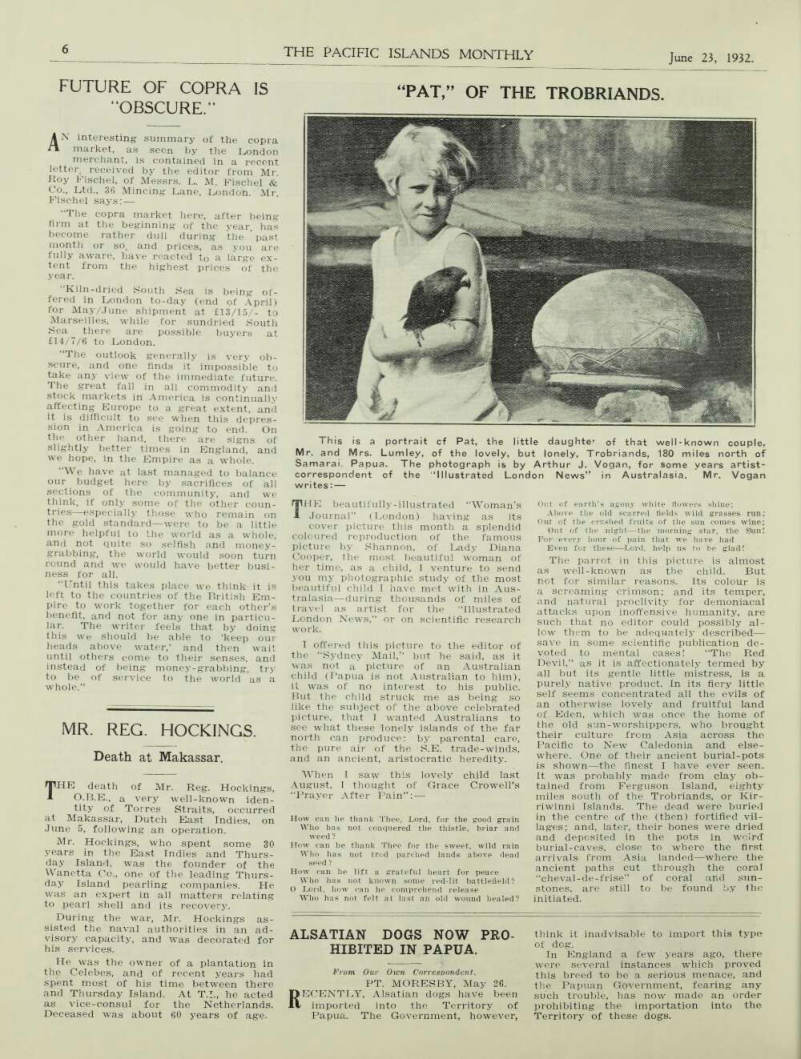
THE beautifully-illustrated “Woman’s Journal” (London) having as its cover picture this month a splendid coloured reproduction of the famous picture by Shannon, of Lady Diana Cooper, the most beautiful woman of her time, as a child, I venture to send you my photographic study of the most beautiful child I have met with in Aus tralasia —during thousands of miles of travel as artist for the “Illustrated London News,” or on scientific research work.
I offered this picture to the editor of the “Sydney Mail,” but he said, as it was not a picture of an Australian child (Papua is not Australian to him), it was of no interest to his public.
But the child struck me as being so like the subject of the above celebrated picture, that I wanted Australians to see what these lonely islands of the far north can produce: by parental care, the pure air of the S.E. trade-winds, and an ancient, aristocratic heredity.
When I saw this lovely child last August, I thought of Grace Crowell’s “Prayer After Pain”: How can he thank Thee, Lord, for the good grain Who has not conquered the thistle, briar and weed?
How can he thank Thee for the sweet, wild rain Who has not trod parched lands above dead seed ?
How can he lift a grateful heart for peace Who has not known some red-lit battlefield? 0 Lord, how can he comprehend release Who has not felt at last an old wound healed?
Out of earth’s agony white flowers shine; Above the old scarred fields wild grasses run; Out of the crushed fruits of the sun comes wine; Out of the night—the morning star, the Sun.
For every hour of pain that we have had Even for these—Lord, help us to be glad!
The parrot in this picture is almost as well-known as the child. But not for similar reasons. Its colour is a screaming crimson; and its temper, and natural proclivity for demoniacal attacks upon inoffensive humanity, are such that no editor could possibly al low them to be adequately described— save in some scientific publication de voted to mental cases! “The Red Devil,” as it is affectionately termed by all but its gentle little mistress, is a purely native product. In its fiery little self seems concentrated all the evils of an otherwise lovely and fruitful land of Eden, which was once the home of the old sun-worshippers, who brought their culture from Asia across the Pacific to New Caledonia and else where. One of their ancient burial-pots is shown —the finest I have ever seem It was probably made from clay ob tained from Ferguson Island, eighty miles south of the Trobriands, or Kir riwinni Islands. The dead were buried in the centre of the (then) fortified vil lages; and, later, their bones were dried and deposited in the pots in weird burial-caves, close to where the first arrivals from Asia landed —where the ancient paths cut through the coral “cheval-de-frise” of coral and sun stones, are still to be found by the initiated.
This is a portrait of Pat, the little daughter of that well-known couple, Mr. and Mrs. Lumley, of the lovely, but lonely, Trobriands, 180 miles north of Samarai Papua. The photograph is by Arthur J. Vogan, for some years artist correspondent of the ‘lllustrated London News” in Australasia. Mr. Vogan writes: