Recent Papuan Massacre
p. 32 · Read in the full issue
Head Hunter's Own Story of Recent Papuan Massacre
From Our Port Moresby Correspondent. (This is the story of how 17 unsuspecting Weredai and Suwami tribesmen were massacred on the Fly River, in Papua, last November. The story is exactly as related to Patrol Officer Hides by Danu, of the Nausakus, one of the two leaders of the raid. Danu is an intelligent native with a smattering of Motu— and it was in Motu that he told his story, in dramatic fashion, to the patrol officer, who wrote it down then and there.)
MEN of the Gumakari and Nausaku tribes (usually called Sukis) came down the Fly River on the warpath.
Four days out, near Weredai village, they came upon a man bailing out a canoe.
“Suama,” shouted Danu, giving the bush greeting in the Motu language.
“We have come. We want to give you tobacco.”
The river man, much frightened. tried to break away.
“We have not come to fight,” said Danu. “See, our women are with us.
Sit down—don’t be frightened.”
The canoe man sat down and Danu addressed him thus: “Go and bring your people to us. We will smoke and make friends, and to-night you can have our women.”
The river man went away and the raiders waited. At sunset he returned,
bringing the people of Weredai village.
The raiders were seated on the ground.
Besides them were their weapons hidden under leaves.
A raider named Insai was to give the signal, when everything was ready.
Insai gave tobacco to a Weredai man, next to him —then suddenly turned and
smashed his bamboo pipe across the face of another Weredai man, on his other side.
“That was the signal, said Danu.
“We all jumped up and started to kill
them.” .
Some of the unfortunate Weredai people escaped, but nearly a score were butchered there in cold blood, “We cut off the arms and heads of the dead Weredai said Danu to the patrol officer. We took them up the river with us. We eat only the arms of those we kill—the rest has no taste.
I carried my head back to my village, but I did not cure it myself. There are special men in the tribe for this work.”
Patrol Officer Hides brought Danu, Ganga (chief of the Gumakari) and 24 others, accused of murder in connec tion with this raid, down to Daru, where they are now in prison and awaiting trial.
It appears that immediately news of the massacre reached Port Moresby, Patrol Officer Hides was rushed up the Fly River in an attempt to apprehend the murderers, while the Assistant Resident Magistrate of the district ap proached the main Gumakari village on the land side. It was arranged, that the two officers were to make a simul taneous attack with their police, in the early morning. Mr. Hides’ launch, however, could not get through the shallow water, when approaching the village, and the Gumaks were alarmed by the land party and escaped.
The police made another surprise at tack on the village of Gwitaka, where some twenty-five men, concerned in the murder of the villagers at Moiam, were arrested. Some of these men had been charged with the massacre at Weredai village in 1928.
There was a certain amount of fight ing, and four of the native police were wounded, but not seriously.
The last Weredai massacre, according to Mr. Hides, was connected with the ceremonies of headhunting. It appears that there were five young unmarried and unclaimed women in the raiding tribe, who were not able to choose hus bands or eat kangaroo meat until new heads had been taken. So the raid on the Weredai people was planned. It is noted that these young women have obtained husbands since the raid.
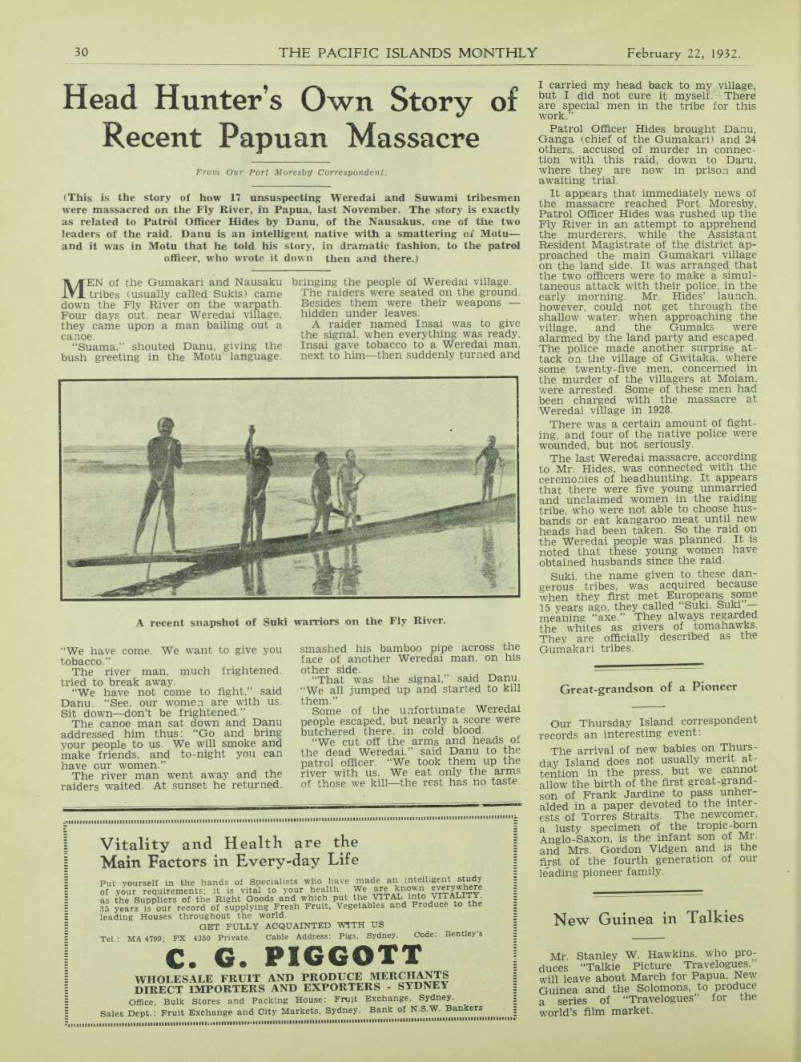
Suki, the name given to these dan gerous tribes, was acquired because when they first met Europeans some 15 years ago, they called “Suki. Suki. meaning “axe.” They always regarded the whites as givers of tomahawks.
They are officially described as the Gumakari tribes.
A recent snapshot of Suki warriors on the Fly River.