Papua’S Nipa Palms
pp. 13-15 · Read in the full issue
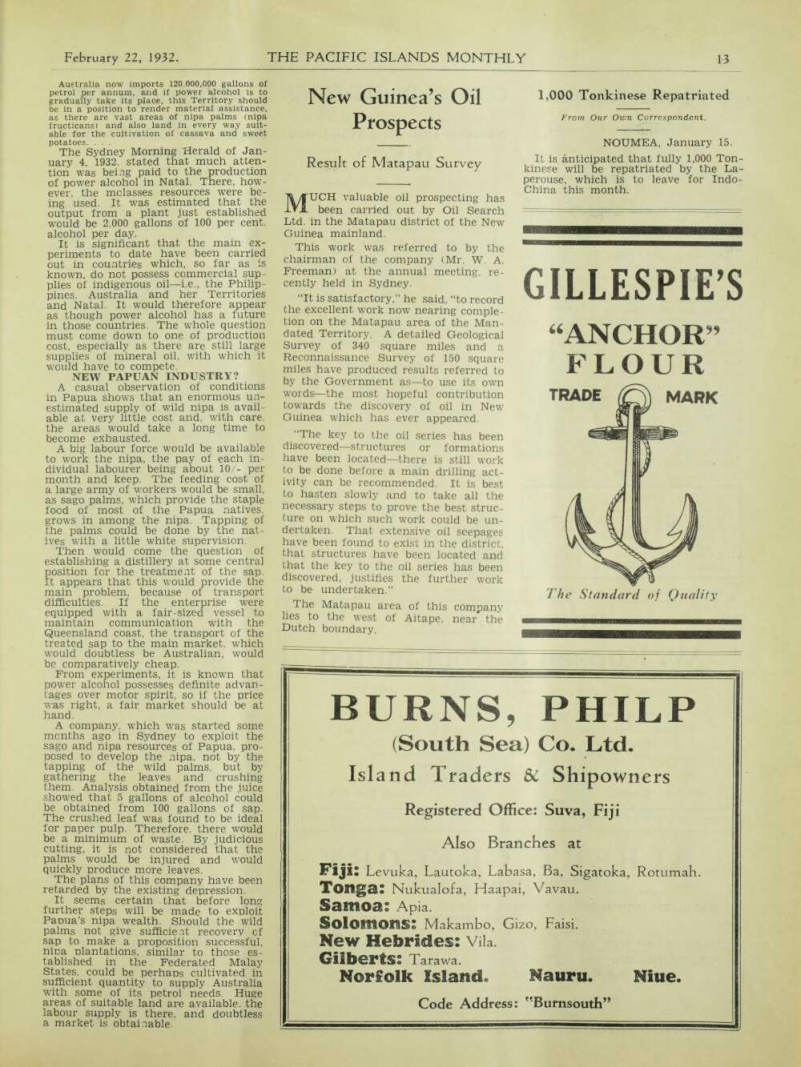
Believed to be Source of Enormous Unexploited Wealth
little has been done to investigate the value of the nipa palm, which grows wild in incalculable abundance along the waterways of Western Papua.
This palm, in the Philippines and Borneo, has an acknowledged commercial value, and is now being cultivated in those regions. It has been also introduced into South Florida, U.S.A.
The main value of the palm seems to lie in the use of the sap, whence is derived power alcohol, which has many uses and is an alternative for petrol in driving engines. However, its chief market to date is for drinking, in the form of spirituous liquor. For this pur pose many distilleries have been estab lished in the Philippines, and to these the sap of the nipa palm is taken for treatment.
During the last decade considerable work has been done in the Philippines and elsewhere in ascertaining the prac ticability of producing power alcohol from the sap of the palm.
It has been calculated that power alcohol could be produced and profit ably marketed as a motor fuel at 1/6 per gallon.
Some few years back the Automotive Industries Journal, published in New York, stated that in 1925 an experi mental plant for the purpose was erec ted in the State of North Borneo, under the direction of the Department of Agriculture there. The article stated that there were 300,000 acres of nipa in North Borneo, and it occurred in nearly solid stands of 5,000 acres or more. The sap flowed for only six months of the year, but it was esti mated that during that period 900,000,000 gallons of sap. capable of producing nearly 60,000,000 gallons of alcohol, could be obtained. The results of the first year’s working of the plant came up to expectations in every way.
Details Of The Palm.
Nipa is a perennial, in that it con tinuously reproduces itself through its
branching rhizomes.
The sap is collected by cutting into the fruit at its point of attachment to the stalk, and fixing a container under neath into which the sap drips. How
ever, a preliminary treatment is neces sary. This consists of kicking or hand shaking the fruit stalks once a week for from three to six weeks, depend ing on the locality, the condition of the palms, or the whim of the tappers. It is claimed that fruit stalks which have
not received this treatment do not bleed when tapped. Filipino tappers turn in as much as 90 gallons of sap for alcohol manufacture a day.
The Philippine Islands Agricultural Review, 1917-18, shows interesting
photos of the collection of the nipa sap and of the distilleries for the treating of the tuba.
The Science Journal of those Islands for 1911 says that the sap of nipa palm
is the cheapest source of alcohol in the world.
The best-managed nipules, or nipa groves, in the Philippines, continues the Journal, are divided into sections of about one hectare, containing 700 to 800 producing plants in every hec tare, each of which is assigned to the care of one or more men. Usually two men are required to handle one hectare and the work of cutting the plants, gathering and transporting the tuba to the distillery and the general care of the grove is divided between them.
Since the sap not only has a recog nised commercial value at the distil lery, but is also greatly prized by the natives as a beverage, a close watch by the guards is necessary.
The sap, as it drops from the flower stalks, is collected in hollow joints of bamboo. Each plant is visited daily and the sap brought to the distillery in bancas, a light canoe, which natives paddle in and out of the waterways.
Sometimes the tuba is emptied into large earthenware jars, which are transported to the distillery, or else it is emptied directly into the boat.
The labourer in the nipa grove builds himself a house of nipa leaves, thatch
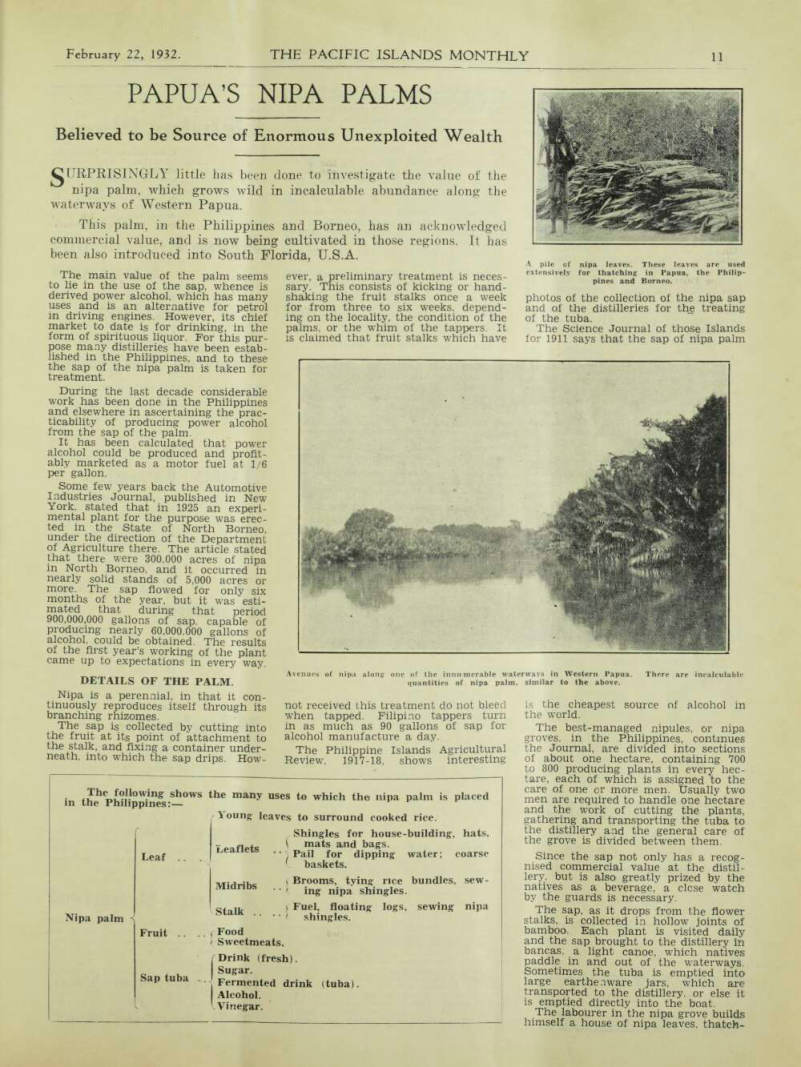
A pile of nipa leaves. These leaves are used extensively for thatching in Papua, the Philip pines and Borneo.
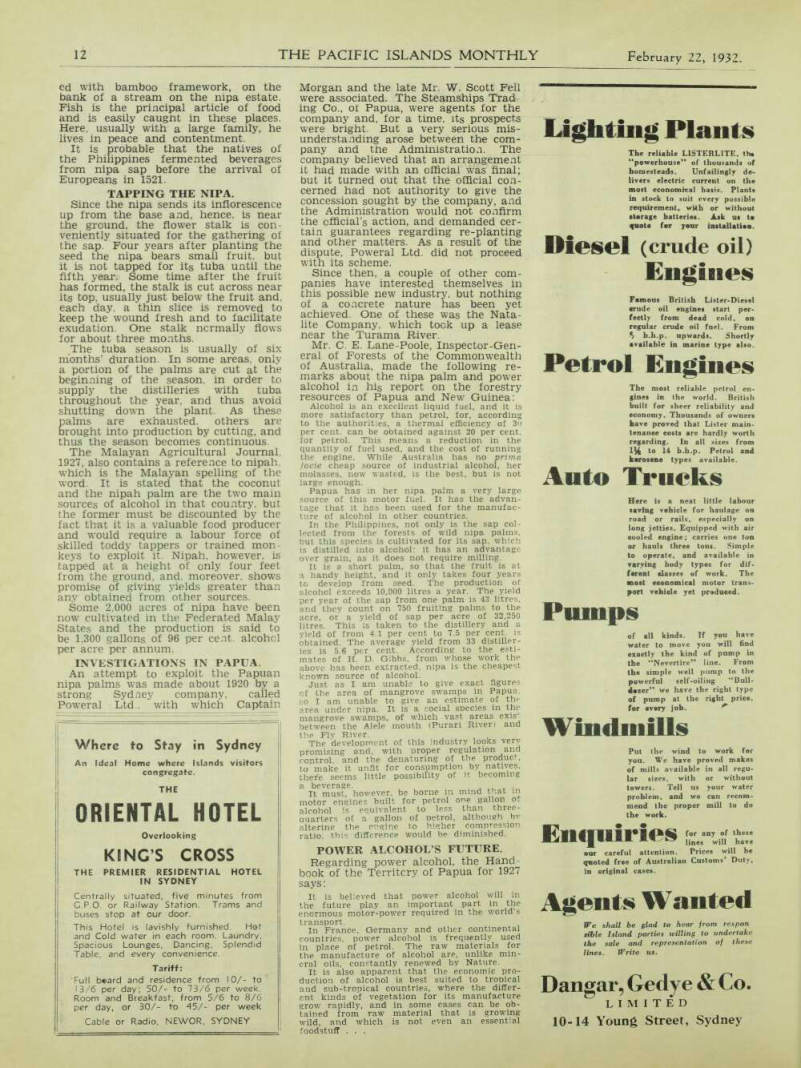
Avenues of nipa along one of the innumerable waterways in Western Papua. There are incalculable quantities of nipa palm, similar to the above.
ed with bamboo framework, on the bank of a stream on the nipa estate.
Fish is the principal article of food and is easily caught in these places.
Here, usually with a large family, he lives in peace and contentment.
It is probable that the natives of the Philippines fermented beverages from nipa sap before the arrival of Europeans in 1521.
Tapping The Nipa.
Since the nipa sends its inflorescence up from the base and, hence, is near the ground, the flower stalk is con veniently situated for the gathering of the sap. Four years after planting the seed the nipa bears small fruit, but it is not tapped for its tuba until the fifth year. Some time after the fruit has formed, the stalk is cut across near its top, usually just below the fruit and. each day, a thin slice is removed to keep the wound fresh and to facilitate exudation. One stalk normally flows for about three months.
The tuba season is usually of six months’ duration. In some areas, only a portion of the palms are cut at the beginning of the season, in order to supply the distilleries with tuba throughout the year, and thus avoid shutting down the plant. As these palms are exhausted, others are brought into production by cutting, and thus the season becomes continuous.
The Malayan Agricultural Journal. 1927, also contains a reference to nipah, which is the Malayan spelling of the word. It is stated that the coconut and the nipah palm are the two main sources of alcohol in that country, but the former must be discounted by the fact that it is a valuable food producer and would require a labour force of skilled toddy tappers or trained mon keys to exploit it. Nipah, however, is tapped at a height of only four feet from the ground, and, moreover, shows promise of giving yields greater than any obtained from other sources.
Some 2,000 acres of nipa have been now cultivated in the Federated Malay States and the production is said to be 1,300 gallons of 96 per cent, alcohol per acre per annum.
Investigations In Papua.
An attempt to exploit the Papuan nipa palms was made about 1920 by a strong Sydney company, called Poweral Ltd. with which Captain
Morgan and the late Mr. W. Scott Fell were associated. The Steamships Trad ing Co., of Papua, were agents for the company and, for a time, its prospects were bright. But a very serious mis understanding arose between the com pany and the Administration. The company believed that an arrangement it had made with an official was final; but it turned out that the official con cerned had not authority to give the concession sought by the company, and the Administration would not confirm the official’s action, and demanded cer
tain guarantees regarding re-planting
and other matters. As a result of the dispute, Poweral Ltd. did not proceed with its scheme.
Since then, a couple of other com panies have interested themselves in
this possible new industry, but nothing
of a concrete nature has been yet achieved. One of these was the Nata lite Company, which took up a lease near the Turama River.
Mr. C. E. Lane-Poole, Inspector-Gen eral of Forests of the Commonwealth of Australia, made the following re marks about the nipa palm and power alcohol in his report on the forestry resources of Papua and New Guinea: Alcohol is an excellent liquid fuel, and it is more satisfactory than petrol, for, according to the authorities, a thermal efficiency of 30 per cent, can be obtained against 20 per cent, for petrol. This means a reduction in the quantity of fuel used, and the cost of running the engine. While Australia has no prima facie cheap source of industrial alcohol, her molasses, now wasted, is the best, but is not large enough.
Papua has in her nipa palm a very large source of this motor fuel. It has the advan tage that it has been used for the manufac ture of alcohol in other countries.
In the Philippines, not only is the sap col lected from the forests of wild nipa palms, but this species is cultivated for its sap, which is distilled into alcohol: it has an advantage over grain, as it does not require milling.
It is a short palm, so that the fruit is at a handy height, and it only takes four years to develop from seed. The production of alcohol exceeds 10,000 litres a year. The yield per year of the sap from one palm is 43 litres, and they count on 750 fruiting palms to the acre, or a yield of sap per acre of 32,250 litres. This is taken to the distillery and a yield of from 4.1 per cent to 7.5 per cent, is obtained. The average yield from 33 distiller ies is 5.6 per cent. According to the esti mates of H. D. Gibbs, from whose work the above has been extracted, nipa is the cheapest known source of alcohol.
Just as I am unable to give exact figures of the area of mangrove swamps in Papua, so I am unable to give an estimate of the area under nipa. It is a social soecies in the mangrove swamps, of which vast areas exist between the Alele mouth (Purari River) and the Fly River.
The development of this industry looks very promising and, with proper regulation and control, and the denaturing of the product, to make it unfit for consumption by natives, there seems little possibility of it becoming a beverage.
It must however, be borne in mind that in motor engines built for petrol one gallon of alcohol is equivalent to less than three quarters of a gallon of petrol, although by altering the engine to higher Compression ratio, this difference would be diminished.
Power Alcohol’S Future.
Regarding power alcohol, the Hand book of the Territory of Papua for 1927 says: It is believed that power alcohol will in the future play an important part in the enormous motor-power required in the world’s transport.
In France, Germany and other continental countries, power alcohol is frequently used in place of petrol. The raw materials for the manufacture of alcohol are, unlike min eral oils, constantly renewed by Nature.
It is also apparent that the economic pro duction of alcohol is best suited to tropical and sub-tropical countries, where the differ ent kinds of vegetation for its manufacture grow rapidly, and in some cases can be ob tained from raw material that is growing wild, and which is not even an essential foodstuff. . .
Australia now imports 120,000,000 gallons of petrol per annum, and if power alcohol is to gradually take its place, this Territory should be in a position to render material assistance, as there are vast areas of nipa palms (nipa fructicans) and also land in every way suit able for the cultivation of cassava and sweet potatoes. . . .
The Sydney Morning Herald of Jan uary 4, 1932. stated that much atten tion was being paid to the production of power alcohol in Natal. There, how ever, the molasses resources were be ing used. It was estimated that the output from a plant just established would be 2,000 gallons of 100 per cent, alcohol per day.
It is significant that the main ex periments to date have been carried out in countries which, so far as is known, do not possess commercial sup plies of indigenous oil —i.e., the Philip pines. Australia and her Territories and Natal. It would therefore appear as though power alcohol has a future in those countries. The whole question must come down to one of production cost, especially as there are still large supplies of mineral oil, with which it would have to compete.
New Papuan Industry?
A casual observation of conditions in Papua shows that an enormous un estimated supply of wild nipa is avail able at very little cost and, with care, the areas would take a long time to become exhausted.
A big labour force would be available to work the nipa, the pay of each in dividual labourer being about 10/- per month and keep. The feeding cost of a large army of workers would be small, as sago palms, which provide the staple food of most of the Papua natives, grows in among the nipa. Tapping of the palms could be done by the nat ives with a little white supervision.
Then would come the question of establishing a distillery at some central position for the treatment of the sap.
It appears that this would provide the main problem, because of transport difficulties. If the enterprise were equipped with a fair-sized vessel to maintain communication with the Queensland coast, the transport of the treated sap to the main market, which would doubtless be Australian, would be comparatively cheap.
From experiments, it is known that power alcohol possesses definite advan tages over motor spirit, so if the price was right, a fair market should be at hand.
A company, which was started some months ago in Sydney to exploit the sago and nipa resources of Papua, pro posed to develop the nipa, not by the tapping of the wild palms, but by gathering the leaves and crushing them. Analysis obtained from the juice showed that 5 gallons of alcohol could be obtained from 100 gallons of sap.
The crushed leaf was found to be ideal for paper pulp. Therefore, there would be a minimum of waste. By judicious cutting, it is not considered that the palms would be injured and would quickly produce more leaves.
The plans of this company have been retarded by the existing depression.
It seems certain that before long further steps will be made to exploit Papua’s nipa wealth. Should the wild palms not give sufficient recovery of sap to make a proposition successful, nipa plantations, similar to those es tablished in the Federated Malay States, could be perhaps cultivated in sufficient quantity to supply Australia with some of its petrol needs. Huge areas of suitable land are available, the labour supply is there, and doubtless a market is obtainable.