Durian Trees Thrive In Tahiti
p. 12 · Read in the full issue
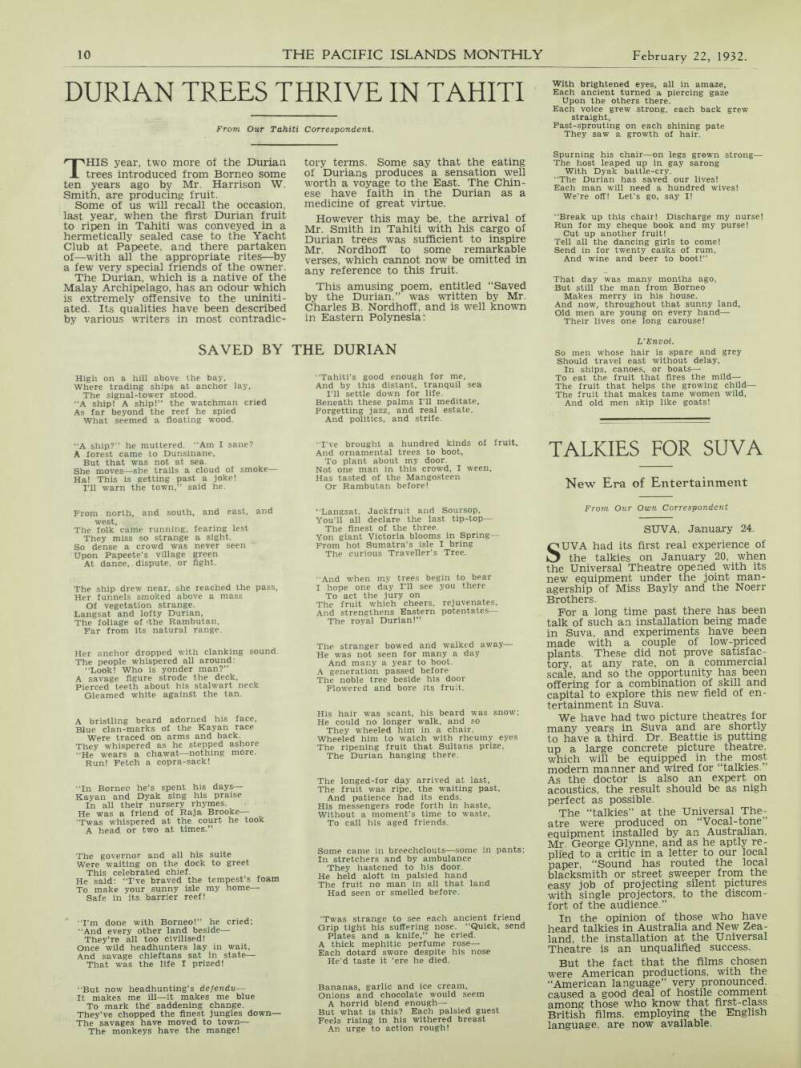
From Our Tahiti Correspondent.
THIS year, two more of the Durian trees introduced from Borneo some ten years ago by Mr. Harrison W.
Smith, are producing fruit.
Some of us will recall the occasion, last year, when the first Durian fruit to ripen in Tahiti was conveyed in a hermetically sealed case to the Yacht Club at Papeete, and there partaken of —with all the appropriate rites —by a few very special friends of the owner.
The Durian, which is a native of the Malay Archipelago, has an odour which is extremely offensive to the uniniti ated. Its qualities have been described by various writers in most contradic
tory terms. Some say that the eating of Durians produces a sensation well worth a voyage to the East. The Chin ese have faith in the Durian as a medicine of great virtue.
However this may be, the arrival of Mr. Smith in Tahiti with his cargo of Durian trees was sufficient to inspire Mr. Nordhoff to some remarkable verses, which cannot now be omitted in any reference to this fruit.
This amusing poem, entitled “Saved by the Durian.” was written by Mr.
Charles B. Nordhoff, and is well known in Eastern Polynesia:
Saved By The Durian
High on a hill above the bay, Where trading ships at anchor lay.
The signal-tower stood.
“A ship! A ship!” the watchman cried As far beyond the reef he spied What seemed a floating wood.
“A ship?” he muttered. “Am I sane?
A forest came to Dunsinane, But that was not at sea.
She moves—she trails a cloud of smoke — Ha! This is getting past a joke!
I’ll warn the town,” said he.
From north, and south, and east, and west, The folk came running, fearing lest They miss so strange a sight.
So dense a crowd was never seen Upon Papeete’s village green At dance, dispute, or fight.
The ship drew near, she reached the pass, Her funnels smoked above a mass Of vegetation strange.
Langsat and lofty Durian, The foliage of the Rambutan, Far from its natural range.
Her anchor dropped with clanking sound.
The people whispered all around; “Look! Who is yonder man?”
A savage figure strode the deck.
Pierced teeth about his stalwart neck Gleamed white against the tan.
A bristling beard adorned his face, Blue clan-marks of the Kayan race Were traced on arms and back.
They whispered as he stepped ashore “He wears a chawat —nothing more.
Run! Fetch a copra-sack!
“In Borneo he’s spent his days— Kayan and Dyak sing his praise In all their nursery rhymes.
He was a friend of Raja Brooke — ’Twas whispered at the court he took A head or two at times.”
The governor and all his suite Were waiting on the dock to greet This celebrated chief.
He said: “I’ve braved the tempest’s foam To make your sunny isle my home— Safe in its barrier reef!
“I’m done with Borneo!” he cried; “And every other land beside— They’re all too civilised!
Once wild headhunters lay in wait, And savage chieftans sat in state — That was the life I prized!
“But now headhunting’s defendu — It makes me ill—it makes me blue To mark the saddening change.
They’ve chopped the finest jungles down— The savages have moved to town — The monkeys have the mange!
“Tahiti’s good enough for me, And by this distant, tranquil sea I’ll settle down for life.
Beneath these palms I’ll meditate, Forgetting jazz, and real estate.
And politics, and strife.
“I’ve brought a hundred kinds of fruit.
And ornamental trees to boot, To plant about my door.
Not one man in this crowd, I ween, Has tasted of the Mangosteen Or Rambutan before!
“Langsat, Jackfruit and Soursop, You’ll all declare the last tip-top— The finest of the three.
Yon giant Victoria blooms in Spring- From hot Sumatra’s isle I bring The curious Traveller’s Tree.
And when my trees begin to bear I hope one day I’ll see you there To act the jury on The fruit which cheers, rejuvenates.
And strengthens Eastern potentates— The royal Durian!”
The stranger bowed and walked away— He was not seen for many a day And many a year to boot.
A generation passed before The noble tree beside his door Flowered and bore its fruit.
His hair was scant, his beard was snow; He could no longer walk, and so They wheeled him in a chair, Wheeled him to watch with rheumy eyes The ripening fruit that Sultans prize, The Durian hanging there.
The longed-for day arrived at last, The fruit was ripe, the waiting past, And patience had its ends.
His messengers rode forth in haste.
Without a moment’s time to waste, To call his aged friends.
Some came in breechclouts —some in pants; In stretchers and by ambulance They hastened to his door.
He held aloft in palsied hand The fruit no man in all that land Had seen or smelled before. ’Twas strange to see each ancient friend Grip tight his suffering nose. “Quick, send Plates and a knife,” he cried.
A thick mephitic perfume rose — Each dotard swore despite his nose He’d taste it ’ere he died.
Bananas, garlic and ice cream.
Onions and chocolate would seem A horrid blend enough— But what is this? Each palsied guest Feels rising in his withered breast An urge to action rough!
With brightened eyes, all in amaze.
Each ancient turned a piercing gaze Upon the others there.
Each voice grew strong, each back grew straight, Past-sprouting on each shining pate They saw a growth of hair.
Spurning his chair —on legs grown strong— The host leaped up in gay sarong With Dyak battle-cry.
“The Durian has saved our lives!
Each man will need a hundred wives!
We’re off! Let’s go, say I!
“Break up this chair! Discharge my nurse!
Run for my cheque book and my purse!
Cut up another fruit!
Tell all the dancing girls to come!
Send in for twenty casks of rum, And wine and beer to boot!”
That day was many months ago.
But still the man from Borneo Makes merry in his house.
And now, throughout that sunny land.
Old men are young on every hand — Their lives one long carouse!
L’Envoi.
So men whose hair is spare and grey Should travel east without delay, In ships, canoes, or boats — To eat the fruit that fires the mild — The fruit that helps the growing child— The fruit that makes tame women wild, And old men skip like goats!