To Ongtong Java
A White Woman's Visit
Ongtong Java lies about 150 miles north of the Solomon Group, and it comes under the administration of the Resident Commissioner of the Solomons. The group is inhabited by an entirely Polynesian race—and this, in the midst of Melanesia, is hard to understand.
These islands grow nothing but coc nuts, and are only about three feet above sea level. No other vegetation of any kind exists, and the natives live entirely on coconuts and fish.
I was quite prepared, after leaving Ysabel, to encounter rough seas, as the nor’-west season had set in, but both coming and going it was dead calm— a record trip, I have been told.
After two days and one night of travel this wonderful group of islands came in sight. Just a line of coconuts, apparently growing in the ocean, was my first impression. Then, as we got closer, I could see miles and miles of reefs and palms, extending for forty miles, forming a perfect oval, with an immense lagoon in the centre.
After negotiating the reefs we drop ped anchor, causing great excitement among the inhabitants. Almost at once a small outboard canoe came alongside, holding two men and one woman. The woman came aboard, much to every one's surprise—such a thing never hav ing been known before. She was ex ceedingly pretty, in her bright calico, in addition to which she had a large white damask tablecloth draped artis tically round her. Very strange to say —but surely pure coincidence—she had her hair done in the latest European style, smoothed down with curling ends tucked behind her ears. Her body was completely covered with tattoo, and she was quite young and beautifully built.
She stared at me in astonishment, but when “Pat” appeared her surprise was beyond description. We were the first white woman and child she had ever seen.
Our next visitor was one of the two white traders who live there. His first request was for iced beer. After he had consumed this, we went ashore, whilst stores and copra were being landed and loaded.
It was quite certain these people had never seen a white woman and child before—they crowded round in hun dreds, in sheer amazement. They were
just as Nature made them, except for a few ornaments and much tattooing— especially the women. I have been told that tattooing is carried on to the stage of utter cruelty by these natives. It is part of their custom that, as they grow up, more and more tattooing is done, denoting each stage of life, until the body is entirely covered.
These people appeared to me less civilised and yet more cultured than the ordinary Solomon boy. They seem so utterly unspoiled by civilisation and live on raw fish and coconuts.
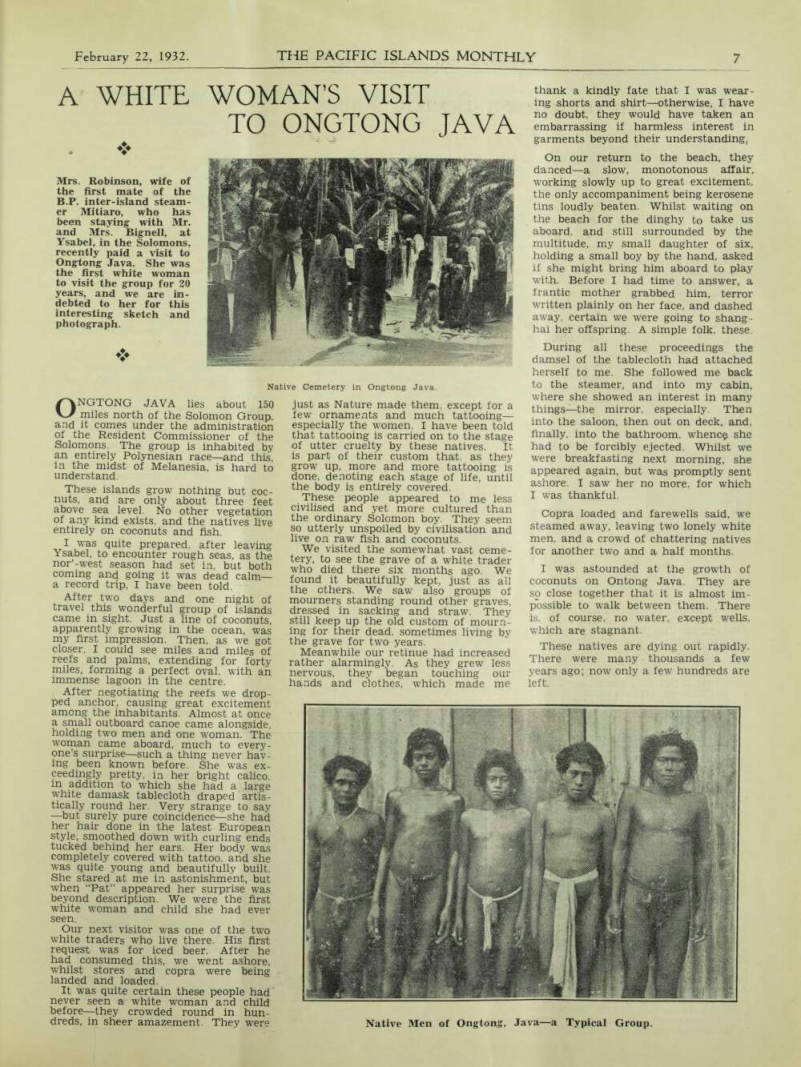
We visited the somewhat vast ceme tery, to see the grave of a white trader who died there six months ago. We found it beautifully kept, just as all the others. We saw also groups of mourners standing round other graves, dressed in sacking and straw. They still keep up the old custom of mourn ing for their dead, sometimes living by the grave for two years.
Meanwhile our retinue had increased rather alarmingly. As they grew less nervous, they began touching our hands and clothes, which made me
thank a kindly fate that I was wear ing shorts and shirt —otherwise, I have no doubt, they would have taken an embarrassing if harmless interest in garments beyond their understanding, On our return to the beach, they danced —a slow, monotonous affair, working slowly up to great excitement, the only accompaniment being kerosene tins loudly beaten. Whilst waiting on the beach for the dinghy to take us aboard, and still surrounded by the multitude, my small daughter of six, holding a small boy by the hand, asked if she might bring him aboard to play with. Before I had time to answer, a frantic mother grabbed him, terror written plainly on her face, and dashed away, certain we were going to shang hai her offspring. A simple folk, these.
During all these proceedings the damsel of the tablecloth had attached herself to me. She followed me back to the steamer, and into my cabin, where she showed an interest in many things—the mirror, especially. Then into the saloon, then out on deck, and, finally, into the bathroom, whence she had to be forcibly ejected. Whilst we were breakfasting next morning, she appeared again, but was promptly sent ashore. I saw her no more, for which I was thankful.
Copra loaded and farewells said, we steamed away, leaving two lonely white men. and a crowd of chattering natives for another two and a half months.
I was astounded at the growth of coconuts on Ontong Java. They are so close together that it is almost im possible to walk between them. There is, of course, no water, except wells, which are stagnant.
These natives are dying out rapidly.
There were many thousands a few years ago; now only a few hundreds are left.
Mrs. Robinson, wife of the first mate of the B.P. inter-island steam er Mitiaro, who has been staying with Mr. and Mrs. Bignell, at Ysabel, in the Solomons, recently paid a visit to Ongtong Java. She was the first white woman to visit the group for 20 years, and we are in debted to her for this interesting sketch and photograph.
Native Cemetery in Ongtong Java.
Native Men of Ongtong, Java —a Typical Group.