Copra Prices In The South Seas
pp. 5-21 · Read in the full issue
Exchange Movements and Commodity Fluctuations
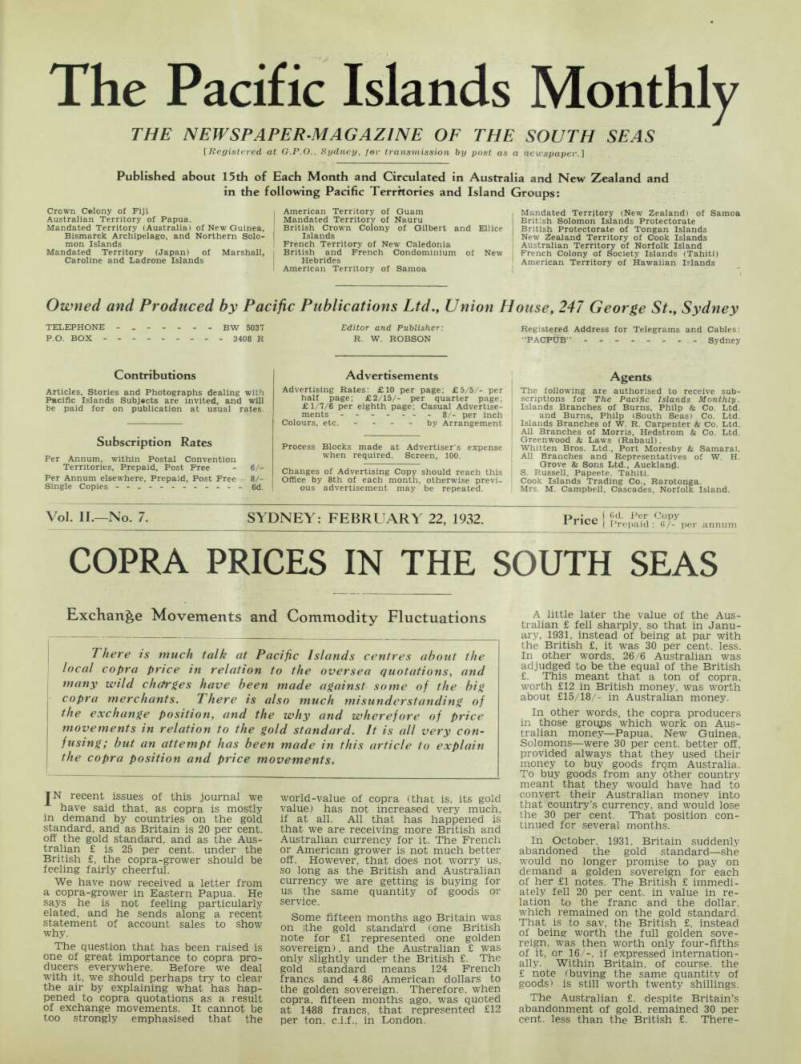
There is much talk at Pacific Islands centres about the local copra price in relation to the oversea quotations, and many wild charges have been made against some of the big copra merchants. There is also much misunderstanding of the exchange position, and the why and wherefore of price movements in relation to the gold standard. It is all very con fusing; but an attempt has been made in this article to explain the copra position and price movements.
IN recent issues of this journal we have said that, as copra is mostly in demand by countries on the gold standard, and as Britain is 20 per cent, off the gold standard, and as the Aus tralian £ is 25 per cent, under the British £, the copra-grower should be feeling fairly cheerful.
We have now received a letter from a copra-grower in Eastern Papua. He says he is not feeling particularly elated, and he sends along a recent statement of account sales to show why.
The question that has been raised is one of great importance to copra pro ducers everywhere. Before we deal with it, we should perhaps try to clear the air by explaining what has hap pened to copra quotations as a result of exchange movements. It cannot be too strongly emphasised that the
world-value of copra (that is, its gold value) has not increased very much, if at all. All that has happened is that we are receiving more British and Australian currency for it. The French or American grower is not much better off. However, that does not worry us, so long as the British and Australian currency we are getting is buying for us the same quantity of goods or service.
Some fifteen months ago Britain was on the gold standard (one British note for £1 represented one golden sovereign), and the Australian £ was only slightly under the British £. The gold standard means 124 French francs and 4.86 American dollars to the golden sovereign. Therefore, when copra, fifteen months ago, was quoted at 1488 francs, that represented £12 per ton. c.i.f., in London.
A little later the value of the Aus tralian £ fell sharply, so that in Janu ary, 1931, instead of being at par with the British £, it was 30 per cent. less.
In other words, 26/6 Australian was adjudged to be the equal of the British £. This meant that a ton of copra, worth £12 in British money, was worth about £15/18/- in Australian money.
In other words, the copra producers in those groups which work on Aus tralian money—Papua, New Guinea, Solomons—were 30 per cent, better off, provided always that they used their money to buy goods from Australia.
To buy goods from any other country meant that they would have had to convert their Australian money into that country’s currency, and would lose the 30 per cent. That position con tinued for several months.
In October 1931, Britain suddenly abandoned the gold standard—she would no longer promise to pay on demand a golden sovereign for each of her £1 notes. The British £ immedi ately fell 20 per cent, in value in re lation to the franc and the dollar, which remained on the gold standard.
That is to say, the British £, instead of being worth the full golden sove reign, was then worth only four-fifths of it, or 16/-, if expressed internation ally. Within Britain, of course, the £ note (buying the same quantity of goods) is still worth twenty shillings.
The Australian £. despite Britain’s abandonment of gold, remained 30 per cent, less than the British £. There
fore, as the British £ was worth 16/in gold, the Australian £ was worth about 10/8 in gold. A little later the value of the Australian £ improved slightly, so that it is now 25 per cent, under British currency values.
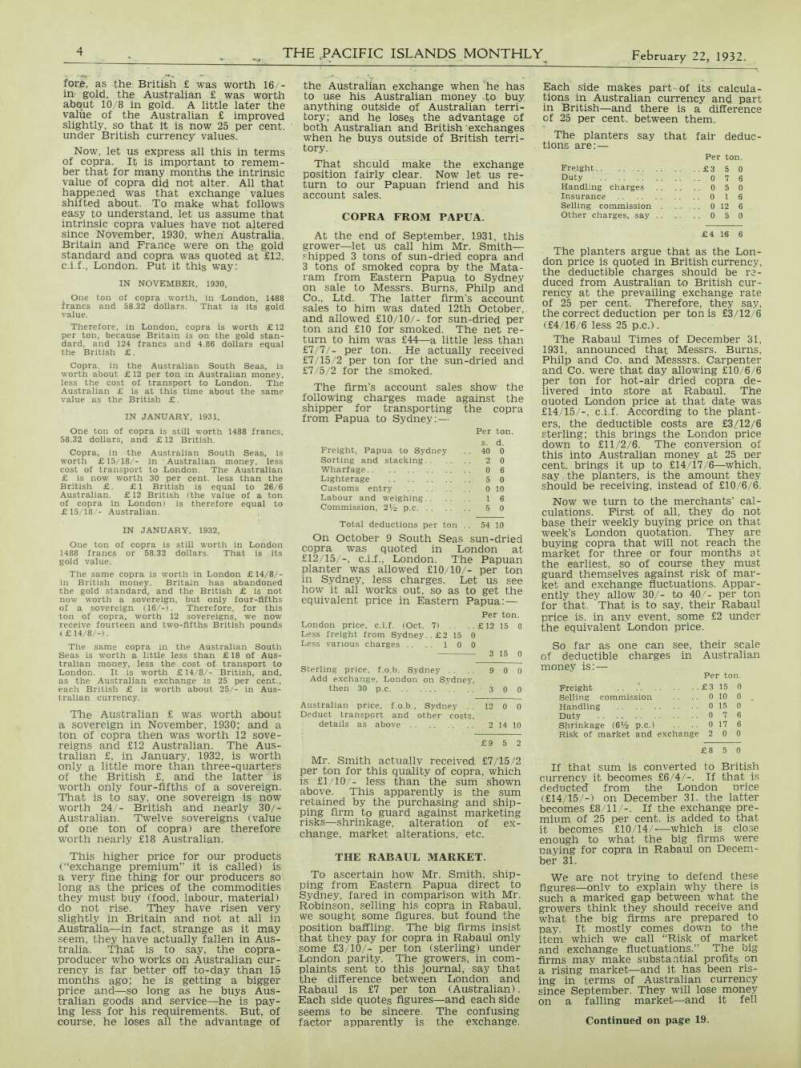
Now, let us express all this in terms of copra. It is important to remem ber that for many months the intrinsic value of copra did not alter. All that happened was that exchange values shifted about. To make what follows easy to understand, let us assume that intrinsic copra values have not altered since November, 1930, when Australia, Britain and France were on the gold standard and copra was quoted at £12. c.i.f., London. Put it this way:
In November, 1930,
One ton of copra worth, in London, 1488 francs and 58.32 dollars. That is its gold value.
Therefore, in London, copra is worth £12 per ton, because Britain is on the gold stan dard, and 124 francs and 4.86 dollars equal the British £.
Copra, in the Australian South Seas, is worth about £ 12 per ton in Australian money, less the cost of transport to London. The Australian £ is at this time about the same value as the British £.
In January, 1931,
One ton of copra is still worth 1488 francs, 58.32 dollars, and £ 12 British.
Copra, in the Australian South Seas, is worth £15/18/- in Australian money, less cost of transport to London. The Australian £ is now worth 30 per cent, less than the British £. £1 British is equal to 26/6 Australian. £12 British (the value of a ton of copra in London) is therefore equal to £15/18/- Australian.
In January, 1932,
One ton of copra is still worth in London 1488 francs or 58.32 dollars. That is its gold value.
The same copra is worth in London £14/8/in British money. Britain has abandoned the gold standard, and the British £ is not now worth a sovereign, but only four-fifths of a sovereign (16/-). Therefore, for this ton of copra, worth 12 sovereigns, we now receive fourteen and two-fifths British pounds (£ 14/8/-).
The same copra in the Australian South Seas is worth a little less than £18 of Aus tralian money, less the cost of transport to London. It is worth £14/8/- British, and, as the Australian exchange is 25 per cent., each British £ is worth about 25/- in Aus tralian currency.
The Australian £ was worth about a sovereign in November, 1930; and a ton of copra then was worth 12 sove reigns and £12 Australian. The Australian £, in January, 1932, is worth only a little more than three-quarters of the British £, and the latter is worth only four-fifths of a sovereign.
That is to say, one sovereign is now worth 24/- British and nearly 30/- Australian. Twelve sovereigns (value of one ton of copra) are therefore worth nearly £18 Australian.
This higher price for our products (“exchange premium” it is called) is a very fine thing for our producers so long as the prices of the commodities they must buy (food, labour, material) do not rise. They have risen very slightly in Britain and not at all in Australia—in fact, strange as it may seem, they have actually fallen in Aus tralia. That is to say, the copra producer who works on Australian cur rency is far better off to-day than 15 months ago; he is getting a bigger price and —so long as he buys Aus tralian goods and service—he is pay ing less for his requirements. But, of course, he loses all the advantage of
the Australian exchange when he has to use his Australian money to buy anything outside of Australian terri tory: and he loses the advantage of both Australian and British exchanges when he buys outside of British terri tory.
That should make the exchange position fairly clear. Now let us re turn to our Papuan friend and his account sales.
Copra From Papua
At the end of September, 1931, this grower—let us call him Mr. Smith— shipped 3 tons of sun-dried copra and 3 tons of smoked copra by the Mata ram from Eastern Papua to Sydney on sale to Messrs. Burns, Philp and Co., Ltd. The latter firm’s account sales to him was dated 12th October, and allowed £10/10/- for sun-dried per ton and £10 for smoked. The net re turn to him was £44—a little less than £7/7/- per ton. He actually received £7/15/2 per ton for the sun-dried and £7/5/2 for the smoked.
The firm’s account sales show the following charges made against the shipper for transporting the copra from Papua to Sydney:—
On October 9 South Seas sun-dried copra was quoted in London at £12/15/-, c.i.f., London. The Papuan planter was allowed £10/10/- per ton in Sydney, less charges. Let us see how it all works out, so as to get the equivalent price in Eastern Papua:
Mr. Smith actually received £7/15/2 per ton for this quality of copra, which is £1/10/- less than the sum shown above. This apparently is the sum retained by the purchasing and ship ping firm to guard against marketing risks—shrinkage, alteration of ex change, market alterations, etc.
The Rabaul Market.
To ascertain how Mr. Smith, ship ping from Eastern Papua direct to Sydney, fared in comparison with Mr.
Robinson, selling his copra in Rabaul, we sought some figures, but found the position baffling. The big firms insist that they pay for copra in Rabaul only some £3/10/- per ton (sterling) under London parity. The growers, in com plaints sent to this journal, say that the difference between London and Rabaul is £7 per ton (Australian).
Each side quotes figures—and each side seems to be sincere. The confusing factor apparently is the exchange.
Each side makes part of its calcula tions in Australian currency and part in British—and there is a difference of 25 per cent, between them.
The planters say that fair deduc tions are:
The planters argue that as the Lon don price is quoted in British currency, the deductible charges should be re duced from Australian to British cur rency at the prevailing exchange rate of 25 per cent. Therefore, they say, the correct deduction per ton is £3/12/6 (£4/16/6 less 25 p.c.).
The Rabaul Times of December 31, 1931, announced that Messrs. Burns, Philp and Co. and Messsrs. Carpenter and Co. were that day allowing £10/6/6 per ton for hot-air dried copra de livered into store at Rabaul. The quoted London price at that date was £14/15/-, c.i.f. According to the plant ers, the deductible costs are £3/12/6 sterling: this brings the London price down to £11/2/6. The conversion of this into Australian money at 25 per cent, brings it up to £14/17/6 —which, say the planters, is the amount they should be receiving, instead of £10/6/6.
Now we turn to the merchants’ cal culations. First of all, they do not base their weekly buying price on that week’s London quotation. They are buying copra that will not reach the market for three or four months at the earliest, so of course they must guard themselves against risk of mar ket and exchange fluctuations. Appar ently they allow 30/- to 40/- per ton for that. That is to say, their Rabaul price is. in any event, some £2 under the equivalent London price.
So far as one can see, their scale of deductible charges in Australian money is:—
If that sum is converted to British currency it becomes £6/4/-. If that is deducted from the London nrice (£14/15/-) on December 31. the latter becomes £8/11/-. If the exchange pre mium of 25 per cent, is added to that it becomes £10/14/ —which is close enough to what the big firms were paying for copra in Rabaul on Decem ber 31.
We are not trying to defend these figures—only to explain why there is such a marked gap between what the growers think they should receive and what the big firms are prepared to pay. It mostly comes down to the item which we call “Risk of market and exchange fluctuations.” The big firms may make substantial profits on a rising market —and it has been ris ing in terms of Australian currency since September. They will lose money on a falling market —and it fell
Continued on page 19.
Freight, Papua to Sydney Per ton. s. d . 40 0 Sorting and stacking 2 0 Wharfage 0 6 Lighterage 5 0 Customs entry 0 10 Labour and weighing 1 6 Commission, 2½ p.c 5 0 Total deductions per ton . 54 10
Per ton.
London price, c.i.f. (Oct. 7) £12 15 0 Less freight from Sydney.. £2 15 0 Less various charges .. 1 0 0 3 15 0 Sterling price, f.o.b. Sydney . . 9 0 0 Add exchange, London on Sydney, then 30 p.c . . .. 3 0 0 Australian price, f.o.b., Sydney 12 0 0 Deduct transport and other costs, details as above 2 14 10 £9 5 2
Per ton.
Freight £3 5 0 Duty 0 7 6 Handling charges 0 5 0 Insurance 0 1 6 Selling commission 0 12 6 Other charges, say 0 5 0 £4 16 6
Per ton.
Freight £3 15 0 Selling commission. 0 10 0 Handling 0 15 0 Duty 0 7 6 Shrinkage ( 6½ p.c.) 0 17 6 Risk of market and exchange 2 0 0 £8 5 0
steadily from 1929 until September, 1931.
It is interesting to compare the Lon don quotations, as published in The Sydney Morning Herald every Monday, with the price quoted in The Rabaul Times every Friday:—
It will be seen that, taking exchange into consideration, the difference be tween the London and Rabaul quo tations remains at about £7 (Austra lian) per ton; and that the Rabaul price generally moved up or down in sympathy with the London quotation.
London.
Rabaul.
Oct. 11, 1931 .. £13 0 0 .. £9 12 6 Oct. 18, 1931 . . 12 15 0 . . 9 17 6 Oct. 25. 1931 . . 13 2 6 9 15 0 Nov. 1, 1931 . . 13 15 0 .. 10 2 6 Nov. 8. 1931 14 5 0 . . 10 10 0 Nov. 22. 1931 . . 13 15 0 . . 10 0 0 Nov. 30, 1931 . . 13 15 0 . . 10 0 0 Dec. 6. 1931 14 10 0 . . 10 6 6 Dec. 13. 1931 14 10 0 . . 10 6 6 Dec. 20. 1931 14 10 0 . . 10 6 6