A Terrifying Earthquake
Solomon Islands Visitation
THE earthquakes in the Solomon Islands between October 3 and 11, with attendant tidal waves, did most damage on Malaita and San Christoval; but the ’quakes were felt severely on the neighbouring islands of Florida and Guadalcanal.
The first and heaviest disturbance, apparently, occurred early on Sunday morning, October 4, and it seemed to centre off the south-east coast of San Christoval. The latter island was badly shaken and a great tidal wave shortly afterwards swept upon its south-east coast, submerging 14 vil lages and rendering 700 people home less. No details are available, but it is estimated that 10 natives were drowned. Messrs. J. Bee and J. Wil son, of the South Seas Evangelical Mission, at villages 15 miles apart, were caught in the rush of water and carried inland, but both miracu lously escaped.
The whole of the southern islands felt frequent tremors during the en suing week, and on Saturday, October 11, there came another great shock, which centred near Su’u, on Malaita.
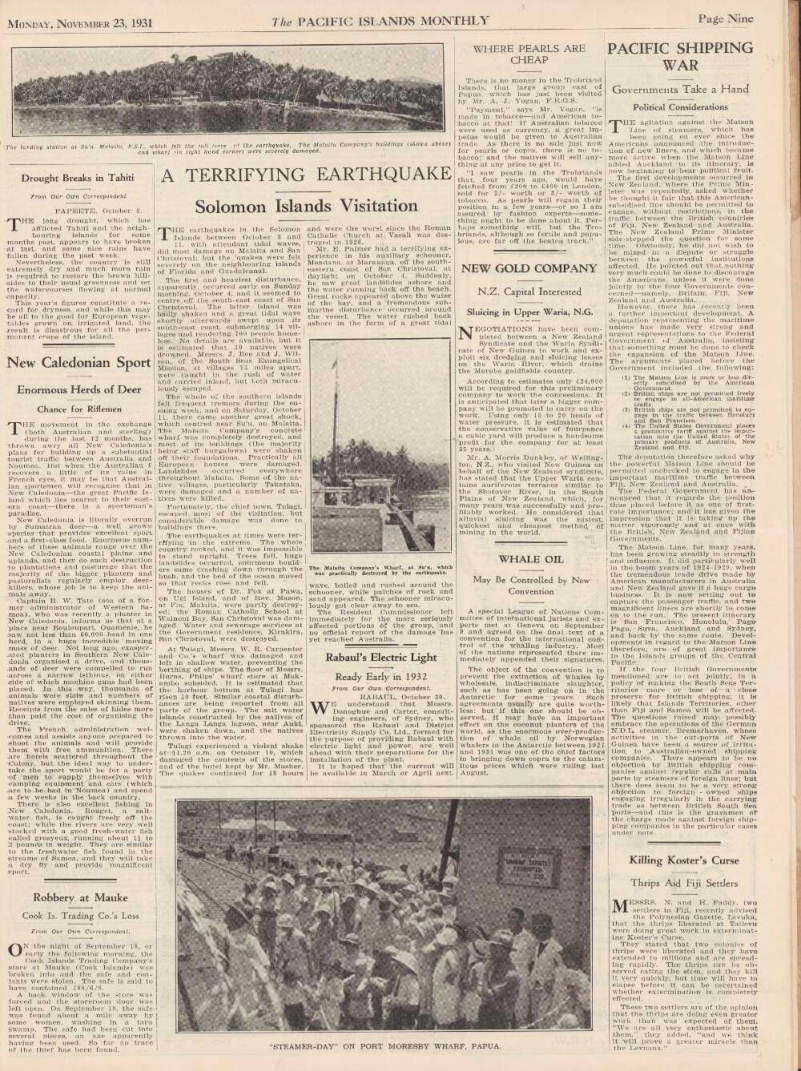
The Malaita Company’s concrete wharf was completely destroyed, and most of its buildings (the majority being staff bungalows) were shaken off their foundations. Practically all European houses were damaged.
Landslides occurred everywhere throughout Malaita. Some of the na tive villages, particularly Takataka, were damaged and a number of na tives were killed.
Fortunately, the chief town, Tulagi, escaped most of the visitation, but considerable damage was done to buildings there.
The earthquakes at times were ter rifying in the extreme. The whole country rocked, and it was impossible to stand upright. Trees fell, huge landslides occurred, enormous bould ers came crashing down through the bush, and the bed of the ocean moved so that rocks rose and fell.
The houses of Dr. Fox at Pawa, on Ugi Island, and of Rev. Mason, at Fiu, Malaita, were partly destroy ed; the Roman Catholic School at Wainoni Bay, San Christoval was dam aged. Water and sewerage services at the Government residence, Kirakira, San Christoval, were destroyed.
At Tulagi, Messrs. W. R. Carpenter and Co.’s wharf was damaged and left in shallow water, preventing the berthing of ships. The floor of Messrs.
Burns, Philps’ wharf store at Mak ambo subsided. It is estimated that the harbour bottom at Tulagi has risen 10 feet. Similar coastal disturb ances are being reported from all parts of the group. The salt water islands constructed by the natives of the Langa Langa lagoon, near Auki, were shaken down, and the natives thrown into the water.
Tulagi experienced a violent shake at 11.20 a.m. on October 10, which damaged the contents of the stores, and of the hotel kept by Mr. Masher, The quakes continued for 18 hours
and were the worst since the Roman Catholic Church at Yasali was des troyed in 1926.
Mr. E. Palmer had a terrifying ex perience in his auxiliary schooner, Mendana, at Maraunga, off the south eastern coast of San Christoval, at daylight on October 4. Suddenly, he saw great landslides ashore and the water running back off the beach.
Great rocks appeared above the water of the bay, and a tremendous sub marine disturbance occurred around the vessel. The water rushed back ashore in the form of a great tidal
wave, boiled and rushed around the schooner, while patches of rock and sand appeared. The schooner miracu lously got clear away to sea.
The Resident Commissioner left immediately for the more seriously affected portions of the group, and no official report of the damage has yet reached Australia.
The landing station at Su’u, Malaita , B.S.I. . which felt the full force of the earthquake. The Malaita Company’s buildings (shown above) and wharf (in right hand corner) were severely damaged.
The Malaita Company’s Wharf, at Su’u, which was practically destroyed by the earthquake.