Whale Oil
p. 13 · Read in the full issue
Market in Chaotic Condition Future Effect on Copra
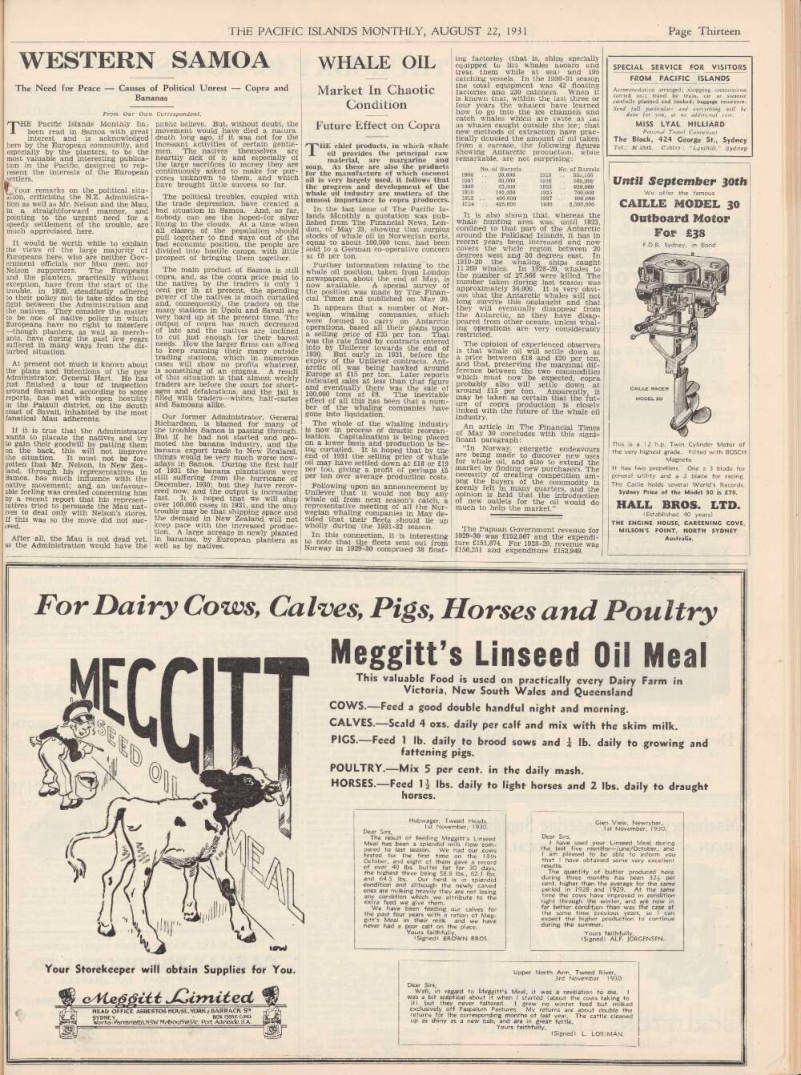
THE chief products, in which whale oil provides the principal raw material, are margarine and soap. As these are also the products for the manufacture of which coconut oil is very largely used, it follows that the progress and development of the whale oil industry are matters of the utmost importance to copra producers.
In the last issue of The Pacific Is lands Monthly a quotation was pub lished from The Financial News, Lon don, of May 23, showing that surplus stocks of whale oil in Norwegian ports, equal to about 100,000 tons, had been sold to a German co-operative concern at £8 per ton.
Further information relating to the whale oil position, taken from London newspapers, about the end of May, is now available. A special survey of the position was made by The Finan cial Times and published on May 30.
It appears that a number of Nor wegian whaling companies, which were formed to carry on Antarctic operations, based all their plans upon a selling price of £25 per ton. That was the rate fixed by contracts entered into by Unilever towards the end of 1930. But early in 1931, before the expiry of the Unilever contracts, Ant arctic oil was being hawked around Europe at £15 per ton. Later reports indicated sales at less than that figure and eventually there was the sale of 100,000 tons at £8. The inevitable effect of all this has been that a num ber of the whaling companies have gone into liquidation.
The whole of the whaling industry is now in process of drastic reorgan isation. Capitalisation is being placed on a lower basis and production is be ing curtailed. It is hoped that by the end of 1931 the selling price of whale oil may have settled down at £18 or £19 per ton, giving a profit of perhaps £5 per ton over average production costs.
Following upon an announcement by Unilever that it would not buy any whale oil from next season’s catch, a representative meeting of all the Nor wegian whaling companies in May de cided that their fleets should lie up wholly during the 1931-32 season.
In this connection, it is interesting to note that the fleets sent out from Norway in 1929-30 comprised 38 float
ing factories (that is, ships specially equipped to lilt whales aboard and treat them while at sea) and 195 catching vessels. In the 1930-31 season the total equipment was 42 floating factories and 230 catcners. When it is known that, within the last three or four years the whalers have learned how to go into the ice channels and catch whales whichare twice as fat as whales caught outside the ice; that new methods of extraction have prac tically doubled the amount of oil taken from a carcase, the following figures showing Antarctic production, while remarkable, are not surprising:
It is also shown that, whereas the whale hunting area was, until 1923, confined to that part of the Antarctic around the Falkland Islands, it has in recent years been increased and now covers the whole region between 20 degrees west and 50 degrees east. In 1919-20 the whaling ships caught 11 369 whales. In 1928-29, whales to the number of 27,566 were killed. The number taken during last season was approximately 36,000. It is very obvi ous that the Antarctic whales will not long survive this onslaught and that they will eventually disappear from the Antarctic, as they have disap peared from other oceans, unless whal ing operations are very considerably restricted.
The opinion of experienced observers is that whale oil will settle down at a price between £18 and £20 per ton, and that, preserving the marginal dif ference between the two commodities which must now be expected, copra probably also will settle down at around £15 per ton. Apparently, it may be taken as certain that the fut ure of copra production is closely linked with the future of the whale oil industry.
An article in The Financial Times of May 30 concludes with this signi ficant paragraph: ‘Tn Norway, energetic endeavours are being made to discover new uses for whale oil, and also to extend the market by finding new purchasers. The necessity of creating competition am ong the buyers of the commodity is keenly felt in many quarters, and the opinion is held that the introduction of new outlets for the oil would do much to help the market.”
The Papuan Government revenue for 1929-30 was £152,567 and the expendi ture £151,874. For 1928-29, revenue was £156,251 and expenditure £152,949.
No. of Barrels No. of Barrels 1906 20,000 1915
. . 500,Coo
1907 30,000 1916 .. 560,000 1908 60,000 1923 . . 620,000 1910 140,000 1925 . . 700,000 1912 400,000 1827 900,000 1C24 . . 425,000 1930 .. 2,500,000