Samoa
pp. 11-12 · Read in the full issue
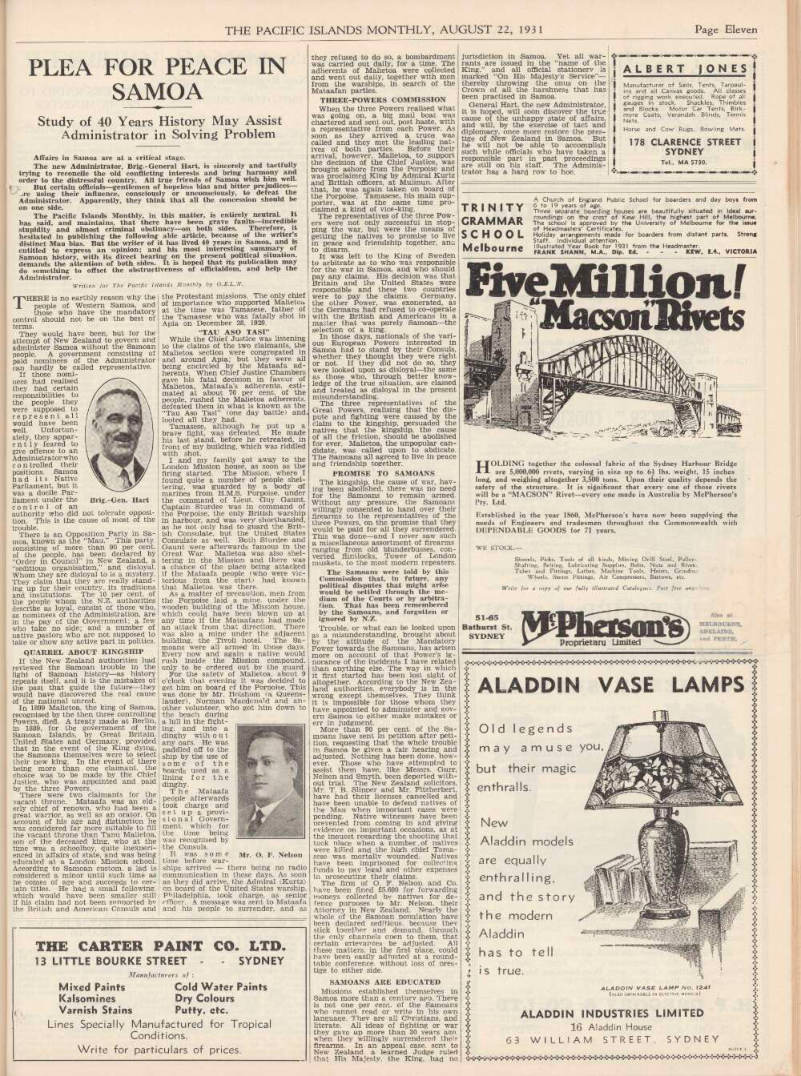
Plea For Peace In
Study of 40 Years History May Assist Administrator in Solving Problem
Affairs in Samoa are at a critical stage.
The new Administrator, Brig.-General Hart, is sincerely and tactfully trying to reconcile the old conflicting interests and bring harmony and order to the distressful country. All true friends of Samoa wish him well.
But certain officials —gentlemen of hopeless bias and bitter prejudices— are using their influence, consciously or unconsciously, to defeat the Administrator. Apparently, they think that all the concession should be on one side.
The Pacific Islands Monthly, in this matter, is entirely neutral. It has said, and maintains, that there have been grave faults—incredible stupidity and almost criminal obstinacy—on both sides. Therefore, it hesitated in publishing the following able article, because of the writer's distinct Mau bias. But the writer of it has lived 40 years in Samoa, and is entitled to express an opinion; and his most interesting summary of Samoan history, with its direct bearing on the political situation, demands the attention of both sides. It is hoped that its publication may do something to offset the obstructiveness of officialdom, and help the Administrator.
Written for The Pacific Islands Monthly by G.E.L.W ,
THERE is no earthly reason why the people of Western Samoa, and those who have the mandatory control should not be on the best of terms.
They would have been, but for the attempt of New Zealand to govern and administer Samoa without the Samoan people. A government consisting of paid nominees of the Administrator can hardly be called representative.
If those nomi nees had realised they had certain responsibilities to the people they were supposed to represent all would have been well. Unfortun ately, they appar ently feared to give offence to an Administrator who con trolled their positions. Samoa had its Native Parliament, but it was a docile Par liament under the control of an
authority who did not tolerate opposi tion. This is the cause of most of the trouble.
There is an Opposition Party in Sa moa, known as the “Mau.” This party, consisting of more than 90 per cent, of the people, has been declared by “Order in Council” in New Zealand, a “seditious organisation,” and disloyal.
Whom they are disloyal to is a mystery.
They claim that they are really stand ing up for their country, its traditions and institutions. The 10 per cent of the people whom the N.Z. authorities describe as loyal, consist of those who, as nominees of the Administration, are in the pay of the Government; a few who take no side; and a number of native pastors who are not supposed to take or show any active part in politics.
Quarrel About Kingship
If the New Zealand authorities had reviewed the Samoan trouble in the light of Samoan history—as history repeats itself, and it is the mistakes of the past that guide the future —they would have discovered the real cause of the national unrest.
In 1899 Malietoa, the king of Samoa, recognised by the then three controlling Powers, died. A treaty made at Berlin, in 1889, for the government of the Samoan Islands, by Great Britain.
United States and Germany, provided that in the event of the King dying, the Samoans themselves were to select their new king. In the event of there being more than one claimant, the choice was to be made by the Chief Justice, who was appointed and paid by the three Powers.
There were two claimants for the vacant throne. Mataafa was an eld erly chief of renown, who had been a great warrior, as well as an orator. On account of his age and distinction he was considered far more suitable to fill the vacant throne than Tanu Malietoa, son of the deceased king, who at the time was a schoolboy, quite inexperi enced in affairs of state, and was being educated at a London Mission school.
According to Samoan custom, a lad is considered a minor until such time as he comes of age and succeeds to cer tain titles. He had a small following, which would have been smaller still if his claim had not been supported by the British and American Consuls and
the Protestant missions. The only chief of importance who supported Malietoa at the time was Tamasese, father of the Tamasese who was fatally shot in Apia on December 28, 1929.
“Tau Aso Tasi”
While the Chief Justice was listening to the claims of the two claimants, the Malietoa section were congregated in and around Apia; but they were all being encircled by the Mataafa ad herents. When Chief Justice Chambers gave his fatal decision in favour of Malietoa, Mataafa’s adherents, esti mated at about 76 per cent, of the people, rushed the Malietoa adherents, defeated them in what is known as the “Tau Aso Tasi” (one day battle) and. looted all they had.
Tamasese, although he put up a brave fight, was defeated. He made his last stand, before he retreated, in front of my building, which was riddled with shot.
I and my family got away to the London Mission house, as soon as the firing started. The Mission, where I found quite a number of people shel tering, was guarded by a body of marines from H.M.S. Porpoise, under the command of Lieut. Guy Gaunt.
Captain Sturdee was in command of the Porpoise, the only British warship in harbour, and was very shorthanded, as he not only had to guard the Brit ish Consulate, but the United States Consulate as well. Both Sturdee and Gaunt were afterwards famous in the Great War. Malietoa was also shel tering in the Mission and there was a chance of the place being attacked if the Mataafa people (who were vic torious from the start) had known that Malietoa was there.
As a matter of precaution, men from the Porpoise laid a mine, under the wooden building of the Mission house, which could have been blown up at any time if the Mataafans had made an attack from that direction. There was also a mine under the adjacent building, the Tivoli hotel. The Sa moans were all armed in those days.
Every now and again a native would rush inside the Mission compound, only to be ordered out by the guard For the safety of Malietoa. about 9 o’clock that evening it was decided to get him on board of the Porpoise. This was done by Mr. Holshom (a Queens lander), Norman Macdonald and an other volunteer, who got him down to
the beach during a lull in the fight ing, and into a dinghy with out any oars. He was paddled off to the ship by the use of some of the boards used as a lining for the dinghy.
The Mataafa people afterwards took charge and set up a provi sional Govern ment, which for the time being was recognised by the Consuls.
It was some time before war
ships arrived there being no radio communication in those days. As soon as they did arrive, the Admiral (Kurtz) on board of the United States warship, Philadelphia, took charge, as senior officer. A message was sent to Mataafa and his people to surrender, and as
they refused to do so, a bombardment was carried out daily, for a time. The adherents of Malietoa were collected and went out daily, together with men from the warships, in search of the Mataafan parties.
Three-Powers Commission
When the three Powers realised what was going on, a big mail boat was chartered and sent out, post haste, with a representative from each Power. As soon as they arrived a truca was called and they met the leading nat ives of both parties. Before their arrival, however, Malietoa, to support the decision of the Chief Justice, was brought ashore from the Porpoise and was proclaimed King by Admiral Kurtz and British officers, at Mulinun. After that, he was again taken on board of the Porpoise. Tamasese, his main sup porter, was at the same time pro claimed a kind of vice-king.
The representatives of the three Pow ers were not only successful in stop ping the war, but were the means of getting the natives to promise to live in peace and friendship together, and to disarm.
It was left to the King of Sweden to arbitrate as to who was responsible for the war in Samoa, and who should pay any claims. His decision was that Britain and the United States were responsible and these two countries were to pay the claims. Germany, the other Power, was exonerated, as the Germans had refused to co-operate with the British and Americans in a matter that was purely Samoan —the selection of a king.
In those days, nationals of the vari ous European Powers interested in Samoa had to stand by their Consuls, whether they thought they were right or not. If they did not do so, they were looked upon as disloyal—the same as those who, through better know ledge of the true situation, are classed and treated as disloyal in the present misunderstanding.
The three representatives of the Great Powers, realising that the dis pute and fighting were caused by the claim to the kingship, persuaded the natives that the kingship, the cause of all the friction, should be abolished for ever. Malietoa, the unpopular can didate, was called upon to abdicate.
The Samoans all agreed to live in peace and friendship together.
Promise To Samoans
The kingship, the cause of war, hav ing been abolished, there was no need for the Samoans to remain armed.
Without any pressure, the Samoans willingly consented to hand over their firearms to the representatives of the three Powers, on the promise that they would be paid for all they surrendered.
This was done —and I never saw such a miscellaneous assortment of firearms ranging from old blunderbusses, con verted flintlocks, Tower of London muskets, to the most modern repeaters.
The Samoans were told by this Commission that, in future, any political disputes that might arise would be settled through the me dium of the Courts or by arbitra tion. That has been remembered by the Samoans, and forgotten or ignored by N.Z.
Trouble, or what can be looked upon as a misunderstanding, brought about by the attitude of the Mandatory Power towards the Samoans, has arisen more on account of that Power’s ig norance of the incidents I have related than anything else. The way in which it first started has been lost sight of altogether. According to the New Zea land authorities, everybody is in the wrong except themselves. They think it is impossible for those whom they have appointed to administer and gov ern Samoa to either make mistakes or err in judgment.
More than 90 per cent, of the Sa moans have sent in petition after peti tion, requesting that the whole trouble in Samoa be given a fair hearing and adjusted. Nothing has been done, how ever. Those who have attempted to assist them have, like Messrs. Gurr, Nelson and Smyth, been deported with out trial. The New Zealand solicitors, Mr. T. B. Slipper and Mr. Fitzherbert, have had their licenses cancelled and have been unable to defend natives of the Mau when important cases were pending. Native witnesses have been prevented from coming in and giving evidence on important occasions, as at the inauest regarding the shooting that took place when a number.of natives were killed and the high chief Tama sese was mortally wounded. Natives have been imprisoned for collecting funds to pay legal and other expenses in prosecuting their claims.
The firm of O. F. Nelson and Co. have been fined £5,600 for forwarding moneys collected by natives for de fence purposes to Mr. Nelson, their Attorney in New Zealand. Nearly the whole of the Samoan population have been declared seditious, because they stick together and demand, through the only channels open to them, that certain grievances be adjusted. All these matters, in the first place, could have been easily adjusted at a round table conference, without loss of pres tige to either side.
Samoans Are Educated
Missions established themselves in Samoa more than a century ago. There is not one per cent, of the Samoans who cannot read or write in his own language. They are all Christians, and literate. All ideas of fighting or war they gave up more than 30 years ago. when they willingly surrendered their firearms. In an appeal case, sent to New Zealand, a learned Judge ruled that His Majesty, the King, had no
jurisdiction in Samoa. Yet all war rants are issued in the “name of the King,” and all official stationery is marked “On His Majesty’s Service” — thereby throwing the onus on the Crown of all the harshness that has been practised in Samoa.
General Hart, the new Administrator, it is hoped, will soon discover the true cause of the unhappy state of affairs, and will, by the exercise of tact and diplomacy, once more restore the pres tige of New Zealand in Samoa. But he will not be able to accomplish such while officials who have taken a responsible part in past proceedings are still on his staff. The Adminis trator has a hard row to hoe.
Brig.-Gen. Hart
Mr. O. F. Nelson
Epidemic In Samoa
A stubborn epidemic of dysentery has existed in Western Samoa since January. It is confined mostly to the natives.
From January 20 to May 31, 147 cases have been treated at Apia Hospital, with 3 per cent. of deaths.
Medicines and disinfectants, and bacteriological examinations are given free on application to the hospital.
The death rate among Papuan lab ourers during 1929-1930 was 1.306. Of this, the death rate from disease was only .88.