By Transport Costs
pp. 1-2 · Read in the full issue
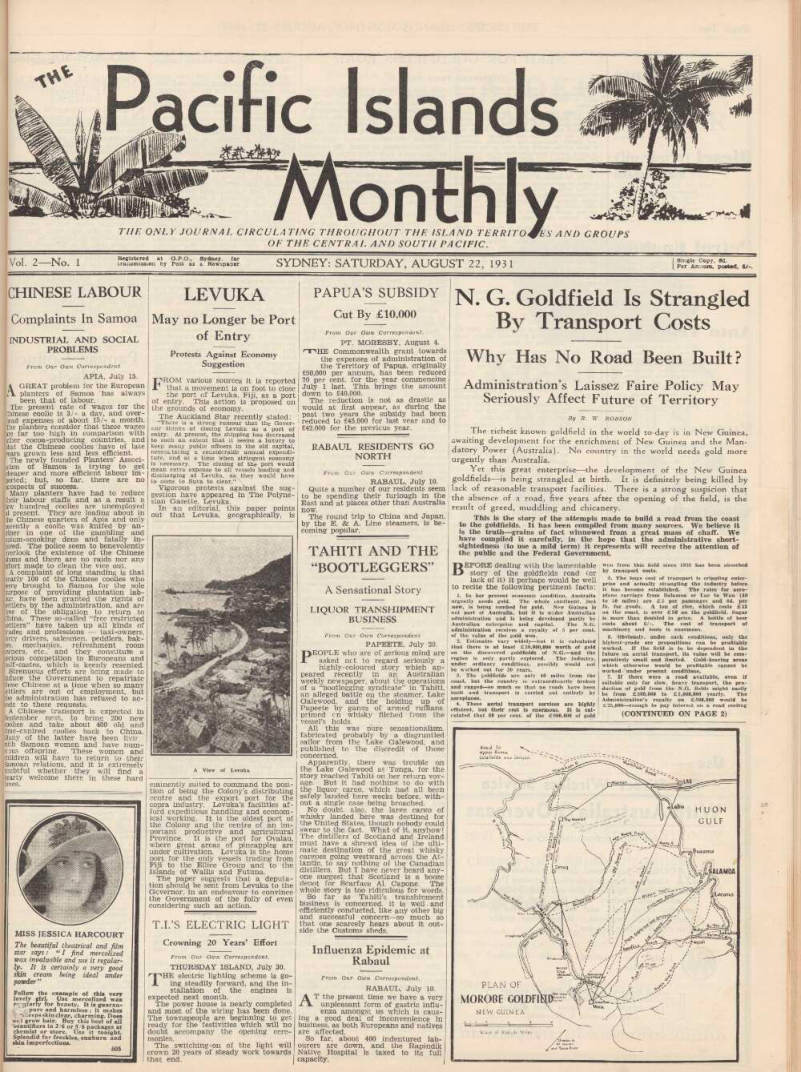
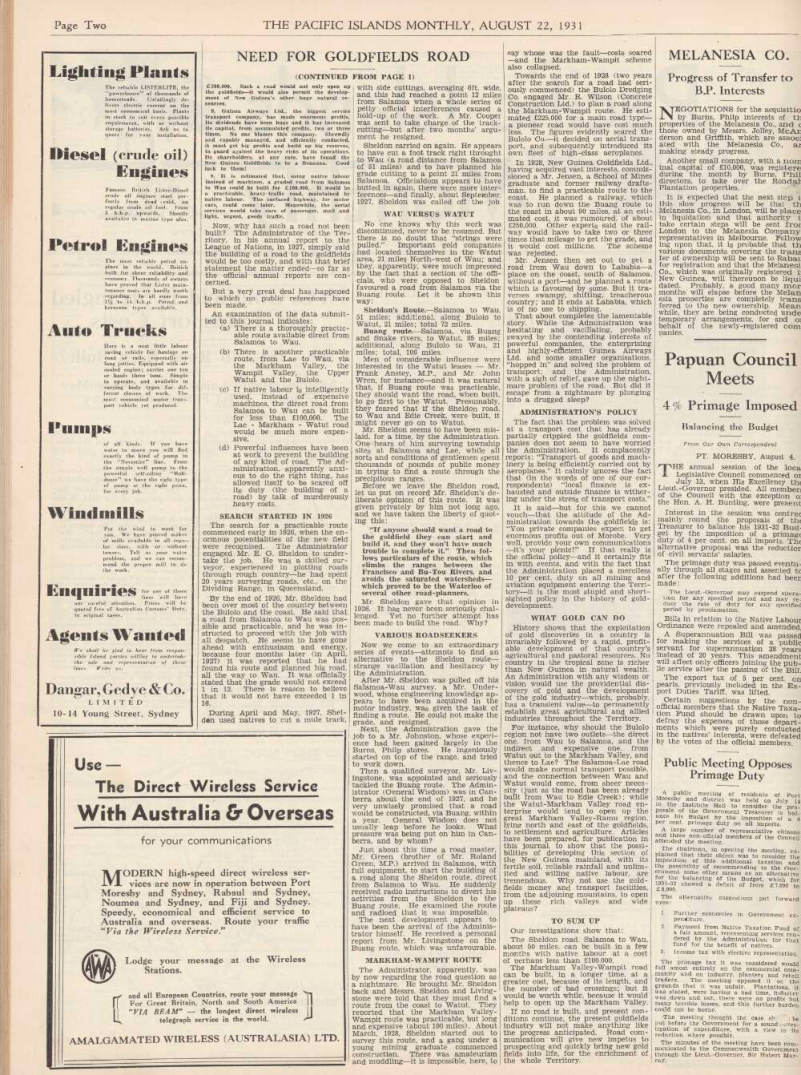
N. G. Goldfield Is Strangled
Why Has No Road Been Built?
Administration’s Laissez Faire Policy May Seriously Affect Future of Territory
By R. W. Robson
The richest known goldfield in the world to-day is in New Guinea, awaiting development for the enrichment of New Guinea and the Man datory Power (Australia). No country in the world needs gold more urgently than Australia.
Yet this great enterprise—the development of the New Guinea goldfields—is being strangled at birth. It is definitely being killed by lack of reasonable transport facilities. There is a strong suspicion that the absence of a road, five years after the opening of the field, is the result of greed, muddling and chicanery.
This is the story of the attempts made to build a road from the coast to the goldfields. It has been compiled from many sources. We believe it is the truth—grains of fact winnowed from a great mass of chaff. We have compiled it carefully, in the hope that the administrative short sightedness (to use a mild term) it represents will receive the attention of the public and the Federal Government.
BEFORE dealing with the lamentable
story of the goldfields road (or
lack of it) it perhaps would be well
to recite the following pertinent facts:
1. In her present economic condition, Australia urgently needs gold. The whole continent, just now, is being combed for gold. New Guinea is not part of Australia, but it is under Australian administration and is being developed partly by Australian enterprise and capital. The N.G. administration receives a royalty of 5 per cent, of the value of the gold won. 2. Estimates vary widely—but it is calculated that there is at least £30,000,000 worth of gold on the discovered goldfields of N.G.—and the region is only partly explored. The industry, under ordinary conditions, possibly would not be worked out for 50 years. 3. The goldfields are only 40 miles from the coast, but the country is extraordinarily broken and rugged—so much so that no roads have been built and transport is carried out entirely by aeroplanes. 4. These aerial transport services are highly efficient, but their cost is enormous. It is calculated that 60 per cent, of the £900,000 of gold
won from this field since 1925 has been absorbed by transport costs. 5. The huge cost of transport is crippling enterprise and actually strangling the industry before it has become established. The rates for aeroplane carriage from Salamoa or Lae to Wau (40 to 50 miles) are £5 per passenger and 6d. per lb. for goods. A ton of rice, which costs £13 on the coast, is over £50 on the goldfield. Sugar is more than doubled in price. A bottle of beer costs about 6/-. The cost of transport of machinery and tools is enormous. 6. Obviously, under such conditions, only the highest-grade ore propositions can be profitably worked. If the field is to be dependent in the future on aerial transport, its value will be comparatively small and limited. Gold-bearing areas which otherwise would be profitable cannot be worked under present conditions. 7. If there were a road available, even if suitable only for slow, heavy transport, the production of gold from the N.G. fields might easily be from £500,000 to £1,000,000 yearly. The Administration’s royalty on £500,000 would be £25,000—enough to pay interest on a road costing
(Continued On Page 2)
the goldfields—it would also permit the development of New Guinea’s other huge natural resources. 8. Guinea Airways Ltd., the biggest service transport company, has made enormous profits.
Its dividends have been huge and it has increased its capital, from accumulated profits, two or three times. No one blames this company. Shrewdly and capably managed, and efficiently conducted, it must get big profits and build up big reserves, to guard against the heavy risks of its operations.
Its shareholders, at any rate, have found the New Guinea Goldfields to be a Bonanza. Good luck to them! 9. It is estimated that, using native labour instead of machines, a graded road from Salamoa to Wau could be built for £100,000. It would be a practicable, heavy-traffic road, maintained by native labour. The surfaced highway, for motor cars, could come later. Meanwhile, the aerial services would take care of passenger, mail and light, urgent, goods traffic.
Now, why has such a road not been built? The Administrator of the Territory, in his annual report to the League of Nations, in 1927, simply said the building of a road to the goldfields would be too costly, and with that brief statement the matter ended—so far as the official annual reports are concerned.
But a very great deal has happened to which no public references have been made.
An examination of the data submitted to this journal indicates: (a) There is a thoroughly practicable route available direct from Salamoa to Wau. (b) There is another practicable route, from Lae to Wau, via the Markham Valley, the Wampit Valley, the Upper Watut and the Bulolo. (c) If native labour is intelligently used, instead of expensive machines, the direct road from Salamoa to Wau can be built for less than £100,000. The Lae - Markham - Watut road would be much more expensive. (d) Powerful influences have been at work to prevent the building of any kind of road. The Administration, apparently anxious to do the right thing, has allowed itself to be scared off its duty (the building of a road) by talk of murderously heavy costs,
Search Started In 1926
The search for a practicable route commenced early in 1926, when the enormous potentialities of the new field were recognised. The Administrator engaged Mr. E. G. Sheldon to undertake the job. He was a skilled surveyor, experienced in plotting roads through rough country—he had spent 20 years surveying roads, etc., on the Dividing Range, in Queensland.
By the end of 1926, Mr. Sheldon had been over most of the country between the Bulolo and the coast. He said that a road from Salamoa to Wau was possible and practicable, and he was instructed to proceed with the job with all despatch. He seems to have gone ahead with enthusiasm and energy, because four months later (in April, 1927) it was reported that he had found his route and planned his road, all the way to Wau. It was ofiicially stated that the grade would not exceed 1 in 12. There is reason to believe that it would not have exceeded 1 in 16.
During April and May, 1927, Sheldon used natives to cut a mule track,
with side cuttings, averaging 6ft. wide, and this had reached a point 12 miles from Salamoa when a whole series of petty official interferences caused a hold-up of the work, A Mr. Cooper was sent to take charge of the track cutting—but after two months’ argument he resigned.
Sheldon carried on again. He appears to have cut a foot track right throught to Wau (a road distance from Salamoa of 51 miles) and to have planned his grade cutting to a point 21 miles from Salamoa. Officialdom appears to have butted in again, there were more interferences—and finally, about September, 1927, Sheldon was called off the job.
Wau Versus Watut
No one knows why this work was discontinued, never to be resumed. But there is no doubt that “strings were pulled.” Important gold companies had located themselves in the Watut area, 21 miles North-west of Wau; and they, apparently, were much impressed by the fact that a section of the officials, who were opposed to Sheldon favoured a road from Salamoa via the Buang route. Let it be shown this way: Sheldon’s Route. —Salamoa to Wau, 51 miles; additional, along Bulolo to Watut, 21 miles; total 72 miles.
Buang route. —Salamoa, via Buang and Snake rivers, to Watut, 85 miles; additional, along Bulolo to Wau, 21 miles; total, 106 miles.
Men of considerable influence were interested in the Watut leases Mr.
Frank Anstey, M.P., and Mr. John Wren, for instance—and it was natural that, if Buang route was practicable, they should want the road, when built, to go first to the Watut. Presumably, they feared that if the Sheldon road, to Wau and Edie Creek, were built, it might never go on to Watut.
Mr. Sheldon seems to have been mislaid, for a time, by the Administration.
One hears of him surveying township sites at Salamoa and Lae, while all sorts and conditions of gentlemen spent thousands of pounds of public money in trying to find a route through the precipitous ranges.
Before we leave the Sheldon road, let us put on record Mr. Sheldon’s deliberate opinion of this route. It was given privately by him not long ago, and we have taken the liberty of quoting this: “If anyone should want a road to the goldfield they can start and build it, and they won’t have much trouble to complete it.” Then follows particulars of the route, which climbs the ranges between the Francisco and Bu-Tou Rivers, and avoids the saturated watersheds— which proved to be the Waterloo of several other road-planners.
Mr. Sheldon gave that opinion in 1926. It has never been seriously challenged. Yet no further attempt has been made to build the road. Why?
Various Roadseekers
Now we come to. an extraordinary series of events —attempts to find an alternative to the Sheldon route— strange vacillation and hesitancy by the Administration.
After Mr. Sheldon was pulled off his Salamoa-Wau survey, a Mr. Underwood, whose engineering knowledge appears to have been acquired in the motor industry, was given the task of finding a route. He could not make the grade, and resigned.
Next, the Administration gave the job to a Mr. Johnston, whose experience had been gained largely in the Burns, Philp stores. He ingeniously started on top of the range, and tried to work down.
Then a qualified surveyor, Mr. Livingstone, was appointed and seriously tackled the Buang route. The Administrator (General Wisdom) was in Canberra about the end of 1927, and he very unwisely promised that a road would be constructed, via Buang, within a year. General Wisdom does not usually leap before he looks. What pressure was being put on him in Canberra, and by whom?
Just about this time a road master, Mr. Green (brother of Mr. Roland Green, M.P.) arrived in Salamoa, with full equipment, to start the building of a road along the Sheldon route, direct from Salamoa to Wau. He suddenly received radio instructions to divert his activities from the Sheldon to the Buang route. He examined the route and radioed that it was impossible.
The next development appears to have been the arrival of the Administrator himself. He received a personal report from Mr. Livingstone on the Buang route, which was unfavourable.
Markham-Wampit Route
The Administrator, apparently, was by now regarding the road question as a nightmare. He brought Mr. Sheldon back and Messrs. Sheldon and Livingstone were told that they must find a route from the coast to Watut. They reported that the Markham Valley- Wampit route was practicable, but long and expensive (about 100 miles). About March, 1928, Sheldon started out to survey this route, and a gang under a young mining graduate commenced construction. There was amateurism and muddling—it is impossible, here, to
say whose was the fault—costs soared —and the Markham-Wampit scheme also collapsed.
Towards the end of 1928 (two years after the search for a road had seriously commenced) the Bulolo Dredging Co. engaged Mr. R. Wilson (Concrete Construction Ltd.) to plan a road along the Markham-Wampit route. He estimated £225,000 for a main road type— a pioneer road would have cost much less. The figures evidently scared the Bulolo Co. —it decided on aerial transport, and subsequently introduced its own fleet of high-class aeroplanes.
In 1928, New Guinea Goldfields Ltd., having acquired vast interests, commissioned a Mr. Jensen, a School of Mines graduate and former railway draftsman, to find a practicable route to the coast. He planned a railway, which was to run down the Buang route to the coast in about 90 miles, at an estimated cost, it was rumoured, of about £250,000. Other experts said the railway would have to take two or three times that mileage to get the grade, and it would cost millions. The scheme was rejected.
Mr. Jensen then set out to get a road from Wau down to Lababia—a place on the coast, south of Salamoa, without a port—and he planned a route which is favoured by some. But it traverses swampy, shifting, treacherous country; and it ends at Lababia, which is of no use to shipping.
That about completes the lamentable story. While the Administration was hesitating and vacillating, probably swayed by the contending interests of powerful companies, the enterprising and highly-efficient Guinea Airways Ltd. and some smaller organisations, “hopped in” and solved the problem of transport; and the Administration, with a sigh of relief, gave up the nightmare problem of the road. But did it escape from a nightmare by plunging into a drugged sleep?
Administration S Policy
The fact that the problem was solved at a transport cost that has already partially crippled the goldfields companies does not seem to have worried the Administration. It complacently reports: “Transport of goods and machinery is being efficiently carried out by aeroplanes.” It calmly ignores the fact that (in the words of one of our correspondents) “local finance is exhausted and outside finance is withering under the stress of transport costs.”
It is said—but for this we cannot vouch—that the attitude of the Administration towards the goldfields is: “You private companies expect to get enormous profits out of Morobe. Very well, provide your own communications —it’s your picnic!” If that really is the official policy—and it certainly fits in with events, and with the fact that the Administration placed a merciless 10 per cent. duty on all mining and aviation equipment entering the Territory—it is the most stupid and shortsighted policy in the history of golddevelopment.
What Gold Can Do
History shows that the exploitation of gold discoveries in a country is invariably followed by a rapid, profitable development of that country’s agricultural and pastoral resources. No country in the tropical zone is richer than New Guinea in natural wealth.
An Administration with any wisdom or vision would use the providential discovery of gold and the development of the gold industry—which, probably, has a transient value —to permanently establish great agricultural and allied industries throughout the Territory.
For instance, why should the Bulolo region not have two outlets—the direct one, from Wau to Salamoa, and the indirect and expensive one, from Watut out to the Markham Valley, and thence to Lae? The Salamoa-Lae road would make normal transport possible, and the connection between Wau and Watut would come, from sheer necessity (just as the road has been already built from Wau to Edie Creek); while the Watut-Markham Valley road enterprise would tend to open up the great Markham Valley-Ramu region, lying north and east of the goldfields, to settlement and agriculture. Articles have been prepared, for publication in this journal, to show that the possibilities of developing this section of the New Guinea mainland, with its fertile soil, reliable rainfall and unlimited and willing native labour, are tremendous. Why not use the gold fields money and transport facilities, from the adjoining mountains, to open up these rich valleys and wide plateaus?
To Sum Up
Our investigations show that: The Sheldon road. Salamoa to Wau, about 50 miles, can be built in a few months with native labour, at a cost of perhaps less than £100,000.
The Markham Valley-Wampit road can be built, in a longer time, at a greater cost, because of its length, and the number of bad crossings; but it would be worth while, because it would help to open up the Markham Valley.
If no road is built, and present conditions continue, the present goldfields industry will not make anything like the progress anticipated. Road communication will give new impetus to prospecting and quickly bring new gold fields into life, for the enrichment of the whole Territory. ———