Rev. James Chalmers—Missionary and Explorer
pp. 11-12 · Read in the full issue
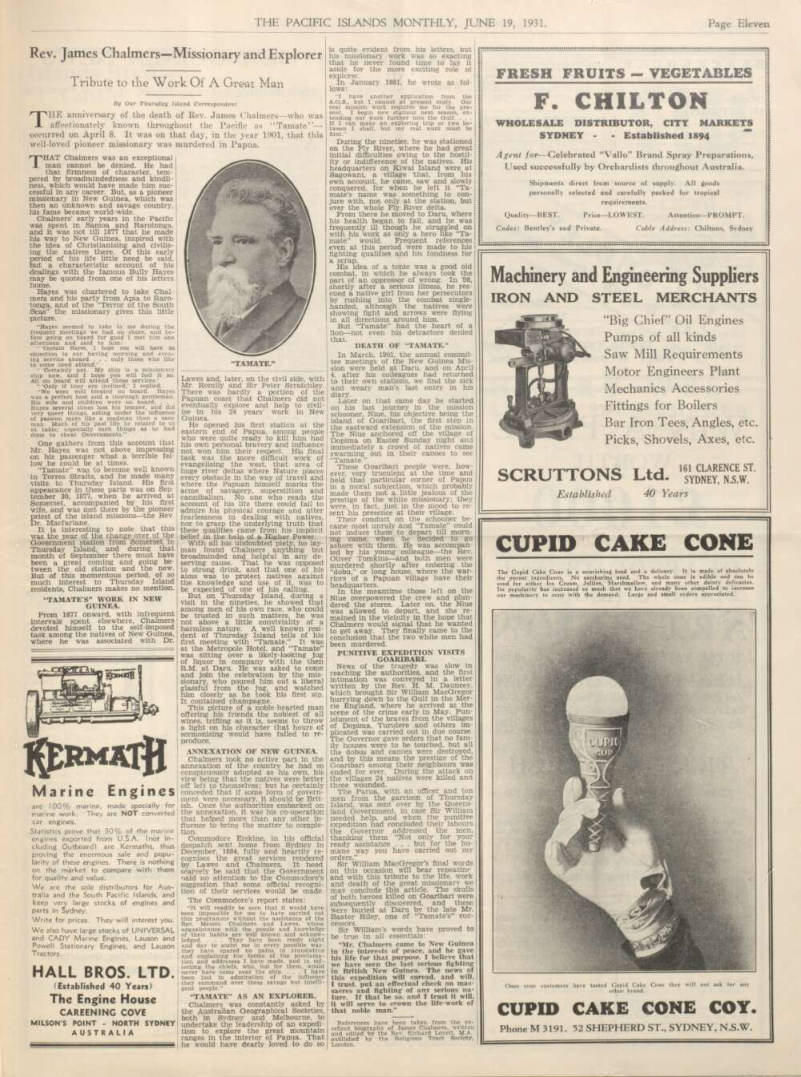
Tribute to the Work Of A Great Man
By Our Thursday Island Correspondent THE anniversary of the death of Rev. James Chalmers—who was affectionately known throughout the Pacific as “Tamate”— occurred on April 8. It was on that day, in the year 1901, that this well-loved pioneer missionary was murdered in Papua.
THAT Chalmers was an exceptional man cannot be denied. He had that firmness of character, tem pered by broadmindedness and kindli ness, which would have made him suc cessful in any career. But, as a pioneer missionary in New Guinea, which was then an unknown and savage country, his fame became world-wide.
Chalmers’ early years in the Pacific was spent in Samoa and Rarotonga, and it was not till 1877 that he made his way to New Guinea, inspired with the idea of Christianising and civilis ing the natives there. Of this early period of his life little need be said, but a characteristic account of his dealings with the famous Bully Hayes may be quoted from one of his letters home.
Hayes was chartered to take Chal mers and his party from Apia to Raro tonga, and of the “Terror of the South Seas” the missionary gives this little picture.
“Hayes seemed to take to me during the frequent meetings we had on shore, and be fore going on board for good I met him one afternoon and said to ham; “ ‘Captain Hayes, I hope you will have no objection to our having morning and even ing service aboard . . . only those who like to come need attend.’
“ ‘Certainly not. My ship is a missionary ship now, and I hope you will feel it so.
All on board will attend those services.’
“ ‘Only if they are inclined,’ I replied.
“We were well treated on board. Hayes was a perfect host and a thorough gentleman.
His wife and children were on board. . . .
Hayes several times lost his temper, and did very queer things, acting under the influence of passion more like a madman than a sane man. Much of his past life he related to us at table; especially such things as he had done to cheat Governments.”
One gathers from this account that Mr. Hayes was not above impressing on his passenger what a terrible fel low he could be at times.
“Tamate” was to become well known in Torres Straits, and he made many visits to Thursday Island. His first appearance in these parts was on Sep tember 30, 1877, when he arrived at Somerset, accompanied by his first wife, and was met there by the pioneer priest of the island missions—the Rev.
Dr. Macfarlane.
It is interesting to note that this was the year of the change-oyer of the Government station from Somerset to Thursday Island, and during that month of September there must have been a great coming and going be tween the old station and the new.
But of this momentous period, of so much interest to Thursday Island residents, Chalmers makes no mention.
“Tamate’S” Work In New
Guinea.
From 1877 onward, with infrequent intervals spent elsewhere, Chalmers devoted himself to the self-imposed task among the natives of New Guinea, where he was associated with Dr.
Lawes and, later, on the civil side, with Mr. Romily and Sir Peter Scratchley.
There was hardly a portion of the Papuan coast that Chalmers did not eventually explore and help to civil ise in his 24 years’ work in New Guinea.
He opened his first station at the eastern end of Papua, among people who were quite ready to kill him had his own personal bravery and influence not won him their respect. His final task was the more difficult work of evangelising the west, that area of huge river deltas where Nature places every obstacle in the way of travel and where the Papuan himself marks the acme of savagery, superstition and cannibalism. No one who reads the account of his life there could fail to admire his physical courage and utter fearlessness in dealing with natives, nor to grasp the underlying truth that these qualities came from his implicit belief in the help of a Higher Power.
With all his undoubted piety, no lay man found Chalmers anything but broadminded and helpful in any de serving cause. That he was opposed to strong drink, and that one of his aims was to protect natives against the knowledge and use of it, was to be expected of one of his calling.
But on Thursday Island, during a visit in the nineties, he showed that among men of his own race, who could be trusted in such matters, he was not above a little conviviality of a harmless nature. A well known resi dent of Thursday Island tells of his first meeting with “Tamate.” It was at the Metropole Hotel, and “Tamate” was sitting over a likely-looking jug of liquor in company with the then R.M. at Daru. He was asked to come and join the celebration by the mis sionary, who poured him out a liberal glassful from the jug, and watched him closely as he took his first sip.
It contained champagne.
This picture of a noble-hearted man offering his friends the noblest of all wines, trifling as it is, seems to throw a light on his character that hours of sermonising would have failed to re produce.
Annexation Of New Guinea.
Chalmers took no active part in the annexation of the country he had so conspicuously adopted as his own, his view being that the natives were better off left to themselves; but he certainly conceded that if some form of govern ment were necessary, it should be Brit ish. Once the authorities embarked on the annexation, it was his co-operation that helped more than any other in fluence to bring the matter to comple tion.
Commodore Erskine, in his official despatch sent home from Sydney in December, 1884, fully and heartily re cognises the great services rendered by Lawes and Chalmers. It heed scarcely be said that the Government naid no attention to the Commodore’s suggestion that some official recogni tion of their services would be made.
The Commodore’s report states: “It will readily be seen that it would have been impossible for me to have carried out this programme without the assistance of the Rev. Messrs. Chalmers and Lawes, whose acquaintance with the people and knowledge of their habits are well known and acknow ledged. . . . They have been ready night and day to assist me in every possible way: they have spared no pains in translating and explaining the terms of the proclama tion and addresses I have made, and in col lecting the chiefs, who, but for them, would never have come near the ship. ... I have been lost in admiration of the influence they command over these savage but intelli gent people.”
“Tamate” As An Explorer.
Chalmers was constantly asked by the Australian Geographical Societies, both in Sydney and Melbourne, to undertake the leadership of an expedi tion to explore the great mountain ranges in the interior of Papua. That he would have dearly loved to do so
is quite evident from his letters, but his missionary work was so exacting that he never found time to lay it aside for the more exciting role of explorer'.
In January 1881, he wrote as fol lows: “I have another application from the A.G.S., but I cannot at present reply. Our real mission work requires me for the pre sent. I begin new stations next season, ex tending our work further into the Gulf. . . .
If I can make an exploring trip or two be tween I shall, but my real work must be first.”
During the nineties, he was stationed on the Fly River, where he had great initial difficulties owing to the hostil ity or indifference of the natives. His headquarters on Kiwai Island were at Sagowani, a village that, from this own account, he came, saw and slowly conquered, for when he left it “Ta mate’s name was something to con jure with, not only at the station, but over the whole Fly River delta.
From there he moved to Daru, where his health began to fail, and he was frequently ill though he struggled on with his work as only a hero like “Ta mate” would. Frequent references even at this period were made to his fighting qualities and his fondness for a scrap.
His idea of a tonic was a good old combat, in which he always took the part of an oppressor of wrong. In ’98, shortly after a serious illness, he res cued a native girl from her persecutors by rushing into the combat single handed, although the natives were showing fight and arrows were flying in all directions around him.
But “Tamate” had the heart of a lion —not even his detractors denied that.
Death Of “Tamate.”
In March, 1901, the annual commit tee meetings of the New Guinea Mis sion were held at Daru, and on April 4, after his colleagues had returned to their own stations, we find the sick and weary man’s last entry in his diary.
Later on that same day he started on his last journey in the mission schooner, Niue, his objective being the island of Goaribari, the first step in the eastward extension of the mission.
The Niue anchored off the village of Dopima on Easter Sunday night and immediately a crowd of natives came swarming out in their canoes to see “Tamate.”
These Goaribari people were, how ever, very truculent at the time and held that particular corner of Papua in a moral subjection, which probably made them not a little jealous of the prestige of the white missionary; they were, in fact, just in the mood to re sent his presence at their village.
Their conduct on the schooner be came most unruly and “Tamate” could not induce them to depart till morn ing came, when he decided to go ashore with them. He was accompan ied by his young colleague—the Rev.
Oliver Tomkins —and both men were murdered shortly after entering the “dobu,” or long house, where the war riors of a Papuan village have their headquarters.
In the meantime those left on the Niue overpowered the crew and plun dered the stores. Later on, the Niue was allowed to depart, and she re mained in the vicinity in the hope that Chalmers would signal that he wanted to get away. They finally came to the conclusion that the two white men had been murdered.
Punitive Expedition Visits
Goaribari.
News of the tragedy was slow in reaching the authorities, and the first intimation was conveyed in a letter written by the Rev. H. M. Dauncey, which brought Sir William MacGregor hurrying down to the Gulf in the Mer rie England, where he arrived at the scene of the crime early in May. Pun ishment of the braves from the villages of Dopima, Turutere and others im plicated was carried out in due course.
The Governor gave orders that no fam ily houses were to be touched, but all the dobus and canoes were destroyed, and by this means the prestige of the Goaribari among their neighbours was ended for ever. During the attack on the villages 24 natives were killed and three wounded.
The Parua, with an officer and ten men from the garrison of Thursday Island, was sent over by the Queens land Government, in case Sir William needed help, and when the punitive expedition had concluded their labours the Governor addressed the men, thanking them “Not only for your ready assistance . . . but for the hu mane way you have carried out my orders.”
Sir William MacGregor’s final words on this occasion will bear repeating and with this tribute to the life, work and death of the great missionary we may conclude this article. The skulls of both heroes killed on Goaribari were subsequently discovered, and these were buried at Daru by the late Mr.
Baxter Riley, one of “Tamate’s” suc cessors.
Sir William’s words have proved to be true in all essentials: “Mr. Chalmers came to New Guinea in the interests of peace, and he gave his life for that purpose. I believe that we have seen the last serious fighting in British New Guinea. The news of this expedition will spread, and will.
I trust, put an effectual check on mas sacres and fighting of any serious na ture. If that be so. and I trust it will, it will serve to crown the life-work of that noble man.”
References have been taken from the ex cellent biography of James Chalmers, written and edited by the Rev. Richard Lovett. M.A. published by the Religious Tract Society, London.
“Tamate.”
Mr. T. Mclntosh, Ambulance Station, Wollongong, N.S.W., writes: “I am desirous of corresponding with some of your readers in the Islands who are interested in the collection of coins and stamps. Anyone sending either coins or stamps can rest assured that I will make a very liberal ex change.”