Credit Facilities
In New Hebrides
Difficult Situation
Complexities Of
Exchange
Some months ago we received letters from residents of the New Hebrides, complaining about the lack of exchange facilities between the Condominium and Australia, and em phasising the point that Australia cannot conveniently trade with the group (except through the Burns, Philp organisation) be cause there is no way of transferring money and credits.
We asked for further particulars and a resident of the New Hebrides has very courteously sent the following article. He explains that it is not written in any spirit of hostility to Burns, Philp and Co. Ltd.— particularly as the “big firm” is carrying about half the planters in the South Seas through this period of economic stress —but he argues that if Australia wants to get any larger portion of the New Hebrides trade, better facilities for the transfer of credit must be provided.
IT would be incorrect to say that we here in the New Hebrides are de pendent upon the trading firms here for the transfer of money. We were, until a year or so ago. Since then, de Bechade has gone into liqui dation, Ballande’s (owing I suppose to their financial position) will no longer give any drafts, and Burns, Philp abso lutely refuse them —although they have given drafts to certain French com panies. I may not even send money to Sydney by the Makambo, for payment into my bank.
We cannot receive nor send money through the post office here, I suppose because it is a Condominium Post Office. In any case, the Postmaster can refuse to accept more than £2 in silver. I cannot say that any attempt has been made to have a Money Order system established here. To do so would require co-operation between the British and French residents and, as the latter already have a Money Order system operated by their national gov ernment through the “Laperouse,” they are not particularly interested in a Condominium Money Order office. The Britishers here are not numerous enough for their wishes to have any influence.
The British Resident Commissioner was asked once if a British system, similar to the French, could be estab
fished here. His reply was that it would cost the purchaser 11 per cent, to get a Money Order. I do not know on what data he based his reply.
Through the French Post Office (on the “Laperouse”) one can obtain a Money Order payable in New Caledonia and dependencies (the New Hebrides
being considered by the French author ities as a dependency of New Caled onia) at a charge of ¾ per cent. For foreign countries the rate is slightly higher. One can even get a French Money Order payable in Australia— but it must go through Paris first!
Of course, this system is quite suit able for people making purchases in France, the U.K. or the Continent, or even in U.S.A.; but it would be too long to wait for a Money Order to go to Paris and then back to Australia.
Our only method of getting coin to Australia is to ship it by the “Laper ouse.” Up till recently it was forbid den by regulation to send coin out of the group; but this regulation has now been withdrawn. How the traders manage who cannot get to the “La perouse” I cannot say. Their only course is to do all their business with Burns, Philp.
There are certain British plantations (three) who sell their copra to Burns, Philp (Sydney). This copra is picked up by the Makambo and the proceeds from sale of same are paid into the Sydney banks of the people concerned.
But in the case of independent traders they usually have a large surplus of coin, after buying produce, and it is often necessary for them to get this money to Sydney.
A trader could certainly open an account with the Bank of Indo-China at Noumea and get drafts from them (the bank) on Sydney; but the trouble is to get French money locally and, when it is obtainable, one can then get only 80 francs for an Australian pound, although the official exchange is over 90.
B.P. Drafts
Concerning the giving of drafts to French companies by Burns, Philp: The Malinoa is now the only inter island steamer trading here; and the local price for copra is about 1,100 francs. B.P.’s convert this at 125 francs and call it, say, £8/15/-. Thus they pay 1,100 francs to a Frenchman; but a Britisher has to be content with £8/15/ —but in Australian money, not sterling. There are certain French companies here which produce a lot of copra; and B.P., by paying an extra 100 francs, secure most of it; but they give these companies drafts. Natur ally, they will say that if they didn’t do so they wouldn’t get the copra. Just so; but the fact remains that they give drafts to a French company but refuse them to a Britisher.
If B.P. were willing to pay the Brit isher in French money he would be satisfied: but, because he is a Britisher he is expected to be content with
£8/15/-, and often less (paid in Aus tralian money). The French trading firms expect the planter or trader, when he sells them his produce, to take half the value in goods and half in cash, so what one gains on the price of the produce one loses on the goods.
French And Australian Prices
I mentioned three planters who sell their copra to Burns, Philp, Sydney and ship it by the Makambo. One of these is very dissatisfied with the arrange ment, for the following reasons. Copra sent by the Makambo is valued in this way: The London price, as per quota tion in The Sydney Morning Herald, is taken on the day of the steamer’s arrival in Sydney (although the copra may have been dumped ashore at Vila) and charges deducted are £6 per ton for kiln-dried and £6/15/- per ton for smoke-dried copra. This works out as follows: London price (say) £14 ton sterling; less charges, £6/15/-; equals £7/5/- ton Australian money.
By shipping copra to Marseilles by the Messageries Maritimes steamer, which takes freight for transhipment only, the return is: Marseilles price (say) £14 Sterling 1,736 frs. (at 124) Freight, island ports to Marseilles 361 frs.
Selling commission, 2½ per cent. .. 43.40 404.40 Price of copra 1,736 frs.
Less charges 404.40 1,331.60 Equals (approx.) £10/14/9 Stg., or (at 96) £13/17/- Australian money.
The buying agent on the M.M. will advance up to 75 per cent, of the value of the copra, by draft. It is therefore argued, that in shinping copra by the Makambo the planter is not making a gcod deal.
Makambo’S Itinerary
The question then arises about get ting goods from Australia. Presumably the Makambo would no longer call on
those who did not ship their copra by her? One planter here, for instance, would be very interested to know if, in the event of his sending copra by the Messageries Maritimes, would the Makambo still call to discharge goods from Sydney? Or, in the event of the Makambo only coming as far as Vila, would the Malinoa be obliged to deliver the Makambo’s cargo for out ports? Could B.P. refuse cargo in Sydney for delivery by either the Mak ambo or Malinoa on the ground that there is no copra to be had at that particular port, or for any other reason?
We understand that, according to her contract with the Commonwealth Gov ernment, the Makambo must call at four ports in the Group, but these ports are not specified. I suppose, if it came to a pinch, the planter could get his goods from Sydney by the Laperouse.
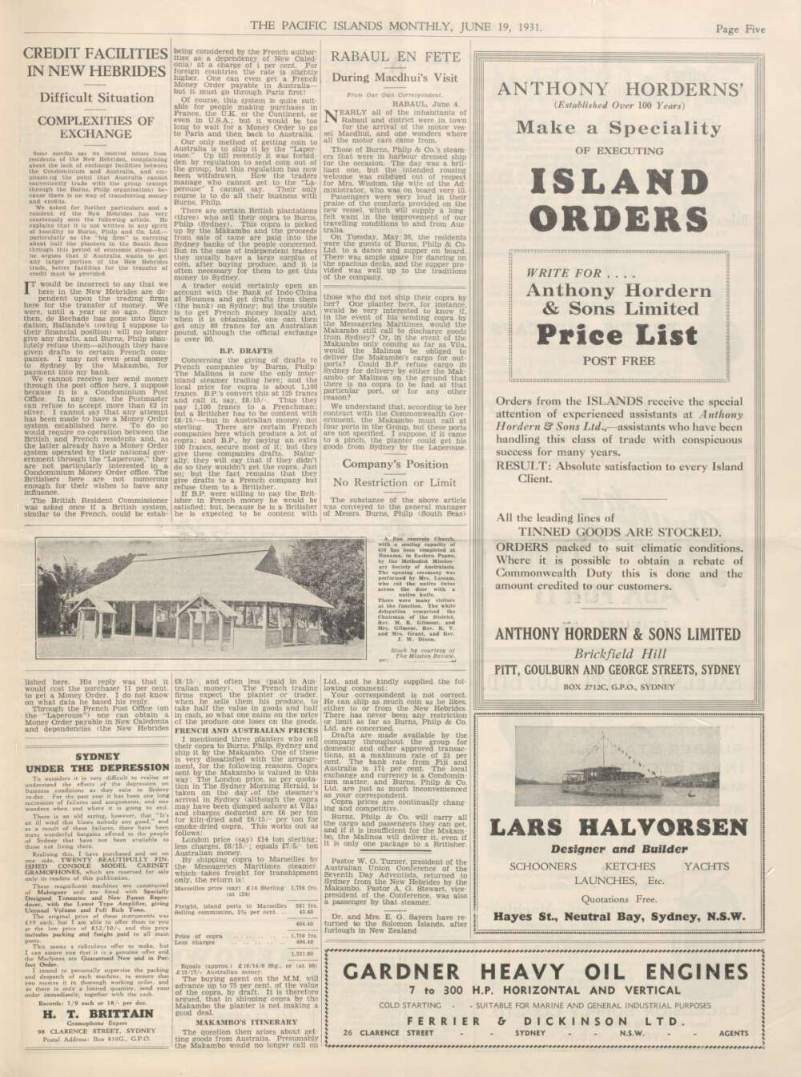
A fine concrete Church, with a seating: capacity of 450 has been completed at Bunama, in Eastern Papua, by the Methodist Mission ary Society of Australasia.
The opening ceremony was performed by Mrs. Lassam, who cut the native twine across the door with a native knife.
There were many visitors at the function. The white delegation comprised the Chairman of the District, Rev. M. K. Gilmour, and Mrs. Gilmour, Rev. R. V. and Mrs. Grant, and Rev.
J. W. Dixon.
Block by courtesy of
The Mission Review.